
DUBAI: The hospitality sector in the Middle East is at a pivotal moment, focusing on sustainable growth and investment while adapting to the evolving demands of modern travelers.
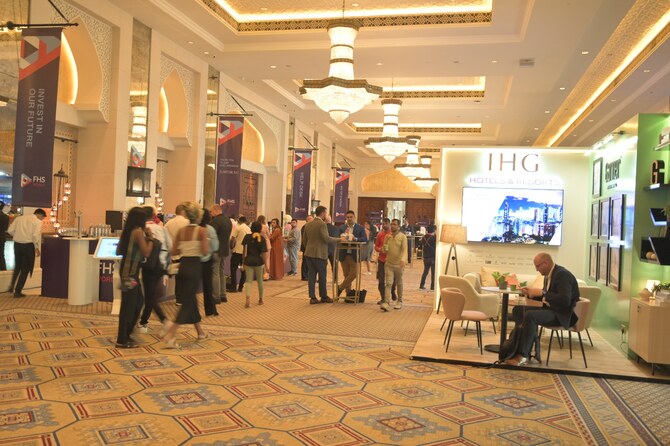
This was a key theme during the second day of the Future Hospitality Summit in Dubai, which focused on shaping the future of the sector through discussions on technology, sustainability, and talent development.
As the industry navigates post-pandemic recovery and aims for long-term growth, the region is emerging as a leader in these transformations.
Speakers from across the industry shared insights on how hospitality can evolve to meet modern travelers’ needs while addressing the increasing demand for environmental and economic sustainability.
The hospitality market in the Gulf Cooperation Council region continues to show strength, with high occupancy rates and increasing demand.
According to Sarah Duignan, director of client relationships at Smith Travel Research, occupancy rates across the GCC range between 65 percent and 70 percent, remaining robust compared to global standards.
While growth rates in some regions have slowed, the GCC has seen a rise of 1-2 percent in demand during the first eight months of the year.
Duignan described the current market trend as a “soft landing,” where demand continues to grow, albeit more slowly in some areas than others.
“We had been using the word ‘deceleration.’ So, to be clear, it is not declining. Demand is still increasing, as it is increasing more rapidly in some locations than others. Here is one of those where it’s more than others.”
The region remains a positive outlier in global trends, with strong demand supporting high occupancy and steady growth in average room rates.
Geopolitical uncertainty
Global economic and geopolitical factors were also discussed, with Pat Thaker, editorial director for the Middle East and North Africa at The Economist, offering an analysis of how these issues could impact the hospitality sector.
“No region is exempt. Slowing US growth, subdued growth in Europe, and more dynamic growth in Asia, Africa, and the Middle East — these three regions will continue to be the most dynamic growth sectors in the coming years,” she said.
Despite the challenging global landscape, Thaker forecasted moderate growth of around 2-3 percent over the next five years, a level that, while not extraordinary, is not indicative of a recession either.
She emphasized that geopolitics would continue to play a significant role in shaping the future of the industry, both globally and regionally.
Role of technology
One of the key themes of the day was the role of technology in hospitality, where it was emphasized that it should serve to enhance, not replace, the human element.
Tatiana Labaki, director of innovation & technology at NEOM’s hotel division, argued strongly that human-centric hospitality should be a given in the industry. “If we need to still say in hospitality that the human comes first, then we are failing,” she stated.
For Labaki, technology — particularly artificial intelligence — is not an end in itself but a means to elevate human interactions. This viewpoint aligns with NEOM’s broader goals, which are heavily shaped by Saudi Vision 2030.
Labaki also touched on the importance of young Saudi talent, who she described as eager to grow, learn, and take pride in their work.
This natural inclination toward hospitality, coupled with a vibrant work culture, is a key asset for NEOM and other Saudi Arabian projects aiming to position the Kingdom at the forefront of global hospitality.
UAE vision
As the UAE continues to grow as a global tourism hub, the country’s commitment to both expansion and sustainability was a major focus of discussions.
Abdulla Al-Marri, UAE economy minister and chairman of the Tourism Council, outlined plans to significantly increase hotel capacity and enhance offerings, particularly in medical and wellness tourism, which he believes should be integrated to provide a more comprehensive visitor experience.
“We are targeting over 450 billion dirhams ($122 billion) worth of investments in the hotel industry itself to come in over the next seven years. We are looking to really increase the number of keys and the range of hospitality products offered,” Al-Marri said.
The UAE is also working closely with the UN to adopt the Measuring Sustainable Tourism, or MST, framework, demonstrating its commitment to sustainability. This move reflects the country’s broader strategy to balance rapid growth with long-term environmental stewardship.
The focus on domestic tourism was another key point, with Al-Marri emphasizing the need for a 50/50 balance between domestic and international visitors as part of a sustainable tourism model.
Aligning sustainability with growth
Sustainability was a recurring theme throughout the day, with industry leaders calling for better alignment between policy and business practices.
Haitham Mattar, special adviser for UN Tourism and managing director for the Middle East and South West Asia at IHG Hotels & Resorts, stressed the need for greater cooperation between governments and hotel operators to establish unified metrics for sustainability.
He pointed to New Zealand as a country that has successfully integrated sustainability into its tourism policies, noting that hotel operators must now compete on sustainability metrics such as carbon emissions and energy consumption.
Mattar warned that while tourism remains a significant contributor to greenhouse gas emissions, it is also an essential driver of economic growth, particularly in vulnerable regions.
“Looking at the sector as a whole and what it can contribute, I always say tourism is too big to fail, with its various components. The sector includes branded hotels, unbranded hotels, operators, small and medium-sized businesses, and larger enterprises, and the challenge is to achieve a sense of alignment,” he said, underscoring the need for collective action to ensure that the sector’s growth does not come at the expense of environmental sustainability.
Deals and announcements
Beyond the discussions, significant deals were announced during the second day of the summit, reinforcing the region’s growing role as a global hub for hospitality investment. Red Sea Global and Marriott International revealed plans to open The Ritz-Carlton AMAALA, a luxury property set to open in 2025.
This will be the fourth collaboration between the two companies and further establishes Saudi Arabia as a key player in luxury tourism.
The property, with its 391 rooms and panoramic views of the Red Sea, will offer guests a unique blend of luxury, wellness, and natural beauty.
Louvre Hotels Group also announced plans to expand its presence in the Middle East and North Africa, with 4,000 new hotel keys to be added by 2027. Of these, 1,000 will be in Saudi Arabia, reflecting the country’s burgeoning hospitality sector.
This expansion is part of the group’s larger strategy to double its footprint in the MENA region by 2030. With a focus on affordable midscale hotels, Louvre Hotels Group aims to meet the growing demand for accessible hospitality options across the region.