

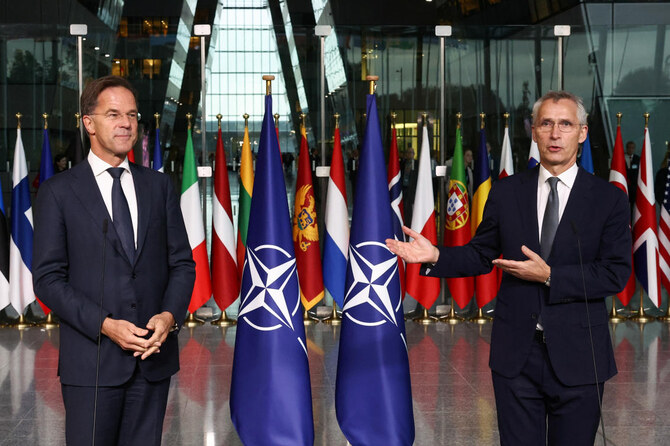

BRUSSELS: NATO’s new chief Mark Rutte on Tuesday downplayed fears over the impact of a potential Donald Trump victory in upcoming US elections and pledged to keep backing Ukraine, as he assumed leadership of the world’s most powerful military alliance.
The former Dutch prime minister steps into the role at a pivotal moment, as Russia presses its war in Ukraine and China flexes its growing might — and just weeks before voters in the United States head to the polls.
Rutte on Tuesday took over the alliance from Norway’s Jen Stoltenberg, who has guided NATO through one of its most tumultuous decades.
The outcome of the November 5 vote is set to be the straight-talking 57-year-old’s first major test — and will shape his initial four-year term at the helm.
On the campaign trail, former president Trump has threatened not to protect NATO members who do not spend enough on defense and promised he can cut a quick deal with Russian President Vladimir Putin to end the war in Ukraine.
“I’m not worried. I know both candidates very well. I worked for four years with Donald Trump. He was the one pushing us to spend more, and he achieved,” Rutte said ahead of a formal handover ceremony.
“I will be able to work with both whatever is the outcome of the elections.”
In opting for the veteran Dutch statesman, a staunch US ally and stalwart backer of Ukraine, NATO’s 32 nations have picked a leader expected to keep pushing support for Kyiv and efforts to bolster the alliance’s own defenses in the face of Russia.
“NATO will be in safe hands with you at the helm,” Stoltenberg said.
Rutte listed backing Kyiv as among his top priorities — along with ensuring NATO keeps on spending more on defense, and bolstering ties with partners in the Asia Pacific.
“We have to make sure that Ukraine prevails as a sovereign, independent, democratic nation,” he told journalists.
But uncertainty over future Western support for Ukraine comes as Russian forces advance on the battlefield more than three-and-a-half years after the Kremlin’s all-out invasion.
NATO, whose members have supplied 99 percent of all foreign weaponry to Ukraine, agreed at a summit in July to play a bigger role in delivering those arms and Rutte will be key in stewarding support.
Another central task for Rutte will be to keep pushing NATO members to spend more on their militaries to counter any potential menace from Moscow.
Spurred on by the war in Ukraine — and pressure from Washington — European countries have already ratcheted up defense spending.
This year, 23 countries are set to reach NATO’s target of spending two percent of gross domestic product on their militaries.
But with the threat from Russia expected to last for years — whatever the outcome in Ukraine — there is a clear understanding that more will be needed.
“We have to spend more. We have to increase our collective defense,” Rutte said.
That could prove a tough sell for Rutte — who only saw the Netherlands reach the two-percent goal in his fourteenth, and final year, in office.
Even if he wanted to change NATO’s direction, Rutte would likely struggle to shake up an alliance based on careful consensus between its members.
Stoltenberg, whose mandate was extended three times, trod a careful balancing act as NATO emerged reenergized in the face of Russia’s aggression.
And the former Norwegian premier has told his successor that the greatest challenge he faces is keeping all of NATO’s sometimes truculent leaders on the same page.
“One thing will not change, and that is NATO’s core mission, and that is to make sure that we defend our people, our nations, and, Of course, our values,” Rutte said.


