Chinese art exhibition highlights parallels with Arab culture

1 / 5
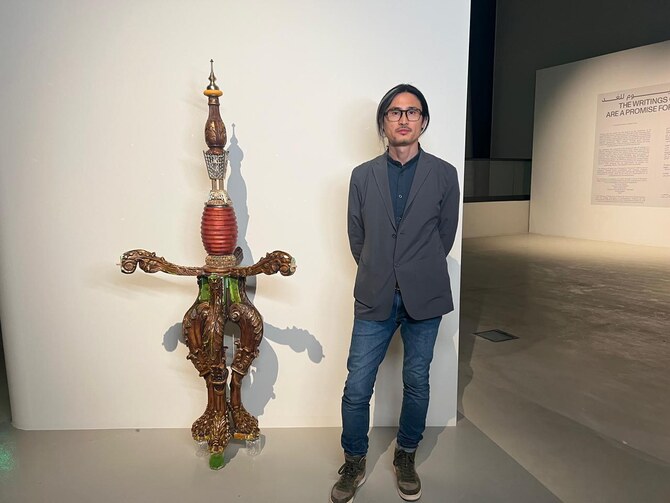
An art exhibition exploring parallels between Chinese and Arab cultures has opened at the Saudi Arabia Museum of Contemporary Art. (AN photo by Jafaar Al Saleh)
2 / 5
An art exhibition exploring parallels between Chinese and Arab cultures has opened at the Saudi Arabia Museum of Contemporary Art. (AN photo by Jafaar Al Saleh)
3 / 5
An art exhibition exploring parallels between Chinese and Arab cultures has opened at the Saudi Arabia Museum of Contemporary Art. (AN photo by Jafaar Al Saleh)
4 / 5
An art exhibition exploring parallels between Chinese and Arab cultures has opened at the Saudi Arabia Museum of Contemporary Art. (AN photo by Jafaar Al Saleh)
5 / 5
An art exhibition exploring parallels between Chinese and Arab cultures has opened at the Saudi Arabia Museum of Contemporary Art. (Supplied)
Short Url
Updated 30 September 2024
Follow

Chinese art exhibition highlights parallels with Arab culture

  • Titled The Writings of Today Are a Promise for Tomorrow, the exhibition hosted by the Saudi Ministry of Culture’s Museums Commission features work from more than 30 artists
  • Curated by Martina Koppel Yang, the exhibition focuses on two elements shared by Arab and Chinese cultures: calligraphy and the garden

RIYADH: A new art exhibition exploring parallels between Chinese and Arab cultures has opened at the Saudi Arabia Museum of Contemporary Art.

Titled “The Writings of Today Are a Promise for Tomorrow,” the exhibition hosted by the Saudi Ministry of Culture’s Museums Commission features work from more than 30 artists.

Curated by Martina Koppel Yang, the exhibition focuses on two elements shared by Arab and Chinese cultures: calligraphy and the garden.

Both cultures regard calligraphy as a significant cultural and spiritual practice, elevating the written word beyond mere communication.

Ibrahim Al-Sanousi, acting CEO of the Museums Commission, emphasized the art museum’s role as a venue for temporary rotating exhibitions rather than a collecting museum. “We aim to integrate contemporary art into everyday life,” he said.

“This exhibition, focused on Chinese artists, is the beginning of a series of collaborations with countries worldwide, aimed at fostering cross-cultural dialogue and international exchange,” he told Arab News.

Artist Dexi Tian shared insights about his creative process, highlighting how he incorporates elements of Saudi culture into his work.

“I use discarded objects that I find during my explorations of the city and desert, reassembling them into new creations that reflect this culture,” he explained.

Wang Du, a Chinese artist residing in France, also spoke about his artwork, saying: “My work doesn’t have a direct connection to Chinese culture; instead, it addresses contemporary media and its impact on society.

“The sculpture you see is made from crumpled newspapers. It symbolizes how we consume news and information in our modern world. Each day, we receive a newspaper, only to crumple it up and toss it aside. This act reflects our habits — while we consume news, it also consumes us in return.”

Wang emphasized the notion of a “throwaway reality,” highlighting how easily we discard information. “Most news is fleeting, and this piece serves as a monument to that short-lived nature of news,” he explained.

The exhibition also explores the connection between the discipline of calligraphy and the natural order found in gardens. In both cultures, gardens are seen as representations of creation — spaces designed for beauty, spirituality, contemplation, and community.

“The Writings of Today Are a Promise for Tomorrow” also conveys aspirations for future dialogues and possibilities, addressing themes of energy flow and synergy. In this context, writing is viewed as a meaningful act of participation and communication.

The exhibition features a thoughtfully designed scenography by Studio GGSV, guiding visitors through thematic stages that explore the dynamics of presence and absence, action and contemplation, memory and imagination.

Visitors will have the chance to view pieces from prominent collections of contemporary Chinese art, such as the Donnersberg Collection and the Dslcollection, alongside site-specific works created in Saudi Arabia.

Notably, the exhibition includes works from French-Algerian artist Adel Abdessemed and Taiwanese artist Michael Lin, both of whom are exhibiting in Saudi Arabia for the first time.

“The Writings of Today Are a Promise for Tomorrow” highlights the ongoing evolution of contemporary art, reflecting cultural energy and bridging the past with the future, embodying the promise of what lies ahead.

The exhibition will run until Jan. 18, 2025, and tickets are available at https://webook.com/en/events/chinese-contemporary-art-exhibition.


Kawthar Al-Atiyah: ‘My paintings speak first to the body, then to the mind’ 

Updated 19 December 2025
Follow

Kawthar Al-Atiyah: ‘My paintings speak first to the body, then to the mind’ 

  • The Saudi artist discusses her creative process and her responsibility to ‘represent Saudi culture’ 

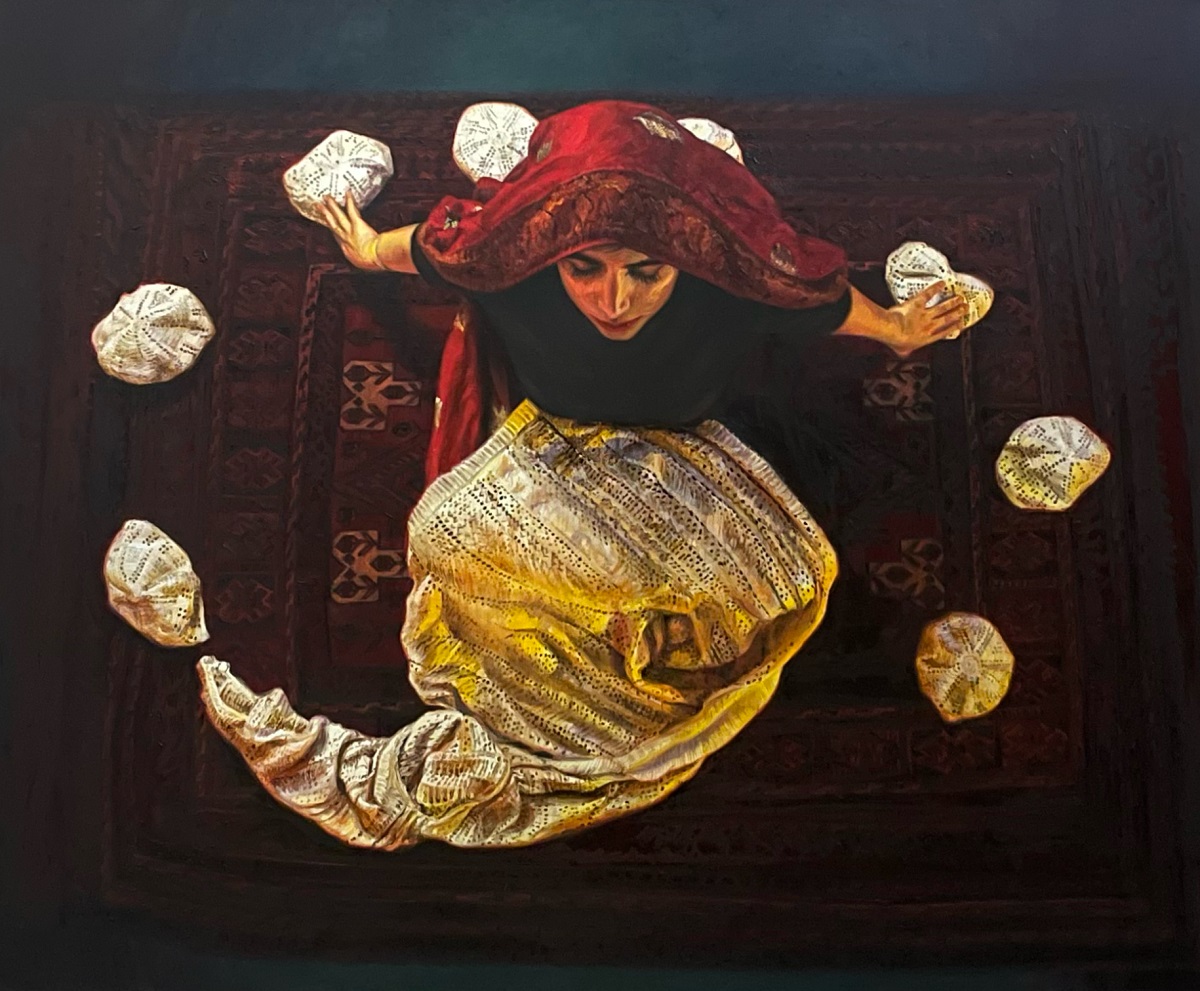
RIYADH: Contemporary Saudi artist Kawthar Al-Atiyah uses painting, sculpture and immersive material experimentation to create her deeply personal works. And those works focus on one recurring question: What does emotion look like when it becomes physical?  

“My practice begins with the body as a site of memory — its weight, its tension, its quiet shifts,” Al-Atiyah tells Arab News. “Emotion is never abstract to me. It lives in texture, in light, in the way material breathes.”  

This philosophy shapes the immersive surfaces she creates, which often seem suspended between presence and absence. “There is a moment when the body stops being flesh and becomes presence, something felt rather than seen,” she says. “I try to capture that threshold.”  

Al-Atiyah, a graduate of Princess Nourah bint Abdulrahman University, has steadily built an international profile for herself. Her participation in VOLTA Art Fair at Art Basel in Switzerland, MENART Fair in Paris, and exhibitions in the Gulf and Europe have positioned her as a leading Saudi voice in contemporary art.  

Showing abroad has shaped her understanding of how audiences engage with vulnerability. “Across countries and cultures, viewers reacted to my work in ways that revealed their own memories,” she says. “It affirmed my belief that the primary language of human beings is emotion. My paintings speak first to the body, then to the mind.” 

Al-Atiyah says her creative process begins long before paint touches canvas. Instead of sketching, she constructs physical environments made of materials including camel bone, raw cotton, transparent fabrics, and fragments of carpet.  

“When a concept arrives, I build it in real space,” she says. “I sculpt atmosphere, objects, light and emotion before I sculpt paint.  

“I layer color the way the body stores experience,” she continues. “Some layers stay buried, others resurface unexpectedly. I stop only when the internal rhythm feels resolved.”  

This sensitivity to the unseen has drawn attention from international institutions. Forbes Middle East included her among the 100 Most Influential Women in the Arab World in 2024 and selected several of her pieces for exhibition.  

“One of the works was privately owned, yet they insisted on showing it,” she says. “For me, that was a strong sign of trust and recognition. It affirmed my responsibility to represent Saudi culture with honesty and depth.”  

Her recent year-long exhibition at Ithra deepened her understanding of how regional audiences interpret her work.  

'Veil of Light.' (Supplied) 

“In the Gulf, people respond strongly to embodied memory,” she says. “They see themselves in the quiet tensions of the piece, perhaps because we share similar cultural rhythms.”  

A documentary is now in production exploring her process, offering viewers a rare look into the preparatory world that precedes each canvas.  

“People usually see the final work. But the emotional architecture built before the painting is where the story truly begins,” she explains.  

Beyond her own practice, Al-Atiyah is committed to art education through her work with Misk Art Institute. “Teaching is a dialogue,” she says. “I do not focus on technique alone. I teach students to develop intuition, to trust their senses, to translate internal experiences into honest visual language.”  

 'Jamalensan.' (Supplied) 

She believes that artists should be emotionally aware as well as technically skilled. “I want them to connect deeply with themselves so that what they create resonates beyond personal expression and becomes part of a cultural conversation,” she explains.  

In Saudi Arabia’s rapidly growing art scene, Al-Atiyah sees her role as both storyteller and facilitator.  

“Art is not decoration, it is a language,” she says. “If my work helps someone remember something they have forgotten or feel something they have buried, then I have done what I set out to do.”