Pakistan’s Sindh asks authorities to restrict travel of cops, clerics accused of blasphemy murder

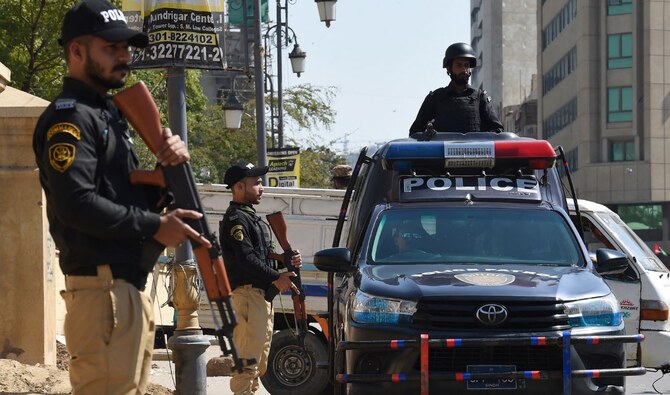
Police stand guard outside a poling station during Pakistan's national elections in Karachi on February 8, 2024. (AFP/File)
Short Url
Updated 30 September 2024
Follow

Pakistan’s Sindh asks authorities to restrict travel of cops, clerics accused of blasphemy murder

  • Provincial home minister says police killed Dr. Shahnawaz Kanbhar in ‘fake encounter’ shortly after arrest on Sept 19
  • The murder sparked rare protests in Sindh this month, prompting provincial authorities to suspend multiple officials 

KARACHI: The government in Pakistan’s southern Sindh province on Monday requested the Federal Investigation Agency (FIA) to restrict 24 individuals, including 21 police officers and three clerics, from leaving the country, in a rare move in connection with the blasphemy murder of a doctor this month.

Dr. Shahnawaz Kanbhar, accused of sharing blasphemous content online, was arrested in Sindh’s Umerkot district, but he was shot dead in a purported shootout hours later on Sept. 19. Police said Dr. Kanbhar was killed when they asked two motorcyclists to stop, but one of the bikers opened fire on them. The law enforcers said it was only after the shooting that they learned the slain man was the doctor being sought by them for alleged blasphemy.

Dr. Kanbhar’s family disputed the police account, claiming he was murdered in custody. Hours after Dr. Kanbhar was fatally shot and his body was handed over to his relatives, a mob snatched it from Kanbhar’s father and burned it. The incident sparked rare protests in Sindh, at which people asked for justice for the slain doctor accused of blasphemy, which has rarely happened in Muslim-majority Pakistan. The widespread protests prompted the Sindh government to suspend a number of police and local administration officials.

Last week, the provincial government said the police had “orchestrated” the killing, marking the first time the government accused the law enforcers of doing what the doctor’s family and rights groups have described as an “extrajudicial killing.” Sindh Home Minister Zia-ul-Hassan Lanjar said a government probe concluded that Dr. Kanbhar was killed shortly after he gave himself up to authorities in what was a “fake encounter” by the police.

“I am directed to refer to the captioned subject and to request the intervention of FIA Sindh to prevent the accused nominated in subject FIR [first information report on Dr. Kanbhar’s murder] from leaving Pakistan,” a section officer of the Sindh home department said in a letter to the FIA, requesting the federal agency to put the individuals accused of the murder on the Exit Control List (ECL).

“In the light of above, I am directed to request that immediate measures may be taken to prevent the departure or fleeing of accused persons from the airport and other point of exit from the country.”

The official highlighted that the accused persons, including the Deputy Inspector General of the Police Javed Soonharo Jiskani, were facing “serious charges” pending an investigation.

Accusations of blasphemy — sometimes even just rumors — can spark riots and mob violence in Pakistan. Although killings of blasphemy suspects by mobs are common, extra-judicial killings by police are rare.

Dr. Kanbhar’s killing marks the second such incident this month. On Sept. 12, a police officer in the southwestern Balochistan province killed a blasphemy suspect in custody, highlighting the grave dangers faced by persons accused of blasphemy in Pakistan.

Human rights groups and civil society organizations have urged the Pakistani government to repeal the country’s blasphemy laws, which they argue contribute to discrimination and violence. They have also called for a comprehensive review of law enforcers’ response to blasphemy accusations.


Pakistan’s OGDC ramps up unconventional gas plans

Updated 4 sec ago
Follow

Pakistan’s OGDC ramps up unconventional gas plans

  • Pakistan has long been viewed as having potential in tight and shale gas but commercial output has yet to be proved
  • OGDC says has tripled tight-gas study area to 4,500 square km after new seismic, reservoir analysis indicates potential

ISLAMABAD: Pakistan’s state-run Oil & Gas Development Company is planning a major expansion of unconventional gas developments from early next year, aiming to boost production and reduce reliance on imported liquefied natural gas.

Pakistan has long been viewed as having potential in both tight and shale gas, which are trapped in rock and can only be released with specialized drilling, but commercial output has yet to be proved.

Managing Director Ahmed Lak told Reuters that OGDC had tripled its tight-gas study area to 4,500 square kilometers (1,737 square miles) after new seismic and reservoir analysis indicated larger potential. Phase two of a technical evaluation will finish by end-January, followed by full development plans.

The renewed push comes after US President Donald Trump said Pakistan held “massive” oil reserves in July, a statement analysts said lacked credible geological evidence, but which prompted Islamabad to underscore that it is pursuing its own efforts to unlock unconventional resources.

“We started with 85 wells, but the footprint has expanded massively,” Lak said, adding that OGDC’s next five-year plan would look “drastically different.”

Early results point to a “significant” resource across parts of Sindh and Balochistan, where multiple reservoirs show tight-gas characteristics, he said.

SHALE PILOT RAMPS UP

OGDC is also fast-tracking its shale program, shifting from a single test well to a five- to six-well plan in 2026–27, with expected flows of 3–4 million standard cubic feet per day (mmcfd) per well.

If successful, the development could scale to hundreds or even more than 1,000 wells, Lak said.

He said shale alone could eventually add 600 mmcfd to 1 billion standard cubic feet per day of incremental supply, though partners would be needed if the pilot proves viable.

The company is open to partners “on a reciprocal basis,” potentially exchanging acreage abroad for participation in Pakistan, he said.

A 2015 US Energy Information Administration study estimated Pakistan had 9.1 billion barrels of technically recoverable shale oil, the largest such resource outside China and the United States.

A 2022 assessment found parts of the Indus Basin geologically comparable to North American shale plays, though analysts say commercial viability still hinges on better geomechanical data, expanded fracking capacity and water availability.

OGDC plans to begin drilling a deep-water offshore well in the Indus Basin, known as the Deepal prospect, in the fourth quarter of 2026, Lak said. In October, Turkiye’s TPAO with PPL and its consortium partners, including OGDC, were awarded a block for offshore exploration.

A combination of weak gas demand, rising solar uptake and a rigid LNG import schedule has created a surplus of gas that forced OGDC to curb output and pushed Pakistan to divert cargoes from Italy’s ENI and seek revised terms with Qatar.