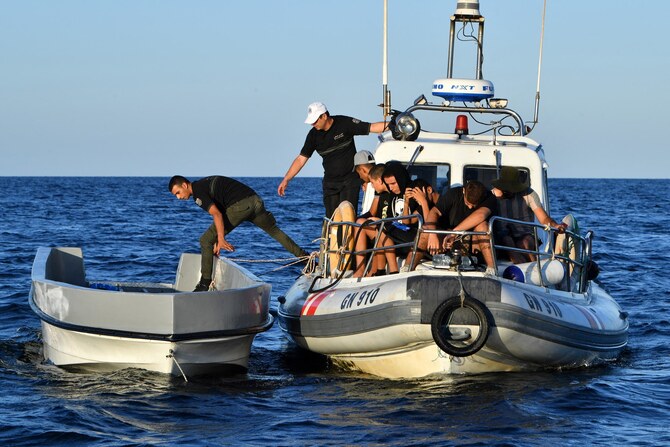
At least 12 Tunisians including three children were found dead after a migrant boat capsized off the coast of the southeastern island of Djerba on Monday, a judicial official said.
The boat went down at dawn and 29 people were rescued, Medenine court spokesman Fethi Baccouche told AFP, adding five men and four women were among the dead, and that the cause of the sinking remained unknown.
The Tunisian National Guard said it was alerted by four migrants who swam back ashore.
Tunisia and neighboring Libya have become key departure points for migrants seeking better lives in Europe, often risking dangerous Mediterranean crossings.
The exodus is fueled by Tunisia’s stagnant economy, with only 0.4 percent of growth in 2023 and unemployment soaring.
The North African country has also been shaken by political tensions, after President Kais Saied orchestrated a sweeping power grab in July 2021.
Each year, tens of thousands of people attempt to make the crossing, with Italy — whose Lampedusa island is only 150 kilometers (90 miles) away — often their first port of call.
Since January 1, at least 103 makeshift boats have capsized and 341 bodies have been recovered off Tunisia’s coast, the government says.
Last year, more than 1,300 people died or disappeared last year in shipwrecks off Tunisia, according to the FTDES rights group.
The International Organization for Migration has said more than 30,309 migrants have died in the Mediterranean in the past decade, including more than 3,000 last year.

At least 12 die, 10 missing as migrant boat sinks off Tunisia
https://arab.news/2zu8y
At least 12 die, 10 missing as migrant boat sinks off Tunisia
- Human Rights Observatory, a local rights group, said that all the migrants on board were Tunisians bar two Moroccans
Israel police to deploy around Al-Aqsa for Ramadan, Palestinians report curbs
- The Al-Aqsa compound is a central symbol of Palestinian identity and also a frequent flashpoint
JERUSALEM: Israeli police said Monday that they would deploy in force around the Al-Aqsa Mosque during the Muslim holy month of Ramadan, which begins this week, as Palestinian officials accused Israel of imposing restrictions at the compound.
Over the course of the month of fasting and prayer, hundreds of thousands of Palestinians traditionally attend prayers at Al-Aqsa — Islam’s third-holiest site, located in east Jerusalem, which Israel captured in 1967 and later annexed.
Arad Braverman, a senior Jerusalem police officer, said forces would be deployed “day and night” across the compound, known to Jews as the Temple Mount, and in the surrounding area.
He said thousands of police would also be on duty for Friday prayers, which draw the largest crowds of Muslim worshippers.
Braverman said police had recommended issuing 10,000 permits for Palestinians from the occupied West Bank, who require special permission to enter Jerusalem.
He did not say whether age limits would apply, adding that the final number of people would be decided by the government.
The Palestinian Jerusalem Governorate said in a separate statement it had been informed that permits would again be restricted to men over 55 and women over 50, mirroring last year’s criteria.
It said Israeli authorities had blocked the Islamic Waqf — the Jordanian?run body administering the site — from carrying out routine preparations, including installing shade structures and setting up temporary medical clinics.
A Waqf source confirmed the restrictions and said 33 of its employees had been barred from entering the compound in the week before Ramadan.
The Al-Aqsa compound is a central symbol of Palestinian identity and also a frequent flashpoint.
Under long?standing arrangements, Jews may visit the compound — which they revere as the site of their second temple, destroyed by the Romans in 70 AD — but they are not permitted to pray there.
Israel says it is committed to maintaining this status quo, though Palestinians fear it is being eroded.
Braverman reiterated Monday that no changes were planned.
In recent years, a growing number of Jewish ultranationalists have challenged the prayer ban, including far?right politician Itamar Ben-Gvir, who prayed at the site while serving as national security minister in 2024 and 2025.


