

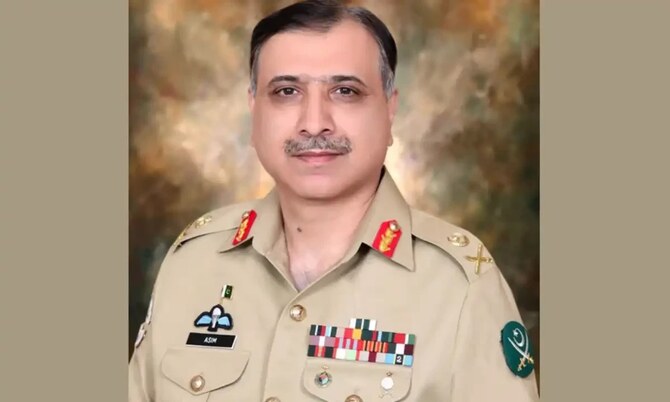
Lt Gen Asim Malik takes charge as new chief of Pakistan’s ISI agency today

The picture shared by Pakistani state media, PTV News, on September 23, 2024, shows the newly appointed head of the Inter-Services Intelligence (ISI), Lt. Gen. Muhammad Asim Malik. (PTV News)
Short Url
Updated 30 September 2024
Follow

Lt Gen Asim Malik takes charge as new chief of Pakistan’s ISI agency today

  • Malik takes over from his predecessor, Lt Gen Nadeem Anjum, who was appointed by ex-PM Imran Khan in 2021
  • His posting comes as Pakistan faces surging attacks in its western provinces of Khyber Pakhtunkhwa and Balochistan

ISLAMABAD: Lt. Gen. Asim Malik will take charge as the new chief of Pakistan’s Inter-Services Intelligence (ISI) today, Monday, exactly a week after he was picked to head the powerful spy agency.

Malik, who was serving as an adjutant general at the General Headquarters (GHQ) in Pakistan’s garrison city of Rawalpindi when his name was announced as the new head of the ISI last Monday, will be replacing Lt. Gen. Nadeem Anjum. His predecessor was appointed by then-prime minister Imran Khan in 2021.

The army is arguably the most influential institution in Pakistan, with the military having ruled the country for about half of its 77-year history since independence from Britain and enjoying extensive powers even under civilian administrations.

“Lt. Gen. Muhammad Asim Malik has been appointed as DG ISI,” state television PTV News said last Monday. “Lt. Gen. Asim Malik will assume charge of his new responsibilities on Sept. 30.”

Sharing details about the new ISI chief, PTV had said Malik previously served in the Balochistan infantry division and commanded the infantry brigade in Pakistan’s volatile northwestern Waziristan district.

Malik also earned an honorary sword in his course and has served as chief instructor at the National Defense University (NDU), and as an instructor at the Command and Staff College Quetta. He is a graduate of Fort Leavenworth in the United States and the Royal College of Defense Studies in London, the state television said.

The head of the ISI occupies one of the country’s most powerful positions. His posting comes at a time when Pakistan faces surging militant attacks in the country’s northwestern Khyber Pakhtunkhwa (KP) and southwestern Balochistan provinces by separatists and religiously motivated militants. The surge in militant attacks in KP has marred Pakistan’s relations with Afghanistan, whose government it accuses of providing sanctuaries to the Pakistani Taliban militants who launch attacks in Pakistan. The Taliban deny these allegations and have urged Pakistan to resolve their security challenges internally.

Created in 1948, the ISI gained importance and power during the 1979-1989 Soviet occupation of Afghanistan, and is now rated one of best-organized intelligence agencies in the developing world.

The agency is seen as the Pakistani equivalent of the US Central Agency (CIA) and Israel’s Mossad. Its size is not publicly known but the ISI is widely believed to employ tens of thousands of agents, with informers in many spheres of public life.

The military intelligence agency is believed to have a hidden role in making many of the nuclear-armed nation’s policies, including in Afghanistan and India. The threat to Pakistan from nuclear-armed neighboring India has been a main preoccupation of the ISI through the decades.


Nearly 25% of Pakistan’s primary schools enrolling girls operate as single-teacher ones— report

Updated 13 sec ago
Follow

Nearly 25% of Pakistan’s primary schools enrolling girls operate as single-teacher ones— report

  • Pakistan needs over 115,000 more teachers in primary schools enrolling girls to meet global benchmark of one teacher per 30 students, says report
  • Sixty percent of Pakistani primary schools enrolling girls are overcrowded, while 32% lack clean drinking water or toilets, says Tabadlab report

ISLAMABAD: Nearly 25% of Pakistan’s primary schools that enrolls girls operate as single-teacher ones, a report by a leading think tank said this week, calling on the government to devolve teacher recruitment powers, upskill underutilized teachers and introduce reforms to hire and promote faculty members. 

Pakistan faces an acute education crisis which is reflected in the fact that it has the world’s second-highest number of out-of-school children, an estimated 22.8 million aged 5-16 who are not in educational institutions, according to UNICEF. 

While poverty remains the biggest factor keeping children out of classrooms, Pakistan’s education crisis is exacerbated by inadequate infrastructure and underqualified teachers, cultural barriers and the impacts of frequently occurring natural disasters. 

According to “The Missing Ustaani,” a report published by Islamabad-based think tank Tabadlab and supported by Malala Fund and the Pakistan Institute of Education (PIE), Pakistan needs over 115,000 more teachers in primary schools with girls’ enrolment to meet the basic international benchmark of ensuring one teacher per 30 children. Currently, the average Student-to-Teacher Ratio (STR) across Pakistan’s primary schools with girls’ enrolment is 39:1, it said. 

“Approximately 60% of these schools are overcrowded, necessitating the recruitment of over 115,000 additional teachers nationwide,” the report said on Monday. “Compounding this, nearly 25% of primary schools with girls’ enrolment operate as single-teacher schools, placing immense pressure on the quality of education.”

It said the situation is more dire in Pakistan’s poverty-stricken southwestern Balochistan province, where nearly 52% of the schools are single-teacher only ones while the percentage decreases slightly in the southern Sindh province to 51 percent. 

The report said while the STR improves to 25:1 at the middle school level, acute shortages of subject specialists emerge as the top-priority concern for quality education in these schools.

“Furthermore, around 32% of primary schools with girls’ enrolment and 18% of middle schools face ‘critical infrastructural shortages’— lacking clean drinking water or toilets in addition to high STRs— which significantly affects girls’ attendance and learning, particularly during adolescence,” the report said. 

The report cited a set of priority recommendations to address Pakistan’s systemic teacher deployment challenges and improve educational equity for girls. 

It urged the government to devolve recruitment authority to school or cluster levels to enable timely, context-specific hiring. It also called upon authorities to reform teacher transfer and promotion policies to introduce school-specific postings with minimum service terms. 

This, it said, would reduce arbitrary transfers and improving continuity in classrooms. The report advised authorities to upskill surplus or underutilized primary teachers to support instruction at the middle school level, helping address subject-specialist shortages.

“Together, these reforms offer a pathway toward a more equitable, efficient, and responsive teaching workforce— one capable of improving learning outcomes and ensuring that every girl in Pakistan has access to a qualified teacher,” the report said. 

To tackle Pakistan’s education crisis, Prime Minister Shehbaz Sharif declared an ‘education emeregency’ in September 2024, stressing the importance of education for all.