



CHICAGO/LONDON: Lebanese experts have painted a bleak picture of the country’s imminent future, describing the nation as trapped “between mafia and militia” and criticizing the failure of the US to intervene effectively in the region.
Speaking on the Ray Hanania Radio Show, Hamoud Salhi, a political science professor at California State University-Dominguez Hills, and Jean AbiNader, vice president for policy at the American Task Force on Lebanon, highlighted the strategic missteps being taken by the US, especially as tensions between Israel and Hezbollah intensify.
The US “is strategically being affected. Number one, can you afford continuing to sponsor this war?” Salhi said, adding that further escalation could draw Hezbollah and Iran’s regional allies, such as Yemen and Iraq, into a broader conflict.
He explained that up to this point the US had attempted to leverage its influence in the region through Israel to counterbalance growing powers such as Russia and China.
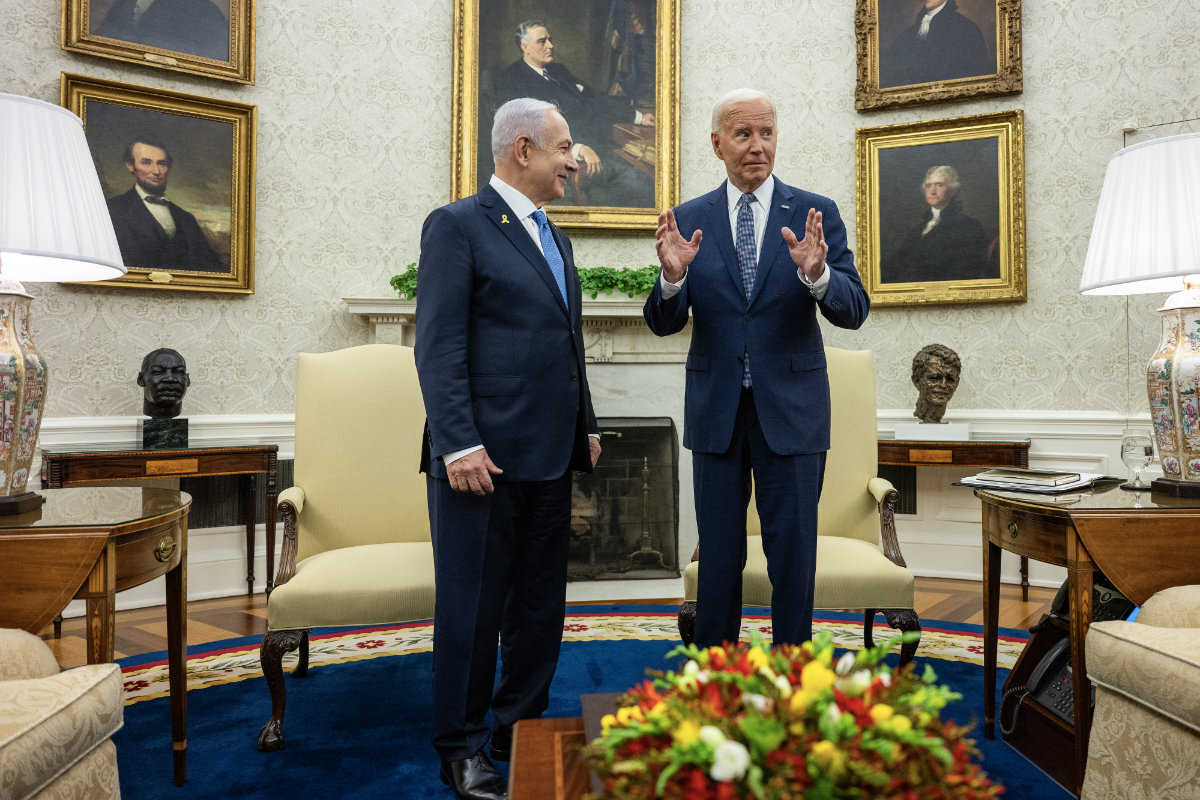
In this photo taken at the White House in Washington, DC, on July 25, 2024, Israeli PM Benjamin Netanyahu seems amused by whatever US President Joe Biden is telling him. Netanyahu has repeatedly rejected US efforts to restrain Israel in its indiscriminate brutal war affecting civilians in Gaza and now in Lebanon. (AFP/File photo)
However, after nearly a year of conflict, Salhi questioned the sustainability of the current US approach, saying: “The US cannot sustain that. And more than anything else, Israel cannot sustain this war.”
He warned that continued regional instability could lead to mass protests, putting “huge pressure” on the US and its Arab allies.
“The US could potentially lose its allies in the region, the leaders they are working with,” Salhi said, adding that any potential normalization efforts must include a solution to the Palestinian’s cause.
FASTFACTS
• A Hezbollah statement on Saturday said Hassan Nasrallah ‘has joined his fellow martyrs.’
• Israeli military said Ali Karki, commander of Hezbollah’s Southern Front, and several other commanders, were also killed in the attack.
• Iranian Supreme Leader Ali Khamenei said ‘the resistance movement, heading by Hezbollah, will decide the fate of the region.’
He anticipated that any significant changes in Washington’s position would likely occur only after the US presidential election on Nov. 5. At that point President Joe Biden, no longer constrained by election concerns and with just over two more months left in office before the inauguration of his successor on Jan. 20 2025, “could get away with adopting decisions that could favor the region.”
Judging by events on Thursday, when Israeli President Benjamin Netanyahu arrived in New York to address the UN General Assembly, US influence over Israel is weakening.
The day before Netanyahu’s arrival, in a joint statement, the US and 11 allies, including France, the European Union, Saudi Arabia and the UAE, had called for “an immediate 21-day ceasefire across the Lebanon-Israel border to provide space for diplomacy toward the conclusion of a diplomatic settlement.”

Israeli Prime Minister Benjamin Netanyahu shows maps as he speaks during the 79th Session of the UN General Assembly in New York City on September 27, 2024. (AFP)
The White House and French officials indicated the ceasefire plan had been coordinated directly with Netanyahu. But faced with pressure from the rightwing members of his government, Netanyahu’s first act on touching down in the US was to disown the proposal, with a spokesperson claiming that he had not even responded to it.
Instead, the prime minister’s office said, he had “instructed the IDF to continue fighting at full force, according to the plans that were presented to him.”
In recent months, the US, alongside Qatar and Egypt, has been a primary broker in ceasefire negotiations between Hamas and Israel in Gaza. Hezbollah’s leader, Hassan Nasrallah, had indicated that similar efforts could also halt the hostilities between Hezbollah and Tel Aviv.
However, in the past week, both Hezbollah and Israel have escalated their attacks, and on Saturday Israeli aircraft carried out a massive airstrike in Beirut’s Dahiyeh suburb, killing Nasrallah along with several other Hezbollah figures and possibly some Islamic Revolutionary Guards commanders.
Opinion
This section contains relevant reference points, placed in (Opinion field)
A statement from Hezbollah on Saturday said Nasrallah “has joined his fellow martyrs” but that the group would “continue the holy war against the enemy and in support of Palestine.”
This escalation followed the detonation of thousands of pagers and walkie-talkies used by Hezbollah operatives in two waves of attacks suspected to have been carried out by Mossad, Israel’s intelligence agency, which killed dozens of people and injured thousands more across Lebanon. Most of the dead are believed to have been fighters, based on death notices posted online by Hezbollah.
Subsequent Israeli airstrikes against Hezbollah strongholds in southern Lebanon and Beirut suburbs have killed nearly 700 people and displaced hundreds of thousands.

“The issue of Lebanon is part of the bigger picture, part of the grand design that Israel has,” said Salhi. “We could talk about the Golan (Heights), we could talk about what’s happening today even in Yemen. Those are really complex issues.
“But it is also, as we’ve seen so far, connected to the big, big problem of the existence of an entity like Israel, who sees its security through strength, military buildup and occupation within the context of their bigger picture, which is to occupy other countries for the purpose of achieving the right agenda.”
Israel and Lebanon have a long history of conflict, with tensions peaking during the Lebanese Civil War. Israel invaded Lebanon in 1978 and 1982 in response to attacks from Palestinian militants, occupying southern Lebanon until 2000 while fighting a guerrilla war against Hezbollah.
After Israel’s withdrawal, Hezbollah attacks led to the 2006 Lebanon War, which formally ended with UN Security Council Resolution 1701. The resolution, calling for a cessation of hostilities, Israeli withdrawal, and the deployment of UNIFIL forces, remains only partially implemented, further entangling Lebanon in a web of unresolved conflict.
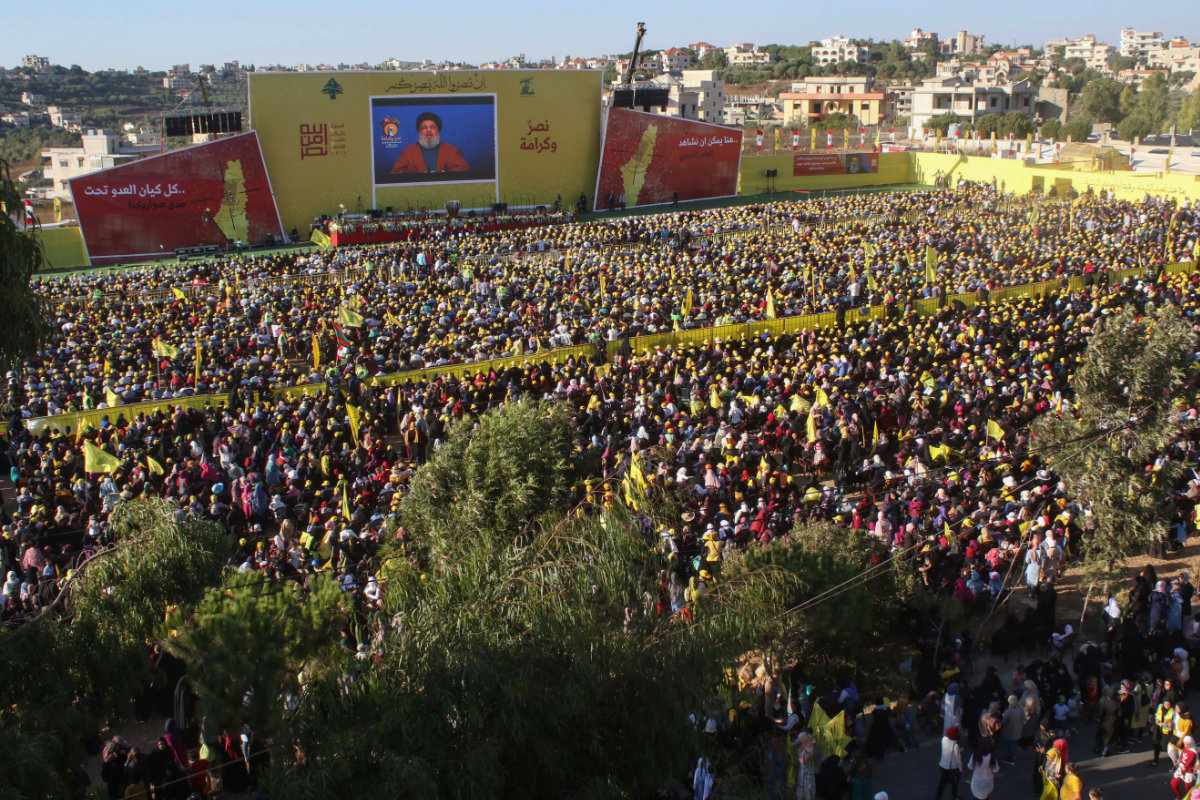
Hezbollah became stronger and bolder after the 2006 war with Israel. When the militia marked the anniversary of the war on August 16, 2019, in the southern Lebanese town of Bint Jbeil, Hezbollah displayed a video showing a sample of its naval missiles that it used to target an Israeli warship off the Lebanese coast during the 2006 war. (AFP)
“(This situation) gets to the heart of what we’ve been saying about Lebanon for 40 years,” said AbiNader.
“In other words, most people have in their mind the image of a country torn between Christians and Muslims, which is absolutely inaccurate. And now the narrative is the country is torn between Christians and Hezbollah, or between Israel and Hezbollah. The overriding images are incorrect to begin with.
“But we are fighting for the soul of Lebanon,” he said, adding that the question at this point was whether Lebanon was going to become “an outpost for the Iranian paramilitary called Hezbollah, or is it going to return to its weak roots as a quasi-democratic country?”
The current situation, he said, highlighted the fragile balance underpinning Lebanon’s entire political system.
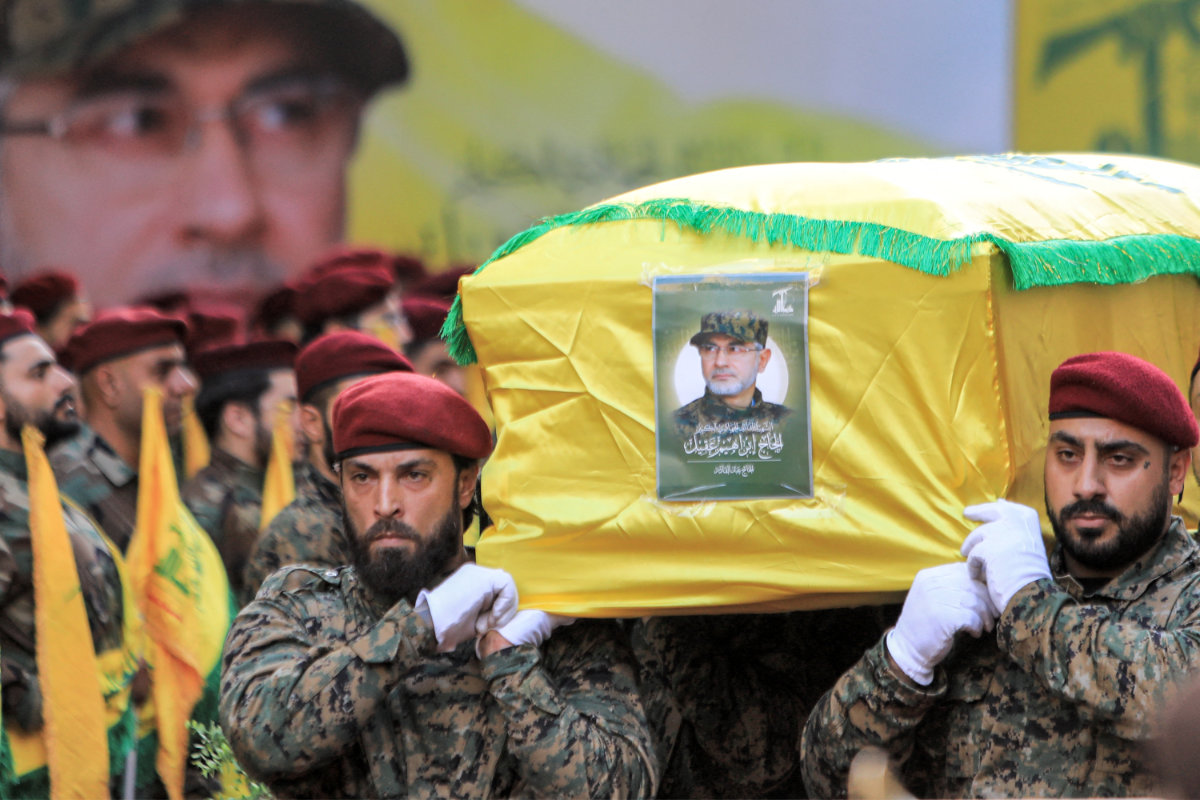
Hezbollah fighters carry the body of their top military commander Ibrahim Aqil during his funeral in Beirut's southern suburbs on September 22, 2024. Aqil and other commanders of Hezbollah's "Radwan Force" were killed in an Israeli air strike on September 20. (AFP)
“The expression a lot of Lebanese use is, they’re caught between the mafia and the militia. Mafia, the old political leadership, and the militia, which has its own raison d’etre.
“And so Lebanon has really put itself into a trap that underscores the question of whether or not Lebanon can survive.”
AbiNader said that Hezbollah had been able to fill the vacuum created by Lebanon’s antiquated and dysfunctional political system, itself a major obstacle to progress.
“Until you have a (proper) state, you have Hezbollah, which has a stronger military, bank system, supermarkets, all this kind of stuff that supports people and has been done the way the government should, but didn’t,” he said.
The Lebanese people are suffering now because “the overriding (Israeli) narrative is that Hezbollah is bad, therefore, by extension, the Lebanese are bad and so we can do whatever we want to protect our northern border.”

Israelis take refuge in a shelter after sirens were heard in the northern city of Kiryat Shmona near the Lebanon border as border tensions with Hezbollah. (AFP/File)
Israel’s current attacks on Lebanon are motivated by a determination to allow an estimated 70,000 Israelis, displaced from the north by Hezbollah rocket and missile attacks since Oct. 7, to return to their homes close to the Lebanese border.
But the bid to drive Hezbollah back from the border region, said AbiNader, “has resulted in increased retaliation toward the Lebanese people, and very little toward Hezbollah.
“Look at the threats that Israel is making. They’re always saying: ‘OK, Lebanese civilians get out of these areas, because it’s where Hezbollah has its rocket launchers. We’re going to go in and clean up the rocket launchers.’
“Well, we just accept what’s said about Hezbollah without really knowing on the ground what’s there and not there. It’s no question (Hezbollah) are a malign force, but they also represent Lebanese people.
“So, the question is, how do we get the needs of the Lebanese people, that Hezbollah represents, met without further antagonism?”
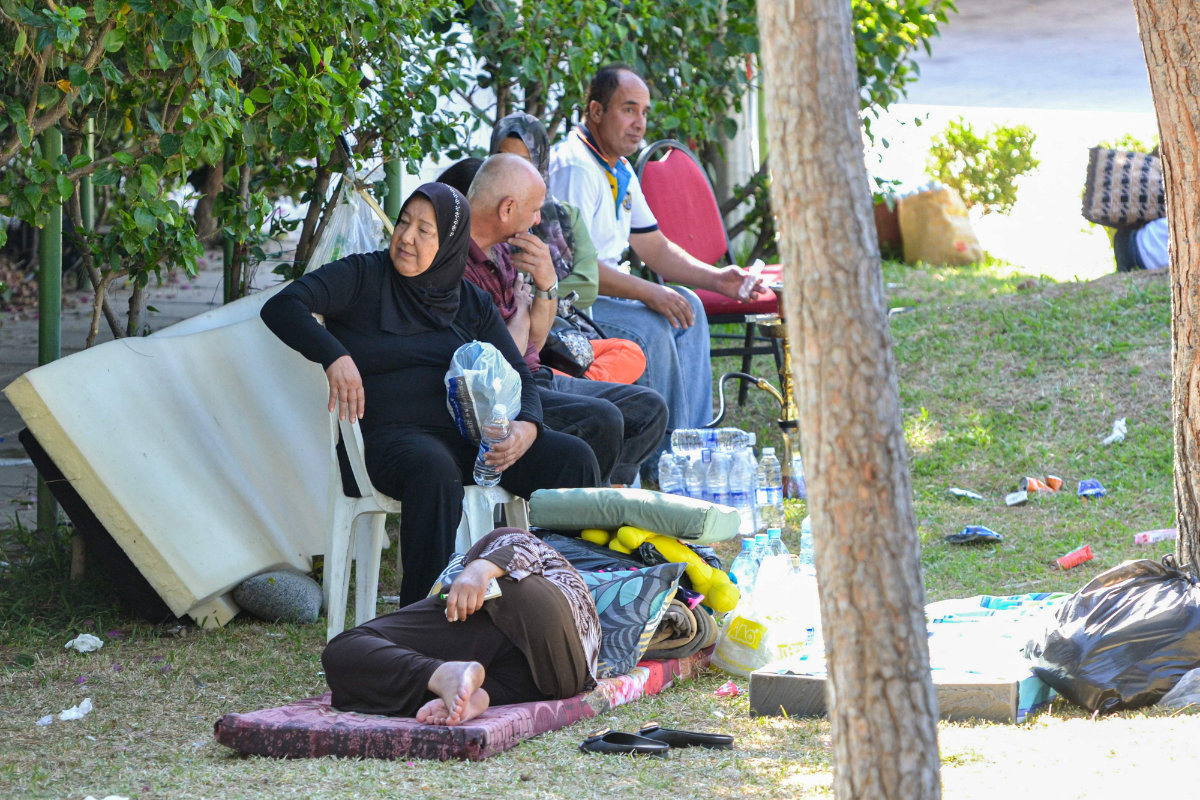
Displaced families who fled Israeli strikes in southern Lebanon are pictured at a park where they are taking refuge in Tripoli, on September 27, 2024. (AFP)
AbiNader called for the international community to intervene and establish clear boundaries to “stop what’s happening in Lebanon,” adding that competing US interests in the region have long complicated Lebanon’s integration and progress.
“But it’s not going to happen,” he said.
“Hezbollah and Israel certainly are not going to change. They both think they’re protecting their own people, their own interests, therefore they’re morally right. So, when you have two moral rights arguing against each other, you’re not going to have an easy resolution.”
He added: “So until there’s some dialog about these dueling narratives — without trying to find who’s right, just to find out where’s the middle ground — we’re going to continue to have this conflict.”


