

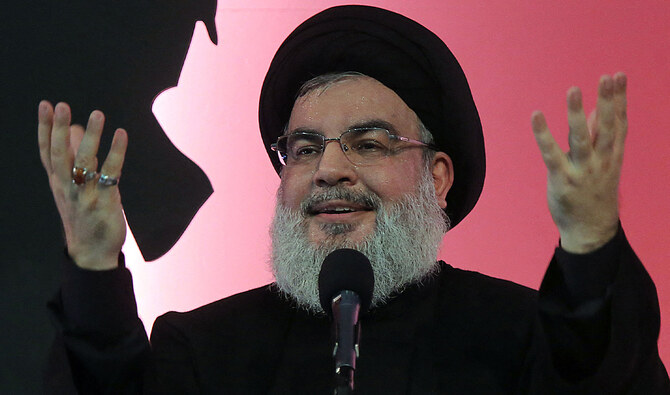

BEIRUT/JERUSALEM: The Israeli military said Saturday that it killed Hassan Nasrallah, the leader of the Hezbollah militant group, in a strike in Beirut on Friday.
The military said that it carried out a precise airstrike while Hezbollah leadership met at their headquarters in Dahiyeh, south of Beirut.
Ali Karki, the Commander of Hezbollah’s Southern Front, and additional Hezbollah commanders, were also killed in the attack, the Israeli military said. The Lebanese Health
Ministry said that 6 people were killed and 91 injured in the strikes on Friday, which leveled six apartment buildings.
Nasrallah has lead Hezbollah for more than three decades. There was no immediate comment from Hezbollah.
Israel maintained a heavy barrage of airstrikes against Hezbollah on Saturday, as Hezbollah launched dozens of rockets toward Israel.
The Israeli military said it was mobilizing additional reserve soldiers as tensions escalate with Lebanon.
The military said Saturday morning it was activating three battalions of reserve soldiers, after earlier sending two brigades to northern Israel earlier in the week to train for a possible ground invasion.
On Saturday morning, the Israeli military carried out several strikes in southern Beirut and eastern Lebanon’s Bekaa Valley. Hezbollah launched dozens of projectiles across northern and central Israel and the Israel-occupied West Bank.
In Beirut’s southern suburbs, smoke rose and the streets were empty after the area was pummeled overnight by heavy Israeli airstrikes. Shelters set up in the city center for displaced people were overflowing. Many families slept in public squares and beaches or in their cars. On the roads leading to the mountains above the capital, hundreds of people could be seen making an exodus on foot, holding infants and whatever belongings they could carry.
At least six people were killed and 91 were wounded in the strikes against the Hezbollah on Friday, Lebanon’s health ministry said. It was the biggest blast to hit the Lebanese capital in the past year and appeared likely to push the escalating conflict closer to full-fledged war. At least 720 people have been killed in Lebanon during the week, according to the Health Ministry.
The death toll is likely to rise significantly as teams comb through the rubble of six buildings. Israel launched a series of strikes on other areas of the southern suburbs following the initial blast.
Reuters journalists heard more than 20 airstrikes in Beirut before dawn on Saturday and more after sunrise. Smoke could be seen rising over the city’s Hezbollah-controlled southern suburbs, known as the Dahiyeh.
Thousands of people have fled the area since Friday’s attack, congregating in squares, parks and sidewalks in downtown Beirut and seaside areas.
“They want to destroy Dahiyeh, they want to destroy all of us,” said Sari, a man in his 30s who gave only his first name, referring to the suburb he had fled after an Israeli evacuation order. Nearby, the newly displaced in Beirut’s Martyrs Square rolled mats onto the ground to try to sleep.
The Israeli military said a missile fired at central Israel on Saturday had struck an open area. Earlier, the military said about 10 projectiles had crossed from Lebanon into Israeli territory and that some had been intercepted.
The Israeli military also said it was striking Hezbollah targets in the Bekaa Valley, a region of eastern Lebanon at the Syrian border that it has pounded over the last week.
Israel’s five hours of continuous strikes on Beirut early on Saturday followed Friday’s attack, by far the most powerful by Israel on the city during the conflict with Hezbollah that has played out in parallel to the Gaza war for nearly a year.
The escalation has sharply increased fears the conflict could spiral out of control, potentially drawing in Iran, Hezbollah’s principal backer, as well as the United States.
There was no immediate confirmation of Nasrallah’s fate after Friday’s heavy strikes, but a source close to Hezbollah told Reuters he was not reachable.
Israel has not said whether it tried to hit Nasrallah, but a senior Israeli official said top Hezbollah commanders were targeted.
“I think it’s too early to say... Sometimes they hide the fact when we succeed,” the Israeli official told reporters when asked if the strike on Friday had killed Nasrallah.
Earlier, a source close to Hezbollah told Reuters that Nasrallah was alive. Iran’s Tasnim news agency also reported he was safe. A senior Iranian security official told Reuters that Tehran was checking his status.
The Israeli military said in a statement that it had killed the commander of Hezbollah’s missile unit, Muhammad Ali Ismail, and his deputy Hossein Ahmed Ismail.
Israel’s attacks in Lebanon have widened to new areas this week. On Saturday, an airstrike hit the Lebanese mountain town of Bhamdoun, southeast of Beirut, Lebanese lawmaker for the area Mark Daou told Reuters.
The mayor of Bhamdoun, Walid Khayrallah, told Reuters the strike hit a large empty lot and did not cause any casualties.
Death toll rises
Hours before the latest barrage, Israeli Prime Minister Benjamin Netanyahu told the United Nations that his country had a right to continue the campaign.
“As long as Hezbollah chooses the path of war, Israel has no choice, and Israel has every right to remove this threat and return our citizens to their homes safely,” he said.
Several delegations walked out as Netanyahu approached the lectern. He later cut short his New York trip to return to Israel.
Hezbollah’s Al-Manar television reported seven buildings were destroyed.
Hours later, the Israeli military told residents in parts of Beirut’s southern suburbs to evacuate as it targeted missile launchers and weapons storage sites it said were under civilian housing.
Hezbollah denied any weapons or arms depots were located in buildings that were hit in the Beirut suburbs, the group’s media office said in a statement.
Alaa Al-Din Saeed, a resident of a neighborhood that Israel identified as a target, told Reuters he was fleeing with his wife and three children.
“We found out on the television. There was a huge commotion in the neighborhood,” he said. The family grabbed clothes, identification papers and some cash but were stuck in traffic with others trying to flee.
“We’re going to the mountains. We’ll see how to spend the night — and tomorrow we’ll see what we can do.”
Around 100,000 people in Lebanon have been displaced this week, increasing the number uprooted in the country to well over 200,000.
Israel’s government has said that returning some 70,000 Israeli evacuees to their homes is a war aim.
Fear the fighting will spread
Hezbollah has fired hundreds of rockets and missiles against targets in Israel, including Tel Aviv. The group said it fired rockets on Friday at the northern Israeli city of Safed, where a woman was treated for minor injuries.
Israel’s air defense systems have ensured the damage has so far been minimal.
Iran, which said Friday’s attack crossed “red lines,” accused Israel of using US-made “bunker-busting” bombs.
At the UN, where the annual General Assembly met this week, the intensification prompted expressions of concern including by France, which with the US has proposed a 21-day ceasefire.
US Secretary of State Antony Blinken told a New York press conference: “We believe the way forward is through diplomacy, not conflict... We will continue to work intentionally with all parties to urge them to choose that course.”
Hezbollah opened the latest bout in a decades-long conflict with a missile barrage against Israel immediately following the Oct. 7 attack on Israel by the Palestinian militant group Hamas in Gaza last year.


