

Pakistan cricket team needs ‘ruthlessness’ to beat England— head coach

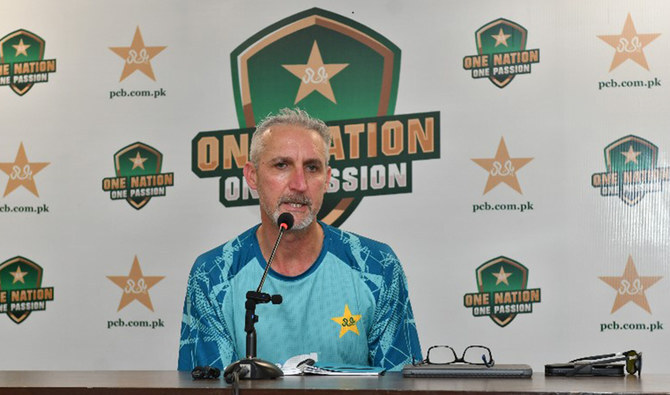
Pakistan men’s red-ball head coach Jason Gillespie’s speaks during a press conference in Karachi on July 7, 2024. (PCB/File)
Short Url
Updated 28 September 2024
Follow

Pakistan cricket team needs ‘ruthlessness’ to beat England— head coach

  • Pakistan will host England for three-match Test series from Oct. 7-28 after humiliating 2-0 loss to Bangladesh 
  • Jason Gillespie urges fans and critics to back Pakistan’s national stars despite string of humiliating losses

ISLAMABAD: Pakistan’s red-ball head coach Jason Gillespie said on Saturday that the national cricket squad required “a bit more ruthlessness” and can’t afford to be complacent when they take on England in the upcoming three-match Test series next month. 

Pakistan suffered a historic 2-0 whitewash at home against Bangladesh earlier this month, putting more pressure on skipper Shan Masood who has lost five matches on the trot as captain since January this year. 

The green shirts lost both matches against Bangladesh despite being in commanding positions at various points in the series. In the first Test, Pakistan lost after declaring their first innings at 448-6 while in the second match, the hosts had Bangladesh on the ropes at 26-6 before Liton Das hit a spectacular century to rescue his team. 

Speaking to the Pakistan Cricket Board (PCB), Gillespie noted that while Pakistan played impressive cricket with both bat and ball in the series, it allowed Bangladesh to “get into the game” and capitalize at key moments during the series. 

“So, what we need is a bit more ruthlessness,” he said. “When we’re ahead, we need to stay ahead and make sure we really drive home that advantage.”

The former Australian fast bowler said Pakistan needs to “minimize those poor periods and maximize the good ones.”

“It boils down to being disciplined, patient, and ready to strike when the opportunity presents itself,” Gillespie said. “When we see the gap, we need to go for it and capitalize on those key moments.”

As criticism over the recent string of poor performances by the Pakistan team mounts, Gillespie urged fans and critics both to back the national squad during its tough time. 

“These players are very, very talented cricketers,” he said. “We just need to give them the backing, love and support to show them that we’re right behind them. It’s an exciting time.”

England will play a three-match Test series against Pakistan from Oct. 7-28. 

England Men’s Test Squad:

Ben Stokes, Durham, Captain; Rehan Ahmed, Leicestershire; Gus Atkinson, Surrey; Shoaib Bashir, Somerset; Harry Brook, Yorkshire; Brydon Carse, Durham; Jordan Cox, Essex; Zak Crawley, Kent; Ben Duckett, Nottinghamshire; Josh Hull, Leicestershire; Jack Leach, Somerset; Ollie Pope, Surrey; Matthew Potts, Durham; Joe Root, Yorkshire; Jamie Smith, Surrey; Olly Stone, Nottinghamshire; Chris Woakes, Warwickshire

Pakistan Men’s Test Squad:

Shan Masood (captain), Saud Shakeel (vice-captain), Aamir Jamal, Abdullah Shafique, Abrar Ahmed, Babar Azam, Mir Hamza, Mohammad Huraira, Mohammad Rizwan (wicket-keeper), Naseem Shah, Noman Ali, Saim Ayub, Salman Ali Agha, Sarfaraz Ahmed (wicket-keeper), Shaheen Shah Afridi, Zahid Mahmood


Pakistan highlights Gwadar transshipment role as shipping routes face disruption over regional tensions

Updated 7 sec ago
Follow

Pakistan highlights Gwadar transshipment role as shipping routes face disruption over regional tensions

  • Pakistani ports possess “untapped potential” to attract global shipping lines for transshipment operations, says minister
  • Pakistan eyes leveraging Gwadar as regional transshipment hub as Iran’s closure of Strait of Hormuz disrupts global maritime trade

KARACHI: Pakistan’s Maritime Affairs Minister Junaid Anwar Chaudhry on Thursday highlighted the importance of the port city of Gwadar’s transshipment role as major shipping routes, including the Strait of Hormuz, face disruption due to Iran’s ongoing conflict with the US and Israel in the Gulf. 

The meeting takes place as Iran has effectively closed the Strait of Hormuz, a strategic waterway that lies between it and Oman. It is one of the world’s most critical oil transit routes, with roughly 20 percent of global oil supplies passing through it. Iran has vowed it will attack any ship that enters the strait, causing energy prices to rise sharply on Monday amid disruptions to tanker traffic in the waterway.

Gwadar is a deep-sea port in Pakistan’s southwestern Balochistan province that lies close to the Strait of Hormuz. Pakistani officials have in the past highlighted Gwadar’s geostrategic position as the shortest trade route to the Gulf and Central Asia, stressing that it has the potential to become a regional transshipment hub.

Chaudhry chaired a high-level meeting of government officials to assess emerging logistical challenges facing Pakistan’s trade, particularly in the energy sector, amid tensions in the Gulf. 

“Special focus was placed on fully leveraging the potential of Gwadar Port as a regional transshipment hub and positioning it as an alternative of regional instability,” Pakistan’s maritime affairs ministry said in a statement. 

The minister said Pakistani ports possessed “significant untapped potential” to attract international shipping lines for transshipment operations, noting that it could also ensure long-term sustainability and growth of the country’s maritime sector.

Participants of the meeting discussed measures to strengthen Pakistan’s position as a viable alternative transit and transshipment destination, as key waterways are affected by the disruption. 

The committee also reviewed proposals to amend relevant rules and regulations to facilitate international transshipment operations through on-dock and off-dock terminals.

The chairmen of the Port Qasim Authority, Karachi Port Trust and Gwadar Port Authority attended the meeting, briefing committee members on the current operational readiness of their ports. They spoke about the available capacity for container transshipment, bulk cargo handling and refueling services at Pakistani ports. 

The port in Gwadar is a central part of the China-Pakistan Economic Corridor (CPEC), under which Beijing has funneled tens of billions of dollars into massive transport, energy and infrastructure projects in Pakistan.

Pakistan has long eyed the deep-sea port as a key asset that can help boost its trade with Central Asian states, the Gulf region and ensure the country earns valuable foreign exchange.