Saudi Arabia, allies seek to push forward two-state solution to Israeli-Palestinian conflict

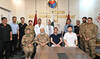
Saudi Arabia's Foreign Minister Prince Faisal bin Farhan Al Saud listens during a meeting with Foreign Ministers of the Gulf Cooperation Council on the sidelines of the 79th Session of the United Nations General Assembly in New York on September 25, 2024.(AFP)
Short Url
Updated 27 September 2024
Follow

Saudi Arabia, allies seek to push forward two-state solution to Israeli-Palestinian conflict

  • FM said the Kingdom and allies would organize meetings at the senior working level in Riyadh, Brussels, Cairo, Oslo, Amman, and Ankara

RIYADH: Saudi Arabia and its partners had convened a global alliance to push forward a two-state solution agenda to the Israeli-Palestinian conflict, Saudi Foreign Minister Prince Faisal bin Farhan said on Thursday.

The agenda is based on the conviction that a permanent settlement can only come via the establishment of a Palestinian state, the top Saudi diplomat said.

“What we are trying to do is build a coalition aimed at implementing the two-state solution and that needs certain building blocks, including capacity building within the Palestinian authority,” Prince Farhan said.

He said the Kingdom and allies would organize meetings at the senior working level in Riyadh, Brussels, Cairo, Oslo, Amman, and Ankara as part of the plan.

“I fail to understand how the continuation of war can be the only option,” he said. “There must be other options, and therefore I will reiterate our call for a ceasefire and for diplomacy to prevail.”

The decades-long conflict has come to a boiling point after Hamas militants stormed across the Gaza border and attacked Israeli settlements on Oct. 7, killing nearly 1,200 people.

Israeli retaliatory action has laid waste to much of Gaza and killed over 41,000 in the enclave.

The conflict now has spread more widely to Lebanon. Israel has been attacking the southern part of the country where the Iran-backed Hezbollah group is strongest.

World powers fear that the conflict could escalate further, especially if Iran gets involved.

A call to halt hostilities between Israel and Hezbollah by the US and France and their allies has been rejected by Israeli Prime Minister Benjamin Netanyahu on Thursday.

Asked about the Israeli premier's response, the Saudi diplomat said: “I wish I could tell you. I was surprised.”

Prince Faisal said the ceasefire proposal had been worded carefully to take into account the interests of both Lebanon and Israel.

There has been ongoing efforts to bring about an end to hostilities in the region, but all have failed except a brief pause in November when a number of hostages were exchanged between the Israelis and Palestinians.

“We have seen since the start of the war a pattern, every time we are told we are close to a ceasefire in Gaza, it does not happen,” Prince Faisal said.

“Similarly, when we were with our partners working together on a very concrete call for a ceasefire in regard to Lebanon, our impression was that was acceptable, only to learn now that, no, it is not acceptable.”

He said that the group was attempting to set the groundwork for the solution. As for Saudi Arabia, the focus was on establishing the Palestinian state.


Iranian ambassador thanks Saudi for not allowing territory to be used during war

Updated 43 min 55 sec ago
Follow

Iranian ambassador thanks Saudi for not allowing territory to be used during war

  • Alireza Enayati tells AFP Iran appreciates Kingdom's pledge not to allow its 'airspace, waters, or territory' to be used in US attacks
  • Envoy also denies that his country hit the US embassy in Riyadh this week with drones

RIYADH: Iran’s ambassador to Saudi Arabia Alireza Enayati said on Thursday his country remained appreciative of Saudi Arabia’s pledge to not allow its airspace or territory to be used during the ongoing war with the US and Israel.
“We appreciate what we have repeatedly heard from Saudi Arabia — that it does not allow its airspace, waters, or territory to be used against the Islamic Republic of Iran,” he told AFP.
Before the outbreak of war, Riyadh had thrown its support behind diplomatic efforts to diffuse tensions between Tehran and Washington and vowed that its airspace would not be allowed to be used for attacks against Iran.
Enayati also categorically denied that his country hit the US embassy in Riyadh this week, after Saudi officials said Iran targeted the compound with drones.
Saudi Arabia has repeatedly accused Tehran of launching missile salvos and drone attacks at its territory and warned that the kingdom reserved the right to defend itself, including by retaliating.
Iran had earlier denied attacking the sprawling Ras Tanura refinery — one of the largest in the Middle East — which Riyadh had also accused Tehran of targeting twice with drones.
Enayati added to the denial, saying Iran also had no hand in the targeting of the US embassy that triggered a fire at the compound.
“We confirmed that Iran has no role in the attack on the US embassy in Riyadh,” the ambassador told AFP.
“If the operations command in Tehran attacks somewhere, it takes responsibility for it.”
The war in the Middle East has engulfed the otherwise stable Gulf region as Iran retaliates over US and Israeli strikes that killed its supreme leader, launching strikes at Israel, the wider region and beyond.
At least 13 people have been killed in the Gulf, including seven civilians, since Iran began its attacks on Saturday.
Enayati, however, denied that Iran was waging a regional war as retaliation for the attacks on his country by the US and Israel.
“This is not a regional war and it is not our war. It was imposed on the region,” he told AFP.