ALGIERS: Algeria said Thursday it was imposing visa requirements on Moroccans, accusing its passport holders of criminal activity, including “Zionist espionage,” in a new downturn in fraught relations with its neighbor.
A statement carried by Algeria’s official APS news agency charged that Morocco had “engaged in various actions that threaten Algeria’s stability.”
It accused Morocco of having “deployed Zionist espionage agents holding Moroccan passports to freely enter the national territory.”
It also said Morocco had been conducting “multiple networks of organized crime, drug and human trafficking, not to mention smuggling and illegal immigration” within its borders.
Earlier this month, authorities in the Algerian city of Tlemcen said they had arrested seven people, including four Moroccans, accused of belonging to a spy ring.
Algiers broke diplomatic ties with Rabat in August 2021, citing “hostile acts” by its neighbor, months after the kingdom normalized relations with Israel.
In 2020, then US president Donald Trump recognized Morocco’s annexation of the disputed Western Sahara in return for Rabat normalizing relations with Israel.
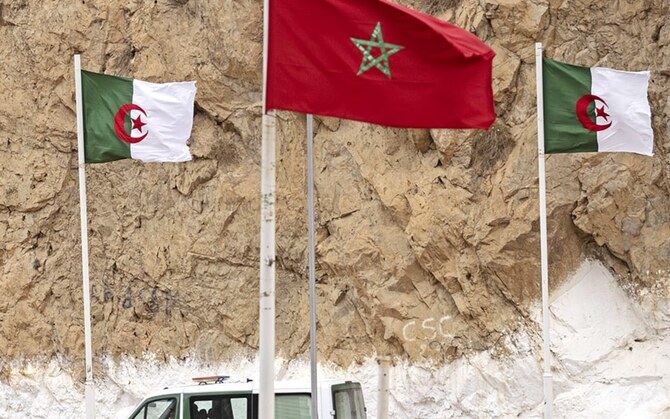
The border between Algeria and Morocco has been closed for 30 years.
But travelers from Morocco did not need a visa to enter Algerian territory — despite the lack of direct flights — and neither do Algerians to enter Morocco.
There was no immediate response from Rabat to Thursday’s move by Algiers.
Algeria said it was “committed to preserving ties” with the “brotherly” Moroccan people, and blamed the Rabat authorities for recent diplomatic rifts.
“The Moroccan regime alone bears responsibility for the current deterioration of bilateral relations due to its hostile and aggressive actions against Algeria,” it said.
The two countries remain at odds over the Western Sahara and alleged Moroccan support for the Berber separatist movement MAK in Algeria.
The Polisario Front, which is backed by Algiers, has campaigned for the independence of Western Sahara since its colonial ruler Spain pulled out in 1975 but the territory is largely controlled by Morocco.
The United Nations, which has had a peacekeeping mission in Western Sahara since 1991, regards it as a “non-self-governing territory.”
After French President Emmanuel Macron said in July that “the only solution” was a Moroccan plan to grant the territory autonomy within the kingdom without the option of independence, Algeria recalled its ambassador.
Algiers also accuses Rabat of backing the MAK movement, which seeks independence for the Berber Kabylie region east of the capital.
Morocco described the 2021 decision to break off diplomatic relations as “completely unjustified.”

Algeria slaps visa requirements on Moroccans, citing ‘Zionist espionage’
https://arab.news/5695j
Algeria slaps visa requirements on Moroccans, citing ‘Zionist espionage’
- A statement carried by Algeria’s official APS news agency charged that Morocco had “engaged in various actions that threaten Algeria’s stability“
- Algiers broke diplomatic ties with Rabat in August 2021, citing “hostile acts” by its neighbor
Inaction over UAE’s role is prolonging ‘worst proxy war in the world,’ Sudan justice minister says
- Had international community characterized it as ‘military rebellion’ and countered Emirati sponsorship of ‘terrorist militia’ it would not have endured, he tells UN Human Rights Council
- He accuses paramilitary Rapid Support forces of ‘targeting basic infrastructure, strategic facilities and public services,’ and ‘atrocities beyond our capacity to describe’
NEW YORK CITY: Sudan’s justice minister on Wednesday blamed the prolongation of the near-three-year conflict in his country on what he described as the failure of the international community to properly label the war as a rebellion.
He also accused the UAE of sponsoring and arming a militia, the Rapid Support Forces, he said was responsible for widespread abuses.
“The war has outstayed its welcome and it should not have gone on for this long had the international community, and particularly the UN and its bodies, fulfilled their responsibility in rightly characterizing this military rebellion,” said Abdullah Mohammed Dirif, “and had they called a spade a spade and countered the Abu Dhabi government, which sponsored this terrorist militia and provided it with high-tech arms and provided it with mercenaries.”
Speaking during the high-level segment of the 61st session of the UN Human Rights Council in Geneva, he warned that “the misleading characterization of this war has given a green light for the militia to keep its flagrant violations.”
The minister, who said he was speaking “on behalf of the government of Sudan and its people,” described the conflict between the Sudanese Armed Forces and the RSF, which began in April 2023, as “one of the worst proxy wars in the world,” which had “targeted the very existence of Sudan and its people.”
The RSF has “continued its methodic targeting of basic infrastructure and strategic facilities and all public services,” Dirif said, adding that “the aim is to displace civilians against whom it has committed atrocities beyond our capacity to describe them.
“The violations and crimes of the militia are going unabated. Yesterday it invaded Moustahiliya region in northern Darfur. It targeted civilians, killed them. It looted. It scorched villages and cities.”
Sudan’s military was “conducting its constitutional responsibility by standing up to the militia, protecting the civilians, preserving the unity of the country and the rule of law,” he said, and it remains “committed to international humanitarian law and the rules governing military engagement, and taking into account proportionality principles in order to protect civilians.”
Khartoum remains “open to genuine efforts which aim to end the war and the rebellion” based on a road map presented by the president of the Transitional Sovereignty Council, and a peace initiative submitted by the prime minister to the UN Security Council on Dec. 22, he added.
Dirif stressed his government’s commitment to continued “cooperation and coordination with human rights mechanisms in Sudan,” including the presence of the UN’s Office of the High Commissioner for Human Rights in the country and the UN special rapporteur on the human rights situation in Sudan.
“We recall, nationally, that achieving justice and redress to victims and ensuring impunity is a top priority for us,” he said, adding that authorities had made progress by investigating violations of national laws and international humanitarian laws.
He also underscored Sudan’s “commitment to continue facilitating and expediting delivery of humanitarian assistance to those affected by the war, including those under the control of the rebellious militia.”
Later, Sudan’s representative to the UN in Geneva exercised his right of reply and responded to prior remarks by the representative from the UAE.
“This is not a mere accusation, it is a well-known fact that is predicated on a number of evidence and documented proofs,” he said, referring to the UAE’s sponsorship of the RSF.
He cited in particular a report by a UN panel of experts on Sudan published on Jan. 15, 2024, which he described as “an official document of the Security Council” that referred to “lines of transferring weapons from Abu Dhabi International Airport” based on “clear-cut evidence.”
Other major international organizations and Sudan’s national commission of inquiry have provided further proof, he added, and Khartoum had submitted “a number of complaints, with proof, to the Security Council of the proven sabotage by the Abu Dhabi authority.”
The Sudanese representative continued: “It is paradoxical that the same authority that is sponsoring criminal militia, that the whole world is seeing and is attesting to its crimes, is now talking about peace in the Sudan. Peace is a noble value, that you have to be full of peace before you talk about it.
“The people of Sudan are only requesting this country stop sponsoring this criminal militia that is killing the innocent people in my country on a daily basis.”
The UAE has denied accusations that it provides military support to armed groups in Sudan, and says it supports efforts to achieve a peaceful resolution to the conflict.