

Canada PM Trudeau survives vote of no confidence

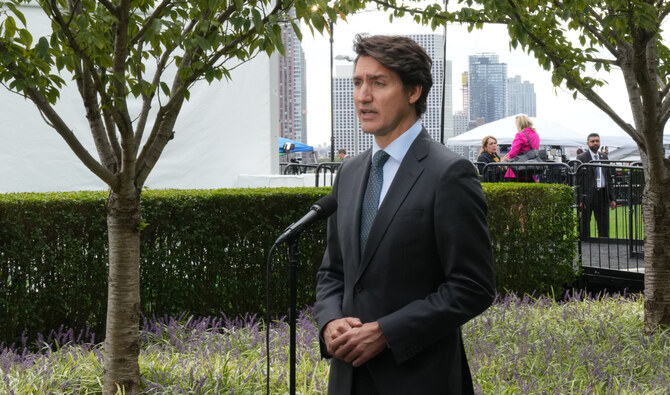
Canadian Prime Minister Justin Trudeau speaks to the press outside UN Headquarters during the 79th Session of the United Nations General Assembly in New York City on September 24, 2024. (AFP)
Short Url
Updated 26 September 2024
Follow

Canada PM Trudeau survives vote of no confidence

OTTAWA: Canadian Prime Minister Justin Trudeau on Wednesday survived a vote of no confidence in the first major test of his minority Liberal government whose popularity has waned after nine years in office.

His tenuous grip on power, however, is already set to face more challenges in the coming days and weeks, with the main opposition Conservatives vowing to try again to topple the government as early as Tuesday.

Following a heated debate that saw members of Parliament trade insults and slam their fists on desks, they voted 211 to 120 against the Conservative motion to unseat the Liberals and force snap elections.

Far ahead in public opinion polls, Tory leader Pierre Poilievre has been itching for a snap election since the leftist New Democratic Party (NDP) earlier this month tore up a coalition agreement with the Liberals, leaving the Trudeau administration vulnerable to being toppled.

A combative Poilievre has railed against Trudeau for what he said was a failure to address soaring costs of living, a housing crisis and crime, while doubling the national debt.

The promise of Canada, “after nine years of Liberal government, is broken,” he said during a Commons debate on Tuesday.

But other opposition parties, whose support is needed to topple the Liberals, have pushed back against his rightwing agenda.

Liberal House leader Karina Gould accused the Tories of “playing games.”

“I think it’s pretty lame that they’re going to put forward another non-confidence vote tomorrow,” she said.

Immediately following the no confidence vote, the NDP again sided with the Liberals to pass legislation on capital gains taxes, averting another political crisis.

Poilievre has vowed to keep trying, with the next opportunity to bring down the government to be presented next week. If that fails, he will have a few more chances before the end of the year.

The separatist Bloc Quebecois has also demanded concessions from the ruling Liberals for its continued support in Parliament beyond the end of October.

Trudeau swept to power in 2015, and has managed to hold on by defeating two of Poilievre’s predecessors in 2019 and 2021 ballots.

The deal with the New Democratic Party to prop up the Liberals would have kept his government in office until late 2025.

But the NDP, seeing its alignment with the Liberals hurting its own popularity, exited the deal early.

According to a recent Angus Reid poll, the Conservatives are well ahead of the Liberals, with 43 percent of voting intention against 21 percent for the ruling party. The NDP is at 19 percent.

Going forward, NDP leader Jagmeet Singh said his party would evaluate each bill in Parliament before deciding how to vote.

With legislation pending on NDP priorities including a national dental plan, political analysts who spoke to AFP suggested an election won’t likely be triggered until at least spring 2025.

However, University of Ottawa professor Genevieve Tellier told AFP: “Anything is possible. It could come before Christmas.”

In the meantime, a weakened Trudeau administration under constant threat “will find it more difficult to govern,” she said.

Bloc leader Yves-Francois Blanchette said Wednesday he would seek to keep the government afloat until the end of October.

But if there has been no movement on its legislative priorities by then, he said the Bloc would turn against the Liberals.

In Canada’s Westminster parliamentary system, a ruling party must hold the confidence of the House of Commons, which means maintaining support from a majority of members.

The Liberals currently have 153 seats, versus 119 for the Conservatives, 33 for the Bloc Quebecois, and the NDP 25.


Cambodia says Thailand bombs casino hub on border

Updated 7 sec ago
Follow

Cambodia says Thailand bombs casino hub on border

PHNOM PENH: Cambodia said Thailand’s military on Thursday bombed the casino town of Poipet, a major crossing between the two nations, as foreign powers pressured them to halt reignited border clashes.
Thai forces “dropped two bombs in the area of Poipet Municipality, Banteay Meanchey Province” at around 11:00 am (0400 GMT) Thursday, the Cambodian defense ministry said in a statement.
Thailand has not yet confirmed any strike on Poipet — a bustling casino hub popular with Thai gamblers.
The renewed fighting between the Southeast Asian neighbors this month has killed at least 21 people in Thailand and 17 in Cambodia, while displacing around 800,000, officials said.
The conflict stems from a territorial dispute over the colonial-era demarcation of their 800-kilometer (500-mile) border and a smattering of ancient temple ruins situated on the frontier.
Each side has blamed the other for instigating the fresh fighting and traded accusations of attacks on civilians.
Thailand said Tuesday that between 5,000 and 6,000 Thai nationals remained stranded in Poipet after Cambodia closed its land border crossings with its neighbor.
Cambodia’s interior ministry said the border closures were a “necessary measure” to reduce risks to civilians amid the ongoing combat, adding that air travel remained an option for those seeking to leave.
At least four casinos in Cambodia have been damaged by Thai strikes, the interior ministry said this week.
- ‘Shuttle-diplomacy’ -
Five days of fighting between Cambodia and Thailand in July killed dozens of people before a truce was brokered by the United States, China and Malaysia, and then broken within months.
US President Donald Trump, who has repeatedly intervened in the long-standing conflict this year, claimed last week that the two countries had agreed to a new ceasefire.
But Bangkok denied any truce had been agreed, and fighting with artillery, tanks, drones and jets has continued daily since a border skirmish earlier this month sparked the latest round of conflict.
China said it was sending its special envoy for Asian affairs to Cambodia and Thailand on Thursday for a “shuttle-diplomacy trip” to help bridge the gaps and “rebuild peace.”
“Through its own way, China has been working actively for deescalation,” Beijing’s foreign ministry said in a statement late Wednesday.
Foreign ministers from ASEAN regional bloc nations are due to meet on Monday in Malaysia for emergency talks aimed at finding a diplomatic solution.
“Our duty is to present the facts but more important is to press upon them that it is imperative for them to secure peace,” Malaysian Prime Minister Anwar Ibrahim told journalists late Wednesday.
“We are appealing to them to immediately stop this frontline offensive and if possible, an immediate ceasefire,” Anwar said at his official residence in Putrajaya, adding that he was “cautiously optimistic” about the talks.
European Commission vice president Kaja Kallas said in a statement that she had spoken with the foreign ministers of Cambodia and Thailand on Wednesday, offering the European Union’s support for ceasefire monitoring with satellite imagery.
“The conflict between Thailand and Cambodia must not be allowed to spiral further. That’s why the ceasefire needs to be immediately restored,” Kallas said.