

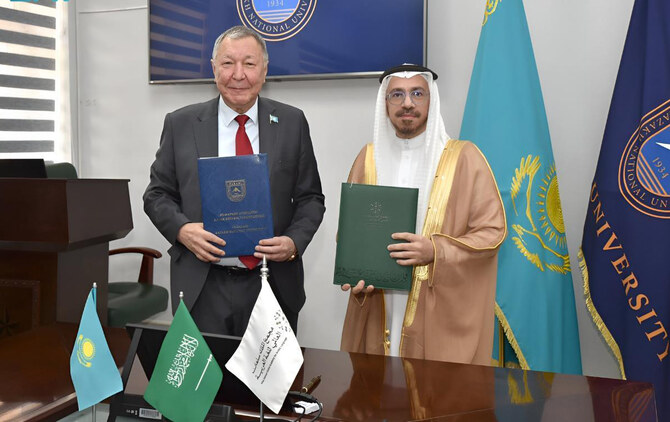
Saudi Arabia, Kazakhstan to expand Arabic language teaching

As a global reference for Arabic language advancement, the academy leverages its expertise in teaching Arabic to non-native speakers. (SPA)
Short Url
Updated 25 September 2024
Follow

Saudi Arabia, Kazakhstan to expand Arabic language teaching

RIYADH: The King Salman Global Academy for Arabic Language signed a memorandum of understanding with Al-Farabi Kazakh National University in Almaty, Kazakhstan, to promote Arabic.

The MoU aims to teach the Arabic language across various fields, preserve its integrity, and support its use in line with the Human Capability Development Program, part of Vision 2030, the Saudi Press Agency reported on Wednesday.

The agreement follows the Saudi Cabinet’s July 23 decision to authorize Prince Badr bin Abdullah bin Farhan, minister of culture and the academy’s chairman, to negotiate with the Kazakh side on the MoU.

The signing took place during the academy delegation’s visit to Kazakhstan, which included visits to universities and institutions to assess the status of the Arabic language and explore collaboration opportunities.

As a global reference for Arabic language advancement, the academy leverages its expertise in teaching Arabic to non-native speakers.

The MoU covers areas such as the Arabic Language Proficiency Test for non-native speakers, developing educational materials, conducting research, creating digital dictionaries, and establishing Arabic-Kazakh linguistic corpora. It also includes sharing language services and consultations in areas of mutual interest.


Saudi inventor wins two gold medals at Mideast International Invention Fair

Updated 14 sec ago
Follow

Saudi inventor wins two gold medals at Mideast International Invention Fair

  • Khudry was recognized for inventing a device designed to filter materials and recycle used liquids
  • The innovation aims to improve efficiency in liquid purification and reuse

RIYADH: Saudi inventor Duaa Nizar Khudry won two gold medals at the 16th International Invention Fair in the Middle East (IIFME), held in Kuwait from February 8 to 11, the Saudi Press Agency (SPA) reported.

Khudry was recognized for inventing a device designed to filter materials and recycle used liquids, an innovation aimed at improving efficiency in liquid purification and reuse. The technology has potential applications in environmental protection, industrial processing, and water conservation, particularly in regions where sustainable resource management is critical.

A member of the Mawhiba Alumni Program, Khudry represented Saudi Arabia with the support and nomination of the King Abdulaziz and His Companions Foundation for Giftedness and Creativity (Mawhiba), which was participating in the fair for the third time.

She received her first gold medal from the fair’s organizers and was also awarded the IFIA Best Invention Award by the International Federation of Inventors’ Associations, recognizing her innovation as one of the most outstanding entries in the exhibition.

The IIFME, organized annually by the Kuwait Science Club since its launch in 2007, is regarded as one of the region’s largest specialized invention exhibitions and a major platform for inventors to present their work to international audiences.

As a student, Khudry won first place nationwide at the National Olympiad for Scientific Creativity (Ibdaa) in 2013 for the same recycling device, competing against tens of thousands of students across the Kingdom. She later obtained an official patent for the invention in 2024, strengthening its scientific and commercial potential. 

She studied chemistry and is currently pursuing graduate studies in materials science and engineering under the Custodian of the Two Holy Mosques Scholarship Program. Her research focuses on environmental sustainability, advanced materials, and liquid purification technologies.