

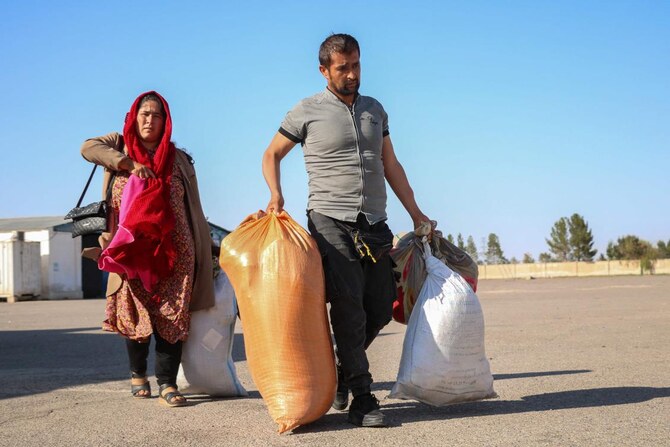

ISLAM QALA: At the border with Iran, streams of Afghan refugees return with children in their arms, their entire worldly possessions contained in a large bag.
Every day up to 3,000 Afghans — some who were born in Iran — arrive back in their home country after a failed attempt at a better life.
“Refugees face a lot of physical and mental torture,” Abdul Ghani Qazizada, responsible for registering the arrivals in the border town of Islam Qala, told AFP.
Many entered Iran illegally or let their visas expire. Nearly 90 percent have been deported, with the rest returning voluntarily.
The rate of expulsions has increased “in the last six months,” said Qazizada.
“They are warned there (in Iran) that they must leave within one week, or anyone above 18 must deposit 100 million toman ($2,375) in the bank,” he said.
“These are the people who return to Afghanistan voluntarily because of this problem.”
These refugees in counterfeit Fendi or Dior T-shirts are registered by the Afghan authorities and examined by the International Organization for Migration (IOM).
To rebuild their lives, they are given 2,000 Afghanis ($29) per person if they arrive with their family, but nothing if they are alone.
Ramazan Azizi, 36, waits, haggard, on a blue plastic chair to be registered with his wife and three children.
They entered Iran illegally in 2023, after paying $1,220 to a trafficker but have faced growing hostility toward Afghans, accused of increasing unemployment and prices but also crime in a country under international sanctions.
“The owners had to pay a fine because they rented their home to us. They threw our things out of the windows,” Azizi, a construction worker, told AFP.
“They (authorities) told us to pack up and we did, we were taken to a military camp to be deported.”
He said the family were crammed in with 2,000 to 3,000 other Afghans for six days.
“We were exhausted... without food or water,” he said, his little girl wearing a pink T-shirt with rabbits on it sat by his side.
Tears flow from Fazila Qaderi, 26, as she recounts the ordeal she and her husband endured in the Karaj camp near the capital Tehran.
The guards “beat us a lot for six or seven days with metal batons,” making no distinction between men or women.
“I saw an Afghan die, and they shouted at him ‘son of a bitch, go home!’,” she said, adding that her husband suffered broken bones.
“Yesterday I told (the guards): ‘kill me or send us back to Afghanistan’.”
They arrived in Iran four years ago, having paid a smuggler, as farm workers in the central-northern province of Qazvin.
Their new life had started well, until she was hospitalized for 12 days for a severe allergy and needed an operation.
“We gave $1,200 to the doctor for the surgery and they said they would do it the next day. When we went back, the security officials took us,” she explained.
“We had a three-room apartment full of belongings, we couldn’t take a single thing with us,” she continues. “We had paid 50 million toman to the owner in advance, we couldn’t take that back either,” nor the advance to the doctor.
Now they have no money to pay for the trip back to their home province of Takhar in northeastern Afghanistan.
Day laborer Abdul Basir, 29, said he was arrested at work and expelled from Iran, despite having a valid passport and visa.
“With a passport I ended up in the military camp (in Karaj) for 10 days,” he said. “What government can do that?“
With his hands and feet tied, he was taken away in a bus with 70 to 80 people standing, and once at the camp he was beaten to the point he couldn’t move.
He describes “broken hands and feet, people fainting, maybe even dead” and thirst and hunger.
“There were elderly Afghans, women and children,” he says, adding that people were taken away and not seen again.
He also claimed that security personnel tore up Afghan passports or valid Iranian residence permits.
He was deported back to Afghanistan without his Afghan passport, which he paid $340 for so he could flee unemployment in Herat province.
“Now, I don’t have any money to pay for the bus to go home,” he said.
The Afghan official at the border, Qazizada, said around 70 percent of the refugees were sent back without Iranian documents.
Afghan Foreign Minister Amir Khan Muttaqi asked Tehran on Thursday to “cooperate patiently with Afghan refugees, who have also contributed to the development of Iran.”
In his first press conference earlier in the week, Iranian President Masoud Pezeshkian said Tehran was repatriating illegal nationals to their country “in a respectful manner.”
Iran has been a host country for 4.5 million Afghans fleeing decades of war and unemployment.
Iran’s spokesman for the parliamentary National Security Committee, Ebrahim Rezaei, earlier this month said police plan to “expel more than two million illegal citizens in the near future.”
Afghans represent more than 90 percent of foreign nationals and most enter without identity papers, according to the official IRNA news agency.
More than 700,000 undocumented Afghans have also left neighboring Pakistan following a crackdown which started in September last year.
In Iranian bakeries, signs prohibit the sale of bread to non-Iranians “under penalty of prosecution,” according to photos on social networks.
Fazila Qaderi confirms that she has not been able to buy bread for two months: “For them, an Afghan is worth less than a dog.”


