

Egypt condemns Israeli military escalation in Lebanon

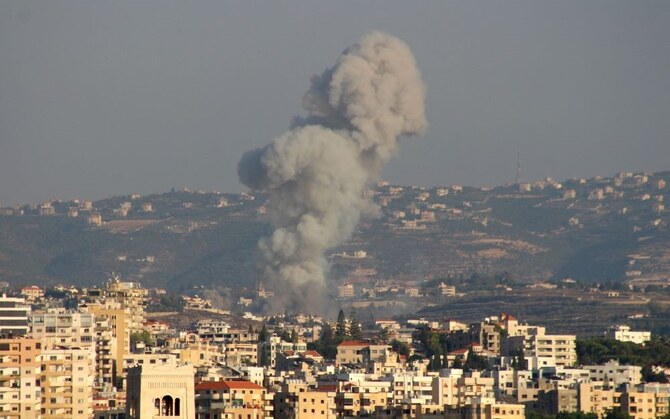
Smoke billows after an Israeli airstrike that targeted the southern Lebanese village of Abbasiyeh on September 24, 2024. (AFP)
Short Url
Updated 24 September 2024
Follow

Egypt condemns Israeli military escalation in Lebanon

  • Egyptian Foreign Ministry expressed ‘sincere solidarity’ with the Lebanese people, offered its sympathies to the families of victims
  • Arab League chief echoes concerns and says international community must halt ‘this perilous slide toward a regional war’

CAIRO: Egypt on Tuesday condemned the escalation of Israeli military operations in Lebanon and the killing and wounding of hundreds of Lebanese citizens, including women and children.

The Egyptian Foreign Ministry expressed “sincere solidarity” with the Lebanese people, offered its sympathies to the families of victims, wished the injured a speedy recovery, and affirmed its “categorical rejection of any violations of the sovereignty of Lebanon and its territories.”

It previously warned of the “gravity of the continued Israeli aggression against the Gaza Strip and the danger of its expansion, which puts the region at risk of sliding into a full-fledged regional war.”

The ministry said that while “Egypt continues its efforts toward achieving a ceasefire in Gaza and containing the dangers resulting from the war there, it calls on world powers and the UN Security Council to immediately intervene to halt the Israeli escalation in the region, which jeopardizes the fate of its peoples and undermines prospects for peace.”

Egypt “calls for a peaceful settlement of the crisis, an immediate deescalation and the start of the implementation of Security Council Resolution 1701, with no selectivity and allowing for diplomatic solutions, especially since military escalation will only exacerbate the crisis,” it added.

Resolution 1701 was adopted in 2006 with the aim of resolving the war that year between Israel and Hezbollah.

Meanwhile, the Arab League’s secretary-general, Ahmed Aboul Gheit, also “vehemently condemned the extensive Israeli raids and military operations against Lebanon, which have resulted in a significant loss of life and thousands of injuries.”

He warned that this “alarming escalation constitutes a flagrant violation of Lebanese sovereignty and poses a grave threat to regional stability, with the potential to ignite a broader conflict that would have devastating consequences for all involved,” said Gamal Roshdy, a spokesperson for the organization.

Aboul Gheit called on the international community to act with urgency and shoulder its responsibilities in efforts to halt this “perilous slide toward a regional war, driven by the Israeli leadership's personal and political ambitions.”

In particular, he urged the UN Security Council to fulfill its duty to safeguard international peace and security by taking immediate action.

He said the current escalation must be halted without delay, warned that the devastation seen in Gaza must not be repeated in Lebanon, and reaffirmed the Arab League’s “unwavering solidarity with Lebanon in the face of these egregious Israeli assaults.”


Trump claims Iran working on missiles that could hit US

Updated 42 min 42 sec ago
Follow

Trump claims Iran working on missiles that could hit US

  • Trump says his preference is diplomacy, but would never allow Tehran to have a nuclear weapon

WASHINGTON: US President Donald Trump on Tuesday claimed Iran is seeking to develop missiles that can strike the United States and accused Tehran of working to rebuild a nuclear program that was targeted by American strikes last year.

The United States and Iran are engaged in high-stakes negotiations over Iran’s atomic program and other issues including missiles, with Trump saying he prefers diplomacy but is willing to use force if talks fail.

“They’ve already developed missiles that can threaten Europe and our bases overseas, and they’re working to build missiles that will soon reach the United States of America,” Trump said during his State of the Union address.

In 2025, the US Defense Intelligence Agency said Iran could potentially develop a militarily viable intercontinental ballistic missile by 2035 “should Tehran decide to pursue the capability,” but did not say if it had made such a decision.

Tehran currently possesses short- and medium-range ballistic missiles with ranges that top out at about 1,850 miles (3,000 kilometers), according to the US Congressional Research Service.

The continental United States is more than 6,000 miles from Iran’s western tip.

Washington and Tehran have concluded two rounds of talks aimed at reaching a deal on Iran’s nuclear program to replace the agreement that Trump tore up during his first term in office.

 ‘Preference’ is diplomacy

The United States has repeatedly called for zero uranium enrichment by Iran but has also sought to address its ballistic missile program and support for armed groups in the region — demands Iran has rejected.

Iran has also repeatedly rejected that it is pursuing nuclear weapons.

Trump ordered strikes on three Iranian nuclear sites last year, claiming afterward that Tehran’s atomic program was obliterated.

On Tuesday, he said Iran wants “to start all over again,” and that it is “at this moment again pursuing their sinister nuclear ambitions.”

Trump has sent a massive US military force to the Middle East, deploying two aircraft carriers as well as more than a dozen other ships, a large number of warplanes and other assets to the region.

He has repeatedly threatened to strike Iran if negotiations fail to reach a new agreement. Talks with Tehran are currently set to continue on Thursday.

“My preference is to solve this problem through diplomacy but one thing is certain: I will never allow the world’s number one sponsor of terror, which they are by far, to have a nuclear weapon,” Trump said.

The US president’s speech primarily focused on domestic issues, making no mention at all of China — Washington’s primary military and economic rival — and only briefly referring to Russia.

Trump said he was working to end the bloody conflict between Russia and Ukraine, and repeated his inaccurate claim that he had brought eight other wars to an end since returning to office in January 2025.

He also hailed NATO’s decision to spend five percent of gross domestic product on defense — a move made under heavy pressure from Trump and his administration.