

Pakistan’s finance minister optimistic about $7 billion IMF bailout approval today

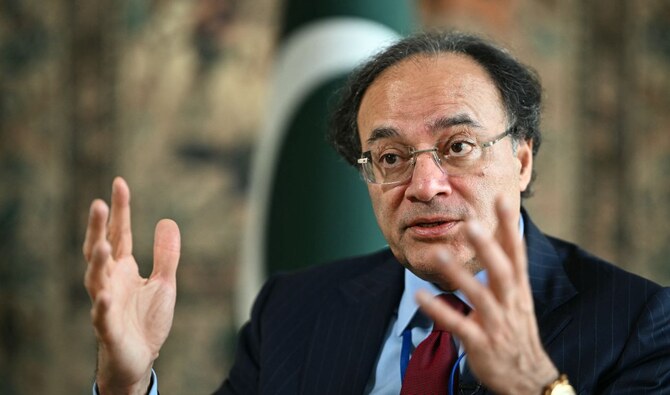
Pakistan's Finance Minister Muhammad Aurangzeb speaks during an interview with AFP at the Embassy of Pakistan in Washington, DC on April 15, 2024. (AFP/File)
Short Url
Updated 24 September 2024
Follow

Pakistan’s finance minister optimistic about $7 billion IMF bailout approval today

  • Muhammad Aurangzeb emphasizes the South Asian nation’s commitment to structural reforms
  • Pakistan has struggled with boom-bust cycles for decades and secured 22 IMF bailouts since 1958

ISLAMABAD: Federal Minister for Finance and Revenue Muhammad Aurangzeb on Tuesday expressed optimism about the approval of Pakistan’s $7 billion International Monetary Fund (IMF) program, when the board of the global lending agency meets on Wednesday.

The government reached a staff-level agreement with the IMF in July, though the approval for the 37-month program has been pending since.

Pakistan’s last $3 billion IMF program helped avert a sovereign default in 2023 amid a sharp decline in foreign exchange reserves, currency depreciation and record inflation.

“We have the IMF board meeting tomorrow in the US,” the minister said, while addressing a high-level private sector dialogue, ‘CPEC-II and the Region.’ “We are very hopeful that the board will approve the 37-month, $7 billion program under which we are very committed to do structural reforms.”

Assuring that the country would stay its current economic course, Aurangzeb pointed out that macroeconomic stability was the “basic foundation” of any economy.

“You have to grow and build from a stable base,” he added. “We have reached that level now. Now, we can say that we have a good foundation on which we can build from here.”

“Now we need to move forward and stay with the reform agenda whether it’s on the taxation or energy side [or] on the state-owned enterprises or privatization side.”

The finance minister said it was important that the KIBOR, or Karachi Interbank Offered Rate, used as a benchmark interest rate in Pakistan, was also coming down, which positively affects the industry. He added that the government was in “no desperation” to borrow money.

“If we want to borrow domestically, we will at our terms,” he said.

Aurangzeb said it was about time the banking sector started lending to the private sector.

Pakistan has struggled with boom-and-bust cycles for decades, leading to 22 IMF bailouts since 1958.

The latest economic crisis has been the most prolonged one, with the highest levels of inflation, pushing the country to the brink of a sovereign default last summer before the IMF loan.

The conditions of the IMF programs have become tougher in recent years, requiring the government to impose higher tariffs and remove subsidies. The latest bailout is aimed at cementing stability and inclusive growth in the crisis-plagued South Asian country, according to the IMF.

The latest IMF staff-level deal is subject to approval by its executive board and the confirmation of necessary financing assurances from Pakistan’s development and bilateral partners.


Pakistan air chief highlights modernization as PAF marks seven years since India aerial clash

Updated 4 sec ago
Follow

Pakistan air chief highlights modernization as PAF marks seven years since India aerial clash

  • Swift Retort was launched in 2019 after India attempted airstrikes following a Kashmir suicide bombing
  • Air chief’s remarks come amid fierce clashes between Pakistan and Afghanistan over cross-border militancy

ISLAMABAD: Pakistan’s air chief said on Friday the country’s air force had undertaken “comprehensive modernization and indigenization” in recent years, as he addressed a ceremony at Air Headquarters to mark seven years since an aerial confrontation with India.

Operation Swift Retort was launched on Feb. 27, 2019, a day after India attempted airstrikes inside Pakistan following a suicide bombing in Indian-administered Kashmir that killed at least 40 Indian paramilitary troops.

Pakistan responded with aerial strikes across the Line of Control and shot down an Indian fighter jet in a subsequent dogfight, capturing one pilot who was later returned in what Islamabad called a gesture of de-escalation.

“PAF has pursued comprehensive modernization and indigenization to transition into a Next Generation Air Force,” Air Chief Marshal Zaheer Ahmed Baber Sidhu said, according to a statement circulated by the military’s media wing, the Inter-Services Public Relations.

He added that the force had recalibrated its operational doctrine and rapidly inducted advanced combat and support capabilities, including indigenously developed unmanned systems, electronic warfare, space and cyber assets, establishing what he described as a “home-grown multi-domain kill chain.”

Sidhu said Pakistan remained committed to peace but would respond decisively to violations of its sovereignty.

“Pakistan is a responsible country which desires peace with honor,” he continued.

The remarks come amid renewed security tensions on Pakistan’s western frontier.

Islamabad earlier this week launched airstrikes inside Afghanistan targeting what it described as hideouts of Tehreek-e-Taliban Pakistan (TTP) and Daesh militants. Afghan authorities condemned the strikes and subsequently launched their own military response that led to fierce clashes between the two sides overnight.

Pakistan has frequently accused Kabul of allowing militant groups to use Afghan territory to carry out cross-border attacks on Pakistani civilians and security forces, an allegation denied by Afghan officials.

Pakistani authorities said earlier in the day small drones launched from the Afghan side were intercepted and brought down by the country’s air defense systems.

Sidhu said the PAF would continue to maintain a vigilant yet responsible defense posture to safeguard national sovereignty.