

Reform of UN can ‘give Africa a voice,’ Mauritanian president says

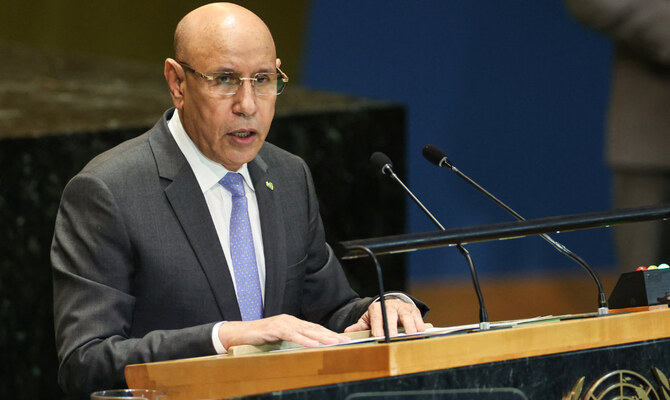
Mohamed Ould Ghazouani, President of Mauritania addresses the "Summit of the Future" in the General Assembly Hall of the United Nations Headquarters in New York City, US, September 23, 2024. (Reuters)
Short Url
Updated 24 September 2024
Follow

Reform of UN can ‘give Africa a voice,’ Mauritanian president says

  • Mohamed Ould Ghazouani highlights continent’s ‘tremendous efforts to achieve Agenda 2063’ plan for development and economic growth
  • But conflict, climate change and debt burdens are causing slowdown in development, he warns

NEW YORK CITY: Stagnating progress in efforts to achieve the UN’s Sustainable Development Goals is holding back African nations and the wider world, Mauritania’s president told the UN as he appealed for reforms of the international system to “give Africa a voice.”

Speaking on Monday at the organization’s headquarters in New York City, Mohamed Ould Ghazouani said that despite setbacks, the African Union and its member states have “made tremendous efforts to achieve Agenda 2063,” a blueprint for sustainable development and economic growth on the continent.

The day before his address, UN member states voted to adopt the “Pact of the Future,” an initiative designed to bring multilateralism “back from the brink” and revive progress toward achieving the SDGs.

“The crises faced by our world recently present a challenge to our common future,” said Ghazouani, who chairs the African Union.

“If we continue to (attempt to) achieve the SDGs following the same track, using the same mechanisms, following the same pace, within the foreseeable future we will not be able either to eradicate poverty or to achieve peace and security, or to restore the environmental balance, or create the sustainable development we want.”

Authorities in Mauritania have sought to battle violence, terrorism, vulnerabilities and poverty, and have worked to ensure the economic integration of Africa, he added.

But progress in efforts to achieve the SDGs, regionally and internationally, are “not up to standard,” Ghazouani warned, as he highlighted the regression in development because of “wars, conflict, climate change and the debt burden.”

Imbalances in international governance have also played a part in the stagnation of progress, he added.

“It has been incumbent on the international community to find solutions, effective and efficient solutions, that will establish a common agenda to accelerate the implementation of the SDGs,” he said.

Reform of the international financial architecture and the UN Security Council remain a priority for his country and continent, Ghazouani continued.

This would “allow our continent to have a voice so its priorities will be given due consideration in the international agenda,” he said.

“We also call (for efforts) to address the debt issue, address environmental needs, enhance international cooperation and ensure international peace and security, so together we can take our planet away from the collapse that it is experiencing.”


Minister walks out of film festival after accusations of German role in Gaza ‘genocide’

Social Democratic Environment Minister Carsten Schneider left the ceremony on Saturday evening because of “unacceptable” remarks
Updated 56 min 52 sec ago
Follow

Minister walks out of film festival after accusations of German role in Gaza ‘genocide’

  • Syrian-Palestinian director Abdallah Al-Khatib said the German government “are partners in the genocide in Gaza by Israel”

BERLIN: A German minister walked out of the awards ceremony of the Berlin Film Festival after a prize-winning director accused Germany of complicity in the “genocide” committed by Israel in Gaza.
Social Democratic Environment Minister Carsten Schneider left the ceremony on Saturday evening because of “unacceptable” remarks, his ministry said.
Syrian-Palestinian director Abdallah Al-Khatib, who picked up a prize for Best First Feature Award with his “Chronicles from the Siege,” said in his speech that the German government “are partners in the genocide in Gaza by Israel. I believe you are intelligent enough to recognize this truth.”
Schneider was the only member of the German government attending the ceremony though he was not representing it, his ministry told AFP.
The Ministry of Culture, contacted by AFP to find out the reason for the absence of its minister Wolfram Weimer, did not respond immediately.
A leading member of Chancellor Friedrich Merz’s conservative party, Alexander Hoffmann, denounced what he said were “repugnant scenes” of “antisemitic” during the ceremony.
“The accusations of genocide, the antisemitic outbursts, and the threats against Germany at the Berlinale are absolutely unacceptable,” Hoffmann, head of the Christian Social Union, the Bavarian party allied with Merz’s Christian Democratic Union, told the Bundestag.
The CDU mayor of Berlin Kai Wegner told newspaper Bild that “The open display of hatred toward Israel is in direct contradiction with what this festival represents.”
The backdrop of the conflict in the Middle East led to a tense 76th edition of the festival.
More than 80 film professionals criticized the Berlinale’s “silence” on the war in Gaza in an open letter, accusing the festival of censoring artists “who reject the genocide” they believe Israel has committed in Gaza.
Award-winning Indian writer Arundhati Roy withdrew from the festival after jury president Wim Wenders said cinema should “stay out of politics” when asked about Gaza.