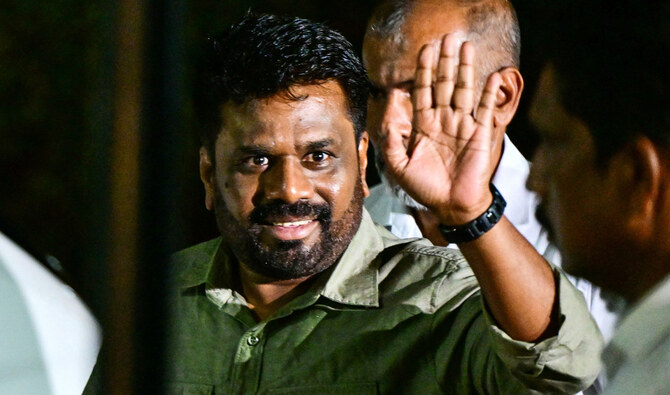
COLOMBO: Sri Lanka’s Marxist president-elect on Sunday invited his compatriots to help him “rewrite” history in the cash-strapped island nation after winning a vote colored by discontent over an unprecedented financial crisis.
Anura Kumara Dissanayaka, the 55-year-old leader of the People’s Liberation Front, was declared the winner of the weekend’s poll with nearly 1.3 million more votes than his nearest rival.
The once-fringe leader, whose party won less than four percent of the vote in parliamentary elections four years ago, saw a surge of support as the economic meltdown forced widespread hardships upon Sri Lankans.
“The dream we have nurtured for centuries is finally coming true,” he said in a statement shortly after the announcement.
“This victory belongs to all of us,” he added. “Millions of eyes filled with hope and expectation push us forward, and together, we stand ready to rewrite Sri Lankan history.”
Outgoing President Ranil Wickremesinghe — who took office at the peak of the 2022 economic collapse and imposed tough austerity policies per the terms of an IMF bailout — was a distant third in the contest with 17 percent of the vote.
“History will judge my efforts, but I can confidently say that I did my best to stabilize the country during one of its darkest periods,” he said in a statement.
He congratulated Dissanayaka on the win and said he was “confident” the politician would “steer Sri Lanka on a path of continued growth and stability.”
Dissanayaka will be sworn in on Monday morning at the colonial-era President Secretariat in Colombo, election commission officials said.
Economic issues dominated the eight-week campaign, with widespread public anger over the belt-tightening measures imposed by Wickremesinghe since the peak of the island nation’s bruising financial crisis.
Dissanayaka would “not tear up” the IMF deal but would seek to modify it, a party politburo member told AFP.
“It is a binding document, but there is a provision to renegotiate,” said Bimal Ratnayake.
He said Dissanayaka had pledged to reduce income taxes that were doubled by Wickremesinghe and slash sales taxes on food and medicines.
“We think we can get those reductions into the program and continue with the four-year bailout program,” he said.
Dissanayaka’s once-marginal Marxist party led two failed uprisings in the 1970s and 1980s that left more than 80,000 people dead.
But Sri Lanka’s crisis has proven an opportunity for Dissanayaka, who has seen a surge of support based on his pledge to change the island’s “corrupt” political culture.
Around 76 percent of Sri Lanka’s 17.1 million eligible voters cast ballots in Saturday’s poll.
Dissanayaka’s party sought to reassure India that any administration he led would not be caught up in geopolitical rivalry between its northern neighbor and China, the country’s largest lender.
New Delhi has expressed concerns over what it sees as Beijing’s growing influence in Sri Lanka, which sits on vital shipping lanes criss-crossing the Indian Ocean.
“Sri Lankan territory will not be used against any other nation,” Ratnayake told AFP.
“We are fully aware of the geopolitical situation in our region, but we will not participate.”
Wickremesinghe sought re-election to continue the austerity policies that stabilized the economy and ended months of food, fuel and medicine shortages during Sri Lanka’s economic meltdown.
His two years in office restored calm to the streets after civil unrest spurred by the downturn saw thousands storm the compound of his predecessor Gotabaya Rajapaksa, who then fled the country.
But Wickremesinghe’s tax hikes and other measures imposed under the $2.9 billion IMF rescue package he secured last year left millions struggling to make ends meet.
Official data showed that Sri Lanka’s poverty rate doubled to 25 percent between 2021 and 2022, adding more than 2.5 million people to those already living on less than $3.65 a day.
Thousands of police were deployed to keep watch over voting on Saturday.
A temporary curfew was imposed after polls closed, despite police reporting that there had been no violence during or after balloting.
No victory rallies or celebrations are permitted until a week after the final results are declared.


New Marxist president vows to ‘rewrite Sri Lankan history’
https://arab.news/2r5ha
New Marxist president vows to ‘rewrite Sri Lankan history’

- Anura Kumara Dissanayaka, 55, was declared winner of weekend’s poll with nearly 1.3 mln more votes than closest rival
- The once-fringe leader saw a surge of support as the economic meltdown forced widespread hardships upon Sri Lankans

Airlines hike ticket prices as war against Iran propels fuel costs
- Conflict deals double blow to Indian airlines already hit by Pakistan airspace ban
CANBERRA, NEW DELHI: Australia’s Qantas Airways, Scandinavia’s SAS and Air New Zealand announced airfare hikes on Tuesday, blaming an abrupt spike in the cost of fuel caused by the Middle East conflict.
Jet fuel prices, which were around $85 to $90 per barrel before US-Israeli strikes on Iran, have soared to between $150 and $200 per barrel in recent days, New Zealand’s flag carrier said as it suspended its financial outlook for 2026 due to uncertainty over the conflict. The war, which disrupted shipping via the world’s most vital oil export route, has sent oil prices surging, upending global travel, pushing airline tickets on some routes sky-high, and sparking fears of a deep travel slump that could lead to widespread grounding of planes.
FASTFACT
Flight disruptions due to the Middle East conflict add to problems at IndiGo whose CEO Pieter Elbers stepped down on Tuesday.
“Increases of this magnitude make it necessary to react in order to maintain stable and reliable operations,” an SAS spokesperson said in a statement, adding it had implemented a “temporary price adjustment.”
The largest Scandinavian airline said last year it had temporarily adjusted its fuel hedging policy due to uncertain market conditions and that it had no fuel consumption hedged for the following 12 months. Several Asian and European airlines, including Lufthansa and Ryanair, have oil hedging in place, securing a part of their fuel supplies at fixed prices. Finnair, which had hedged over 80 percent of its first quarter fuel purchases, warned, however, that even the availability of fuel could be at risk if the conflict dragged on.
Qantas said in addition to increasing international fares, it was exploring redeploying capacity to Europe as airlines and passengers seek to evade disruptions in the Middle East
Airspace restrictions in the Middle East have dealt another blow to Indian airlines, which count the region as a corridor for flights to Europe and the US since Pakistan banned Indian carriers from its airspace last year.
As war in the Middle East forces flight rescheduling and re-routing, Indian airlines have limited options because they can’t fly over Pakistan either.
The country’s biggest international carriers Air India and IndiGo did not operate 64 percent of their 1,230 scheduled flights to the Middle East, Europe and North America in the last 10 days, Cirium data shows.
“It is a double whammy for Indian airlines which fly international routes,” said Amit Mittal, an independent aviation expert.
Pakistan has banned Indian carriers from its airspace since last April following military tensions between the two neighbors.