

Pakistan warns torrential rains from Sept. 26-Oct. 1 may trigger floods, landslides

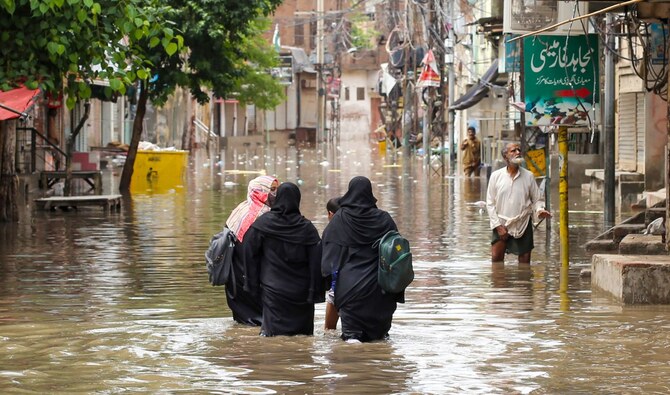
People wade through flood waters after heavy monsoon rains in Multan on August 30, 2024. (AFP/File)
Short Url
Updated 22 September 2024
Follow

Pakistan warns torrential rains from Sept. 26-Oct. 1 may trigger floods, landslides

  • Moist currents from Bay of Bengal likely to penetrate upper parts of the country from Sept. 25, says Met Office
  • Urges farmers to manage activities by following weather forecast, advises tourists to remain “extra cautious“

ISLAMABAD: Pakistan’s Meteorological Department on Sunday warned that torrential rains from Sept. 26 to Oct. 1 could trigger floods and landslides in the country’s low-lying and northern areas, urging citizens to take extra precautions to stay out of harm’s way. 

The Met Office said moist currents from the Bay of Bengal are likely to penetrate the upper parts of the country from Sept. 25, adding that a westerly wave is also likely to approach the upper parts of Pakistan from Sept. 26. 

“Heavy rains may increase flow in local nullas/streams in Murree, Galliyat, Mansehra, Abbottabad, Kohistan, Gilgit-Baltistan, Kashmir, Chitral, Dir, Swat, Shangla, Bajaur, Mohmand, Khyber, Nowshera, Swabi, Islamabad/Rawalpindi and Northeast Punjab during the forecast period,” the Met Office said in a statement. 

It added that torrential rains may cause urban flooding in low-lying areas of Islamabad/Rawalpindi, Gujranwala, Lahore, Sheikhupura, Kasur and Sialkot while landslides may disrupt roads in upper Khyber Pakhtunkhwa, Murree, Galliyat, Kashmir and GB during the rain forecast period. 

In KP, the Met Office said rain and thundershowers are expected in Chitral, Dir, Swat, Kohistan, Shangla, Battagram, Mansehra, Abbottabad, Haripur, Buner, Malakand, Bajaur, Mohmand, Khyber, Peshawar, Swabi, Nowshera, Mardan, Charsadda, Kurram, Orakzai and Kohat from Sept. 26 to Oct. 1.

In Hangu, Bannu, Lakki Marwat, Waziristan and Dera Ismail Khan, heavy rains are expected from Sept. 27 to Oct. 1 with occasional gaps. 

In Punjab, the Met Office forecast rain with thundershowers in Islamabad/Rawalpindi, Murree, Galliyat, Attock, Chakwal, Tala Gang, Jhelum, Mandi Bahauddin, Gujrat, Gujranwala, Lahore, Sheikhupura, Sialkot, Narowal, Hafizabad, Wazirabad from Sept. 26 to Oct. 1.

In Sahiwal, Jhang, Toba Tek Singh, Nankana Sahib, Khushab, Sargodha, Mianwali, Chiniot, Faisalabad, Okara, Pakpattan, Kasur and Bhakkar, the department forecast heavy rains with thundershowers from Sept. 27 to Oct. 1. 

In Azad Kashmir, it said that rain with thundershowers is expected in Neelum valley, Muzaffarabad, Rawalakot, Poonch, Hattian, Bagh, Haveli, Sudhanoti, Kotli, Bhimber and Mirpur from Sept. 26 to Oct. 2. 

In the country’s northern GB area, the Met Office said rain and thunderstorms were expected in Diamir, Astore, Skardu, Gilgit, Hunza, Ghanche and Shigar from Sept. 26 to Oct. 2.

Meanwhile, it forecast hot and dry weather in the southern provinces of Balochistan and Sindh during the same period. 

“However, rain, wind and thunderstorm is expected at isolated places in Mirpurkhas, Tharparkar, Umerkot and adjoining areas from 26th to 28th September,” the Met Office said. 
 
It warned that windstorms and lightning may damage weak structures such as the roofs and walls of mud houses, electric poles, billboards, vehicles, and solar panels.

The Met Office urged farmers to manage their activities keeping in mind the weather forecast. 

“Travelers and tourists are advised to remain extra cautious and manage their traveling according to weather conditions and avoid any untoward situation during the wet spell,” it said. 


‘Fully stand with Bangladesh’: Pakistan PM backs decision to boycott India match

Updated 04 February 2026
Follow

‘Fully stand with Bangladesh’: Pakistan PM backs decision to boycott India match

  • Pakistan’s government have not allowed the national cricket team to play its World Cup match against India on Feb. 15
  • Pakistan has accused India of influencing ICC decisions, criticized global cricket body for replacing Bangladesh in World Cup

ISLAMABAD: Prime Minister Shehbaz Sharif on Wednesday backed his government’s decision to bar the national men’s cricket team from playing against India in the upcoming T20 World Cup tournament, reaffirming support for Bangladesh. 

Pakistan’s government announced on social media platform X last week that it has allowed its national team to travel to Sri Lanka for the World Cup. However, it said the Green Shirts will not take the field against India on their scheduled match on Feb. 15. 

Pakistan’s participation in the tournament was thrown into doubt after Pakistan Cricket Board (PCB) Chairman Mohsin Naqvi criticized the International Cricket Council (ICC) for replacing Bangladesh with Scotland. The decision was taken after Bangladesh said it would not let its team travel to India out of security concerns. 

During a meeting of the federal cabinet, Sharif highlighted that Pakistan has said that politics should be kept away from sports. 

“We have taken this stand after careful consideration and in this regard, we should stand fully with Bangladesh,” Sharif said in televised remarks. 

“And I believe this is a very reasonable decision.”

Pakistan has blamed India for influencing the ICC’s decisions. The global cricket governing body is currently led by Jay Shah, the head of the Board of Control for Cricket in India. Shah is the son of Indian Home Minister Amit Shah. 

Pakistan’s boycott announcement has triggered media frenzy worldwide, with several Indian cricket experts and analysts criticizing Islamabad for the decision. An India-Pakistan cricket contest is by far the most lucrative and eagerly watched match of any ICC tournament. 

The ICC has ensured that the two rivals and Asian cricket giants are always in the same group of any ICC event since 2012 to capitalize on the high-stakes game. 

The two teams have played each other at neutral venues over the past several years, as bilateral cricket remains suspended between them since 2013 due to political tensions. 

Those tensions have persisted since the two nuclear-armed nations engaged in the worst fighting between them since 1999 in May 2025, after India blamed Pakistan for an attack in Indian-administered Kashmir that killed tourists. 

Pakistan denied India’s allegations that it was involved in the attack, calling for a credible probe into the incident.