Marxist leader Dissanayaka set to become Sri Lanka’s next president

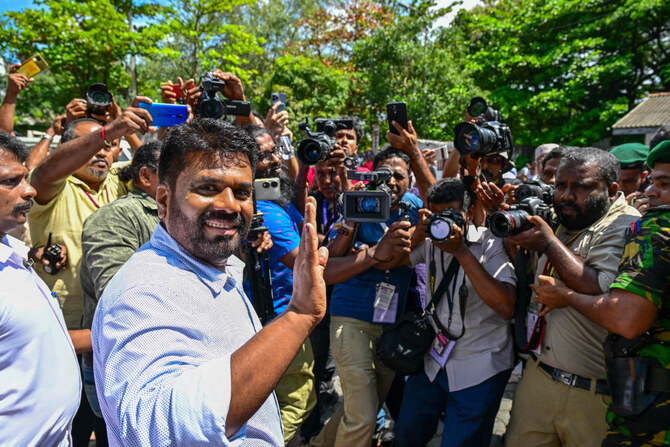
National People's Power (NPP) party's presidential candidate Anura Kumara Dissanayaka (2R) leaves a polling station after casting his ballot during voting in Sri Lanka's presidential election in Colombo on September 21, 2024. (AFP)
Short Url
Updated 22 September 2024
Follow

Marxist leader Dissanayaka set to become Sri Lanka’s next president

  • Ongoing count shows Anura Kumara Dissanayaka on 52 percent of over a million votes counted
  • Opposition leader Sajith Premadasa was second at 22%, ahead of President Ranil Wickremesinghe in third place

COLOMBO: A previously fringe Marxist politician was on course Sunday to become Sri Lanka’s next leader after a presidential vote colored by discontent over the island nation’s response to an unprecedented financial crisis.
The ongoing count in Saturday’s poll showed Anura Kumara Dissanayaka on 52 percent with just over a million votes counted, well above his nearest rivals.
Opposition leader Sajith Premadasa was in second, with 23.3 percent of the vote.
Incumbent President Ranil Wickremesinghe — who took office at the peak of the 2022 economic collapse and imposed tough austerity policies per the terms of an IMF bailout — was trailing at a distant third with around 16 percent of the vote.
Wickremesinghe has yet to concede, and an official result was not expected until later Sunday, but foreign minister Ali Sabry said the early count made it clear that Dissanayaka had won.
“Though I heavily campaigned for President Ranil Wickremesinghe, the people of Sri Lanka have made their decision, and I fully respect their mandate for Anura Kumara Dissanayaka,” Sabry said on social media.


National People's Power (NPP) party's presidential candidate Anura Kumara Dissanayaka (2R) leaves a polling station after casting his ballot during voting in Sri Lanka's presidential election in Colombo on September 21, 2024. (AFP)

Around 76 percent of Sri Lanka’s 17.1 million eligible voters cast ballots in Saturday’s poll.
Dissanayaka’s once-marginal Marxist party led two failed uprisings in the 1970s and 1980s that left more than 80,000 people dead.
It won less than four percent of the vote during the most recent parliamentary elections in 2020.
But Sri Lanka’s crisis has proven an opportunity for Dissanayaka, 55, who has seen a surge of support based on his pledge to change the island’s “corrupt” political culture.
“Our country needs a new political culture,” he said after casting his ballot on Saturday.


Election officials seal a ballot box at the end of voting in Sri Lanka's presidential election at a polling station in Colombo on September 21, 2024. (AFP)

Wickremesinghe sought re-election to continue belt-tightening measures that stabilized the economy and ended months of food, fuel and medicine shortages during Sri Lanka’s economic meltdown.
His two years in office restored calm to the streets after civil unrest spurred by the downturn saw thousands storm the compound of his predecessor Gotabaya Rajapaksa, who fled the country and resigned.
But Wickremesinghe’s tax hikes and other measures imposed under the $2.9 billion IMF bailout left millions struggling to make ends meet.
Dissanayaka pledged during the campaign to renegotiate the terms of the IMF rescue package, which Wickremesinghe secured last year after the government defaulted on its foreign debt.
Economic issues dominated the eight-week campaign, with public anger widespread over the hardships endured since the peak of the crisis two years ago.
Official data showed that Sri Lanka’s poverty rate doubled to 25 percent between 2021 and 2022, adding more than 2.5 million people to those already living on less than $3.65 a day.
Thousands of police were deployed to keep watch over voting on Saturday, with the government also banning the sale of liquor.
A night-time curfew imposed after polls closed was extended until midday on Sunday, despite police reporting that there had been no violence during or after balloting.
No victory rallies or celebrations are permitted until a week after the final results are declared.


Olympic town warms up as climate change puts Winter Games on thin ice

Updated 3 sec ago
Follow

Olympic town warms up as climate change puts Winter Games on thin ice

CORTINA D’AMPEZZO: Olympic fans came to Cortina with heavy winter coats and gloves. Those coats were unzipped Sunday and gloves pocketed as snow melted from rooftops — signs of a warming world.
“I definitely thought we’d be wearing all the layers,” said Jay Tucker, who came from Virginia to cheer on Team USA and bought hand warmers and heated socks in preparation. “I don’t even have gloves on.”
The timing of winter, the amount of snowfall and temperatures are all less reliable and less predictable because Earth is warming at a record rate, said Shel Winkley, a Climate Central meteorologist. This poses a growing and significant challenge for organizers of winter sports; The International Olympic Committee said last week it could move up the start date for future Winter Games to January from February because of rising temperatures.
While the beginning of the 2026 Olympic Winter Games in Cortina truly had a wintry feel, as the town was blanketed in heavy snow. The temperature reached about 40 degrees Fahrenheit (4.5 degrees Celsius) Sunday afternoon. It felt hotter in the sun.
This type of February “warmth” for Cortina is made at least three times more likely due to climate change, Winkley said. In the 70 years since Cortina first held the Winter Games, February temperatures there have climbed 6.4 degrees Fahrenheit (3.6 degrees Celsius), he added.
Coping with varying climates across host cities
For the Milan Cortina Games, there’s an added layer of complexity. It’s the most spread-out Winter Games in history, so Olympic venues are in localities with very different weather conditions. Bormio and Livigno, for example, are less than an hour apart by car, but they are separated by a high mountain pass that can divide the two places climatically.
The organizing committee is working closely with four regional and provincial public weather agencies. It has positioned weather sensors at strategic points for the competitions, including close to the ski jumping ramps, along the Alpine skiing tracks and at the biathlon shooting range.
Where automatic stations cannot collect everything of interest, the committee has observers — “scientists of the snow”— from the agencies ready to collect data, according to Matteo Pasotti, a weather specialist for the organizing committee.
The hope? Clear skies, light winds and low temperatures on race days to ensure good visibility and preserve the snow layer.
The reality: “It’s actually pretty warm out. We expected it to be a lot colder,” said Karli Poliziani, an American who lives in Milan. Poliziani was in Cortina with her father, who considered going out Sunday in just a sweatshirt.
And forecasts indicate that more days with above-average temperatures lie ahead for the Olympic competitions, Pasotti said.
Weather can affect competition
Weather plays a critical role in the smooth running and safety of winter sports competitions, according to Filippo Bazzanella, head of sport services and planning for the organizing committee. High temperatures can impact the snow layer on Alpine skiing courses and visibility is essential. Humidity and high temperatures can affect the quality of the ice at indoor arenas and sliding centers, too.
Visibility and wind are the two factors most likely to cause changes to the competition schedule, Bazzanella added. Wind can be a safety issue or a fairness one, such as in the biathlon where slight variations can disrupt the athletes’ precise shooting.
American alpine skier Jackie Wiles said many races this year have been challenging because of the weather.
“I feel like we’re pretty good about keeping our heads in the game because a lot of people are going to get taken out by that immediately,” she said at a team press conference last week. “Having that mindset of: it’s going to be what it’s going to be, and we still have to go out there and fight like hell regardless.”