ISLAMABAD: A major Chinese business group unveiled its plan to set up textile parks in two Pakistani provinces during a meeting with Prime Minister Shehbaz Sharif on Friday, saying these “international-standard” facilities will help generate up to $5 billion in textile exports from the country.
China’s Ruyi Shandong Group, one of the largest textile and clothing manufacturers, has expanded globally over the past decade through acquisitions and investments. It has also benefited from the multibillion-dollar China-Pakistan Economic Corridor (CPEC) in the past by investing in a coal power plant in the country.
The group’s chairman, Qiu Yafu, held a meeting with the prime minister to discuss the investment proposal and highlight its details.
“Ruyi Group will establish international-standard textile parks in Sindh and Punjab provinces, inviting around 100 major Chinese textile industries to invest,” he said in his briefing, according to an official statement circulated after the meeting.
“The primary focus of these textile parks is to boost Pakistan’s textile exports and make Pakistan a global hub for textiles and garments,” he continued.
The Chinese businessman added these parks will utilize solar energy, operate with zero carbon emissions and employ modern automated technology.
“In the first phase, these parks are expected to generate $2 billion in exports, with $5 billion anticipated in the second phase,” he noted. “The parks will create employment opportunities for 300,000 to 500,000 local individuals.”
According to the briefing, the foundation stone for the textile parks will be laid by the end of the year, with completion expected within three years.
Ruyi Group will also establish wholesale commodity centers in both Karachi and Lahore.
It was decided during the meeting to establish working groups in Islamabad and Beijing to advance matters between Pakistan and the Chinese business group.
“China has always stood by Pakistan in difficult times,” the prime minister said during the meeting. “Economic relations between China and Pakistan are growing stronger with each passing day.”
He also formed a special committee headed by Deputy Prime Minister Ishaq Dar to oversee the initiative.
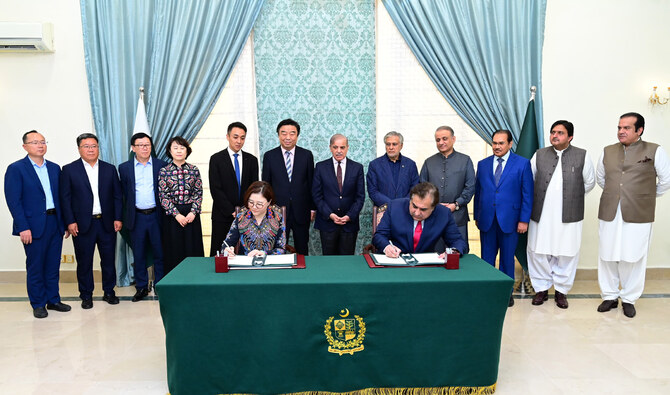
A memorandum of understanding was signed between Pakistan’s Board of Investment and Ruyi Shandong Group regarding the establishment of the parks, with the prime minister in attendance.


Chinese group to set up textile parks in Pakistan, aiming for $5 billion boost in exports
https://arab.news/cmca3
Chinese group to set up textile parks in Pakistan, aiming for $5 billion boost in exports

- Textile parks will utilize solar energy, modern automated technology and will operate with zero carbon emissions
- The foundation stone of the parks will be laid by the end of the year and they will employ up to 500,000 people

Pakistan strikes $4 billion deal to sell weapons to Libyan force, officials say
- Pakistan’s defense industry spans aircraft, vehicles, and naval construction
- The deal, spread over two-and-a-half years, includes JF-17 jets, officials say
KARACHI: Pakistan has reached a deal worth over $4 billion to sell military equipment to the Libyan National Army, four Pakistani officials said, despite a UN arms embargo on the fractured North African country.
The deal, one of Pakistan’s largest-ever weapons sales, was finalized after a meeting last week between Pakistan military chief Field Marshal Asim Munir and Saddam Khalifa Haftar, deputy commander-in-chief of the LNA, in the eastern Libyan city of Benghazi, said the four officials.
The officials, all involved in defense matters, declined to be identified because of the sensitivity of the deal.
Pakistan’s foreign ministry, defense ministry and military did not respond to requests for comment.
Any arms agreement with the LNA is likely to face scrutiny given Libya’s long-running instability following a 2011 NATO-backed uprising that toppled Muammar Qaddafi and split the country between rival authorities.
A copy of the deal before it was finalized that was seen by Reuters listed the purchase of 16 JF-17 fighter jets, a multi-role combat aircraft that has been jointly developed by Pakistan and China, and 12 Super Mushak trainer aircraft, used for basic pilot training.
One of the Pakistani officials confirmed the list was accurate while a second official said the arms on the list were all part of the deal but could not provide exact numbers.
One of the Pakistani officials said the deal included the sale of equipment for land, sea and air, spread over 2-1/2 years, adding it could also include the JF-17 fighter jets. Two of the officials said the deal was valued at more than $4 billion, while the other two said it amounted to $4.6 billion.
The LNA’s official media channel reported on Sunday that the faction had entered a defense cooperation pact with Pakistan, which included weapons sales, joint training and military manufacturing, without providing details.
“We announce the launch of a new phase of strategic military cooperation with Pakistan,” Haftar said in remarks broadcast on Sunday by Al-Hadath television.
Authorities in Benghazi also did not immediately respond to a request for comment.
The UN-recognized Government of National Unity, led by Prime Minister Abdulhamid Dbeibah, controls much of western Libya, while Haftar’s LNA controls the east and south, including major oilfields, and does not recognize the western government’s authority.
ARMS EMBARGO
Libya has been subject to a UN arms embargo since 2011, requiring approval from the UN for transfers of weapons and related material.
A panel of experts said in a December 2024 report to the UN that the arms embargo on Libya remained “ineffective.” The panel said some foreign states had become increasingly open about providing military training and assistance to forces in both eastern and western Libya despite the restrictions.
It was not immediately clear whether Pakistan or Libya had applied for any exemptions to the UN embargo.
Three of the Pakistani officials said the deal had not broken any UN weapons embargo.
One of the officials said Pakistan is not the only one to make deals with Libya; another said there are no sanctions on Haftar; and a third said Benghazi authorities are witnessing better relations with Western governments, given rising fuel exports.
PAKISTAN EYEING MARKETS
Pakistan has been seeking to expand defense exports, drawing on decades of counterinsurgency experience and a domestic defense industry that spans aircraft production and overhaul, armored vehicles, munitions and naval construction.
Islamabad has cited its Air Force’s performance in clashes with India in May.
“Our recent war with India demonstrated our advanced capabilities to the world,” military chief Munir said in remarks broadcast by Al-Hadath on Sunday.
Pakistan markets the Chinese co-developed JF-17 as a lower-cost multi-role fighter and has positioned itself as a supplier able to offer aircraft, training and maintenance outside Western supply chains.
Pakistan has also been deepening security ties with Gulf partners, signing a Strategic Mutual Defense Agreement with Saudi Arabia in September 2025 and holding senior-level defense talks with Qatar.
The Libya deal would expand Pakistan’s footprint in North Africa as regional and international powers compete for influence over Libya’s fragmented security institutions and oil-backed economy.