ISLAMABAD: As Pakistan’s Anti-Narcotics Force (ANF) this month announced a country-wide campaign against drugs on educational institutions, the chairman of the Higher Education Commission (HEC) as well as teachers and students in the federal capital also acknowledged the growing problem of narcotics use at the nation’s colleges and universities.
According to an ANF study conducted in 2022, about 53 percent of students at Pakistani universities and colleges had been exposed to drugs, with around 27 percent admitting to using them.
“This campaign is in all tiers, like in drug demand reduction domain, in kinetic operations domain, in collecting information, in increasing outreach of government institutions so that that there is no drug or there is zero tolerance of any drug in any educational institution,” ANF Director Syed Sijjeel Haider told Arab News in an interview this month, explaining the agency’s plans to crackdown on drug use at institutions of higher learning.
“We are arranging awareness sessions in all universities. We are sensitizing the vice chancellors and the professors, etc. We are also sensitizing the parents, the teachers. We are also establishing focal points in all universities in collaboration with the Higher Education Commission.”
Haider said the ANF was in the process of collecting “focused and specific information” about drug use and sale of drugs in educational institutions.
“Accordingly, we will take enforcement measures as well,” he said, adding that the ANF had acted 84 times this year against drug dealers at educational institutions and filed charges against individuals arrested.
Pakistan’s interior ministry this year approved a new National Drug Survey, more than a decade after the last survey, conducted in 2012-13, revealed that around six percent of the Pakistani population, or 6.7 million people at the time, had used substances other than alcohol and tobacco in the previous year. The highest prevalence of drug use was recorded in the Khyber Pakhtunkhwa province, where nearly 11 percent of the population had used an illicit substance.
HEC Chairman Dr. Mukhtar Ahmed acknowledged that drug use was becoming a rampant problem on campuses.
“Yes, this is an issue and we are very much serious and we are concerned,” Ahmed told Arab News in an interview earlier this month. “The government has given a policy of smoke-free campuses and we have evolved a policy document, which was approved by the Commission and we have asked all universities to implement it.”
“Similarly, we are working with different bodies, statuatory bodies, regulatory bodies that they should also provide support and curb those people [drug dealers] which are doing such type of activity, especially when they are reaching our education institutions. It is not only in higher education, it is everywhere, unfortunately. But I think everybody is alert, university administration, government, HEC and other agencies are also working on these things.”
Ahmed said the menace of drug use could not be controlled by any single institution or body.
“It is the collective responsibility of parents, society, teachers, the HEC and university administrations,” the HEC chairman said, pointing out how social media platforms had made buying drugs or being exposed to dealers much easier. “We are all responsible for ensuring that such things do not happen.”
“VERY EASY TO ACCESS”
Students and faculty at a number of universities in the Pakistani capital also cited the easy availability of drugs as one of the key factors fueling the problem.
“The main issue with drugs is that they are very easy to access. With just one phone call, you can get any illegal substance delivered to your doorstep for very little money,” Muhammad Bilal Sial, a computer science student at the Shaheed Zulfikar Ali Bhutto Institute of Science and Technology (SZABIST) in Islamabad, told Arab News.
“There are parties, there are pills, and many other things,” he added.
Stress was a major factor also, many students said.
Students are using drugs a lot, one reason is anxiety due to pressures, and financial issues,” Sial said. “Plus there are no jobs, no businesses and students are roaming around [unemployed] with degrees.”
Mahnoor Shah, a psychology student at Quaid-e-Azam University, also pointed to stress and a sense of isolation as a reason why students were turning to drugs.
“Many students stay in the hostels, leaving their homes, so they indulge in such things due to loneliness, as it is very difficult to live alone,” she told Arab News.
Muqaddas Iqbal, another student at Quaid-e-Azam University, attributed the rise in drug use to peer pressure.
“First of all, there is a lot of peer influence. If a friend is taking drugs and it is something normal for him, then you start thinking this must be something normal for me as well,” she said. “They start taking things out of a sense of adventure or thrill but ultimately, they become addicted.”
Dr. Wajid Zulqarnain, Head of the Media Sciences Department at SZABIST, said most students who took drugs lacked a strong bond with parents, making them more vulnerable to substance abuse.
“Majority of the cases is that they feel alien, they don’t have a good relationship with their parents,” he said, urging parents to pay more attention to their children’s activities and social media use.
“Even though they [children] know this [drugs] is not good for their health, they take them because they don’t feel that they have any other alternative.”
Zulqarnain also blamed the proliferation of social media for the rise in drug use on campuses.
“Particularly the students and the young students especially, after the invention of social media, that they have now easily accessed those groups and members who supply these types of drugs, particularly ice and atoms [methamphetamine],” he said.
“Before that, it was thought that there were some sort of lower [university] staff involved in such activities, but not now.”


![]()

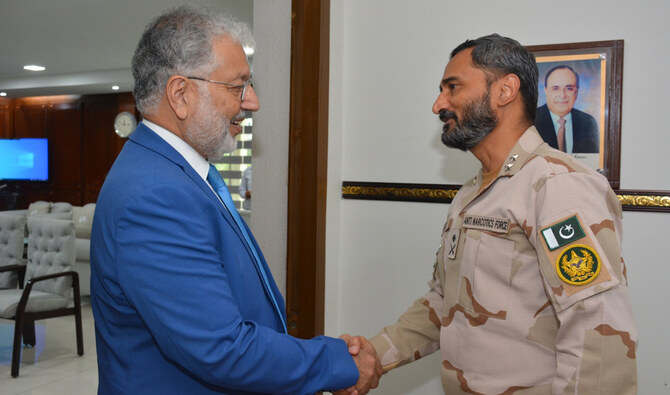
Pakistan anti-narcotics body teams up with Higher Education Commission against drugs on campus
Short Url
https://arab.news/n98na
Pakistan anti-narcotics body teams up with Higher Education Commission against drugs on campus
- According to 2022 study by ANF, about 53% of university and college students in Pakistan were exposed to drugs
- Student and facility say easy access, stress, sense of isolation and social media adding to problem of drug use
Latest updates


© 2026 SAUDI RESEARCH & PUBLISHING COMPANY, All Rights Reserved And subject to Terms of Use Agreement.