BEIRUT: A second wave of device explosions killed three people and wounded more than 100 in Hezbollah strongholds of Lebanon on Wednesday, officials said, stoking fears of an all-out war in the region.
A source close to Hezbollah said walkie-talkies used by its members blew up in its Beirut stronghold, with state media reporting similar blasts in south and east Lebanon.
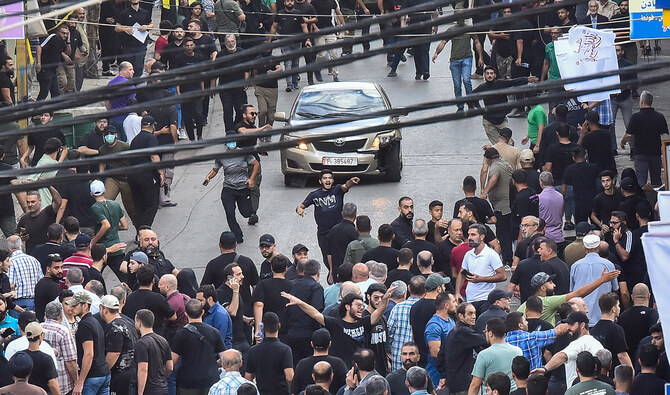
AFPTV footage showed people running for cover when an explosion went off during a funeral for Hezbollah militants in south Beirut on Wednesday afternoon.
Three people were killed and more than 100 wounded in the latest attacks, the Lebanese authorities said, with the health ministry also describing the devices targeted as walkie-talkies.
It came a day after the simultaneous explosion of hundreds of paging devices used by Hezbollah killed 12 people, including two children, and wounded up to 2,800 others across Lebanon, in an unprecedented attack blamed on Israel.
There was no comment from Israel, which only hours before Tuesday’s attacks had announced it was broadening the aims its war with Hamas in the Gaza Strip to include its fight against the Palestinian group’s ally Hezbollah.
Hezbollah said Israel was “fully responsible for this criminal aggression” and reiterated it would avenge the attack, while vowing to continue its fight against Israel in support of Hamas in the Gaza war.
Cross-border exchanges with Israeli forces were “ongoing and separate from the difficult reckoning that the criminal enemy must await for its massacre,” Hezbollah said.
Lebanese Foreign Minister Abdallah Bou Habib warned the “blatant assault on Lebanon’s sovereignty and security” was a dangerous development that could “signal a wider war.”
The influx of so many casualties all at once overwhelmed hospitals in Hezbollah strongholds.
At a Beirut hospital, doctor Joelle Khadra said “the injuries were mainly to the eyes and hands, with finger amputations, shrapnel in the eyes — some people lost their sight.”
A doctor at another Beirut hospital, requesting anonymity because he was not authorized to speak to the media, said he had worked through the night and that the injuries were “out of this world — never seen anything like it.”
Experts said Israeli operatives had likely planted explosives on the paging devices before they were delivered to Hezbollah.
“This was more than lithium batteries being forced into override,” said Charles Lister of the Middle East Institute.
“A small plastic explosive was almost certainly concealed alongside the battery, for remote detonation via a call or page,” the analyst said, adding Israel’s spy agency “Mossad infiltrated the supply chain.”
Among the dead was the 10-year-old daughter of a Hezbollah member, killed in east Lebanon’s Bekaa Valley when her father’s pager exploded, the family and a source close to the group said.
Tehran’s ambassador in Beirut, Mojataba Amani, who was injured, said on social media platform X that it was “a source of pride for me that my blood was mixed with that of the wounded Lebanese” in what he called a “horrific terrorist crime.”
Iran’s President Masoud Pezeshkian condemned the attack, decrying Western support for Israeli “crimes, killings and indiscriminate assassinations.”
The attack dealt a heavy blow to the militant group, which already had concerns about the security of its communications after losing several key commanders to targeted air strikes in recent months.
A source close to Hezbollah, asking not to be identified, told AFP the pagers were “recently imported” and appeared to have been “sabotaged at source.”
After The New York Times reported the pagers had been ordered from Taiwanese manufacturer Gold Apollo, the company said they had been produced by its Hungarian partner BAC Consulting KFT.
A government spokesman in Budapest said the company was “a trading intermediary, with no manufacturing or operational site in Hungary.”
As fears again surged of a regional conflagration nearly a year into the Gaza war, Lufthansa and Air France announced the suspension of flights to Tel Aviv, Tehran and Beirut until Thursday.
Since October, the unabating exchanges of fire between Israeli troops and Hezbollah have killed hundreds of mostly fighters in Lebanon, and dozens including soldiers on the Israeli side.
They have also forced tens of thousands of people on both sides of the border to flee their homes.
United Nations rights chief Volker Turk said Tuesday’s attack had come at an “extremely volatile time,” calling the blasts “shocking” and their impact on civilians “unacceptable.”
UN Secretary-General Antonio Guterres urged governments “not to weaponize civilian objects.”
US officials have expressed increasing frustration with Israel, which has rejected American assessments that a deal is nearly complete and insisted on an Israeli military presence on the Egypt-Gaza border.
The October 7 attack that sparked the war resulted in the deaths of 1,205 people, mostly civilians, on the Israeli side, according to an AFP tally based on official Israeli figures which includes hostages killed in captivity.
Out of 251 hostages seized by militants, 97 are still held in Gaza, including 33 the Israeli military says are dead.
Israel’s retaliatory military offensive has killed at least 41,272 people in Gaza, the majority of them civilians, according to data provided by the Hamas-run territory’s health ministry. The UN has acknowledged these figures as reliable.
In Gaza on Wednesday, the civil defense agency said an Israeli air strike on a school-turned-shelter killed five people, while the Israeli military said it targeted Hamas militants.


![]()

Three dead, 100 wounded in new wave of Lebanon device explosions
Short Url
https://arab.news/ns72d
Three dead, 100 wounded in new wave of Lebanon device explosions
- Footage shows people running for cover as explosion goes off during funeral for Hezbollah fighters
- Incident takes place day after explosion of hundreds of pagers used by Hezbollah killed 12 people
Latest updates


© 2026 SAUDI RESEARCH & PUBLISHING COMPANY, All Rights Reserved And subject to Terms of Use Agreement.