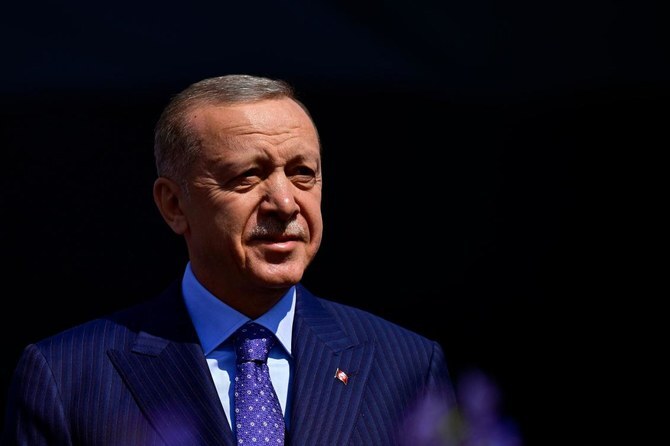
ANKARA: President Tayyip Erdogan said on Wednesday that Türkiye would not stop deepening ties with the East, including the BRICS group of nations and the Shanghai Cooperation Organization (SCO), even as it continued to face West.
Türkiye, a NATO member, has in recent months voiced interest in joining the BRICS and SCO groups, both of which include China and Russia. This has stirred US and European fears that Türkiye may be pivoting away from its traditionally Western geopolitical orientation, despite repeated denials from Ankara.
Speaking at an event in Ankara, Erdogan said debates over an “axis shift” were unfounded, but that Türkiye had to adapt to new “centers of power” forming in the fields of economy, production, and technology, while keeping itself open to opportunities with every structure and actor.
“That is the approach that lies behind our country’s will to expand the basis of dialogue with all of them, from the Shanghai Cooperation Organization to BRICS and ASEAN,” Erdogan said.
“Of course, our face is turned to the West, but this certainly does not mean that we will turn our backs on the East, that we will ignore the East, or not improve our ties with the East,” he added.
BRICS comprises Brazil, Russia, India, China, South Africa, Ethiopia, Iran, Egypt, and the United Arab Emirates. China and Russia, in particular, want to expand the group further as they seek to counter Western economic dominance.
The SCO is a security, political and economic club launched by Moscow, Beijing and Central Asian states in 2001 as a counterweight to Western alliances.


![]()

Erdogan says Turkiye will deepen ties with East while still facing West
Short Url
https://arab.news/wzfeg
Erdogan says Turkiye will deepen ties with East while still facing West
- Erdogan said debates over an “axis shift” were unfounded, but that Türkiye had to adapt to new “centers of power” forming in the fields of economy, production, and technology
- “That is the approach that lies behind our country’s will to expand the basis of dialogue with all of them, from the Shanghai Cooperation Organization to BRICS and ASEAN“


Latest updates


© 2026 SAUDI RESEARCH & PUBLISHING COMPANY, All Rights Reserved And subject to Terms of Use Agreement.