Gavi to buy 500,000 mpox vaccine doses from Bavarian Nordic

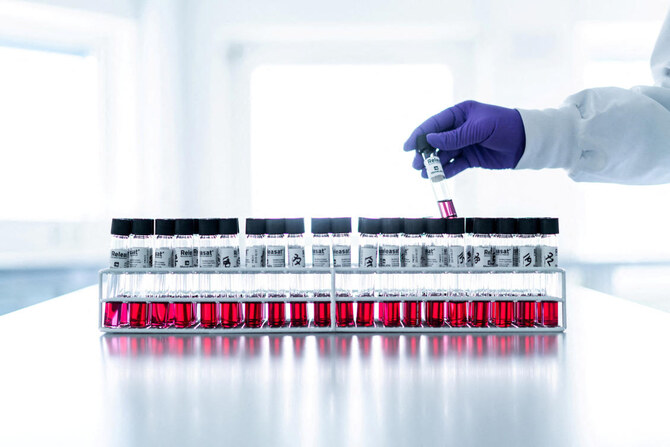
The global vaccine group Gavi will buy 500,000 doses of Bavarian Nordic’s mpox vaccine, its first purchase of the shot to help battle an outbreak in parts of Africa, the group said on Wednesday. (Reuters/File)
Short Url
Updated 18 September 2024
Follow

Gavi to buy 500,000 mpox vaccine doses from Bavarian Nordic

  • Gavi said it will spend up to $50 million on the plan, which includes the transportation, delivery and costs of administering the vaccines
  • Around 3.6 million doses of mpox vaccine have already been pledged to the DRC by rich nations which have stockpiles, WHO has said

LONDON: The global vaccine group Gavi will buy 500,000 doses of Bavarian Nordic’s mpox vaccine, its first purchase of the shot to help battle an outbreak in parts of Africa, the group said on Wednesday.
In 2024, there have been more than 25,000 suspected mpox cases and 723 deaths in Africa, mainly in the Democratic Republic of Congo, according to the World Health Organization, which has declared the outbreak a global health emergency.
Gavi, a public-private alliance which co-funds vaccine purchases for low-income countries, said it will spend up to $50 million on the plan, which includes the transportation, delivery and costs of administering the vaccines. The doses are due to be delivered this year.
Around 3.6 million doses of mpox vaccine have already been pledged to the DRC by rich nations which have stockpiles, the World Health Organization has said, but only a small portion has arrived so far. The WHO approved the vaccine for use on Friday last week.
Gavi’s purchase, using a new facility set up after the COVID-19 pandemic to respond quickly to public health emergencies, could speed up the response in Congo and other affected countries.
Also on Wednesday, the Global Fund to Fight AIDS, Tuberculosis and Malaria said it would provide $9.5 million to support Congo with its emergency response at the request of the government there, including surveillance, laboratory systems and risk communication.
The price of the vaccine was not disclosed. Gavi’s $50 million investment would likely equate to less than around $100 per vaccine, because transportation and logistics are included in the total. The figure is lower than previous estimates of the cost.
Gavi chief executive Sania Nishtar said the priority was working with partners “to turn these vaccines into vaccinations as quickly and effectively as possible and, over time, to build a global vaccine stockpile.”
The deal will significantly increase the availability of mpox vaccine for African countries, Bavarian Nordic chief executive Paul Chaplin said. Last week, the company said it would push back some existing orders to 2025, based on US government contracts, to focus on market needs now.
Mpox, which spreads through close contact and typically causes flu-like symptoms and pus-filled lesions, has been a public health problem in parts of Africa for decades. But vaccines have never previously been available outside clinical trials in affected countries in Africa, even after a different strain of the virus spread globally in 2022 and high-income countries used vaccines to help stem the outbreak.


New deadly clashes break out on Afghanistan-Pakistan border despite truce

Updated 7 sec ago
Follow

New deadly clashes break out on Afghanistan-Pakistan border despite truce

  • At least 5 people were killed, 5 injured on the Afghan side, Taliban authorities say
  • Latest clash comes amid reports of back-channel negotiations between the two countries

KABUL: Overnight border clashes have broken out between Afghan and Pakistani forces, authorities in Afghanistan said on Saturday, as tensions between the neighbors escalated following a fragile ceasefire. 

The latest exchange of fire that spanned Spin Boldak and Chaman, a key crossing between southeastern Afghanistan’s Kandahar province and Pakistan’s Balochistan, marked violations of a ceasefire that has been in place since October. 

The truce brokered by Qatar and Turkey has mostly held for the past two months, after dozens were killed on both sides in what was the deadliest confrontation in years between Afghanistan and Pakistan. 

But heavy gunfire and shelling erupted again late on Friday, with each side blaming the other for sparking the deadly violence. 

“Unfortunately, last night the Pakistani side once again attacked Spin Boldak in Kandahar. The forces of the Islamic Emirate had to respond,” Hamdullah Fitrat, deputy spokesperson of Afghanistan’s Taliban government, told Arab News on Saturday. 

He said five people on the Afghan side — including four civilians — were killed in the violence, while five others were injured. 

Mosharraf Zaidi, spokesman for Pakistan’s prime minister, said that the Taliban “resorted to unprovoked firing” along their shared border. 

“An immediate, befitting & intense response has been given by our armed forces. Pakistan remains fully alert & committed to ensuring its territorial integrity & the safety of our citizens,” he wrote on X. 

Local residents in Spin Boldak told Arab News that Friday’s clashes forced families to flee their homes. 

“Mortars and bullets smashed into houses and public places,” Samiullah Malang said. “It was difficult … (to) watch women and children flee on motorbikes, tractors and on foot in the cold night.” 

Although the fighting largely subsided around midnight, sporadic gunfire continued into the morning, he added. 

The overnight violence also reached the Friendship Gate, an official crossing point between Spin Boldak and Chaman, which was closed by Pakistan authorities after the fighting. 

Clashes at the border have led to repeated closures of the key border crossing, devastating commerce and disrupting the movement of thousands. 

“Every time Pakistan shuts the gate, our fruits rot inside the trucks,” said Afghan businessman Haji Rahmatullah. “Hotels are filled with patients waiting to cross for treatment.”

After the ceasefire agreement in October, subsequent talks for a long-term truce have so far yielded little progress. The latest deadly exchange of fire comes amid reports of back-channel negotiations between Afghan and Pakistani officials, which neither governments have openly confirmed. 

Both sides remain deeply divided on core security issues and repeated clashes highlight the absence of an effective de-escalation mechanism, according to Asad Waheedi, a political analyst based in Kabul. 

“The talks are not bearing fruit because the demands are unrealistic,” he said. “Pakistan asks the Taliban to guarantee the security of their country. This is impossible. Even when America had all its troops here, it could not guarantee Afghanistan’s security. The Taliban have no presence there (in Pakistan). It is an impractical demand.”

Clashes between Afghan and Pakistani forces along the Durand Line — their 2,640-km border — have occurred for decades but intensified after the Taliban took control of Afghanistan in 2021, following the withdrawal of US-led troops.

Pakistan accuses the Afghan Taliban of sheltering fighters from the banned Tehreek-e-Taliban Pakistan and allowing them to stage cross-border attacks — a charge Afghanistan denies, saying it does not allow its territory to be used against other countries.

The deadly violence in October was triggered by an unclaimed explosion in Kabul and another in the southeastern province of Paktika, for which the Afghan government blamed the Pakistani military. 

“The facts show that the distance between them is huge,” Waheedi said. “Until the demands become practical, these talks will go nowhere, and the fighting will continue.”