Egypt won’t accept security changes on Gaza border, foreign minister says

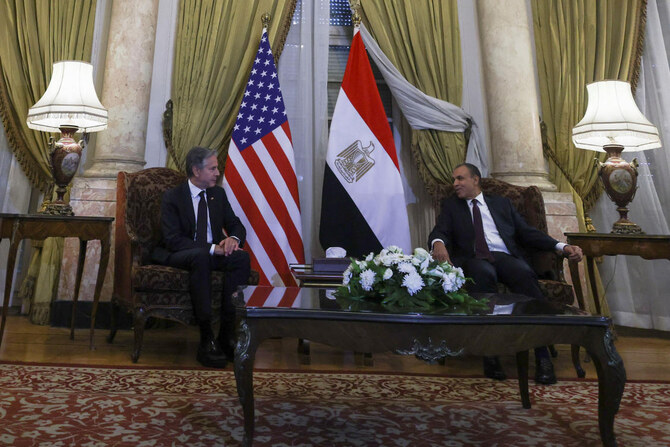
US Secretary of State Antony Blinken meets with Egyptian Foreign Minister Badr Abdelatty in Tahrir Palace in Cairo, Egypt. (Reuters)
Short Url
Updated 18 September 2024
Follow

Egypt won’t accept security changes on Gaza border, foreign minister says

  • Security on the border, and whether Israel will maintain a troop presence along a 14-km (9-mile) buffer zone known as the Philadelphi Corridor, have become a focal point of months-long talks
  • Israeli troops entered the buffer zone in May as they pursued an offensive around Rafah

CAIRO: Egypt will not accept any changes to the security arrangements that were in place on its border with Gaza before war broke out between Israel and Hamas last October, the Egyptian foreign minister said on Wednesday.
Security on the border, and whether Israel will maintain a troop presence along a 14-km (9-mile) buffer zone known as the Philadelphi Corridor, have become a focal point of months-long talks aimed at securing a ceasefire and the release of hostages in Gaza.
Israeli troops entered the buffer zone in May as they pursued an offensive around Rafah.
Egypt, which is a mediator in ceasefire talks, says Israel must withdraw and that a Palestinian presence needs to be restored at the Rafah crossing between Egypt’s Sinai Peninsula and Gaza.
“Egypt reiterates its position, it rejects any military presence along the opposite side of the border crossing and the aforementioned (Philadelphi) corridor,” Egyptian Foreign Minister Badr Abdelatty told reporters during a press conference in Cairo with US counterpart Antony Blinken.
Abdelatty also said that any escalation, including blasts that wounded Hezbollah operatives in Lebanon on Tuesday, would create hurdles for the completion of a Gaza ceasefire deal.


Hamas says technocratic committee key to consolidating Gaza truce

Updated 2 sec ago
Follow

Hamas says technocratic committee key to consolidating Gaza truce

  • A senior Hamas official on Thursday welcomed the formation of a technocratic committee to govern post-war Gaza, saying it would help consolidate the ceasefire and prevent a return to fighting
GAZA: A senior Hamas official on Thursday welcomed the formation of a technocratic committee to govern post-war Gaza, saying it would help consolidate the ceasefire and prevent a return to fighting.
Egypt, a mediator in indirect ceasefire talks between Israel and Hamas, announced the formation of a 15-member Palestinian technocratic committee that would operate under the overall supervision of a so-called “Board of Peace,” to be chaired by US President Donald Trump.
“The formation of the committee is a step in the right direction,” said Bassem Naim, a senior leader in the Palestinian Islamist movement.
“This is crucial for consolidating the ceasefire, preventing a return to war, addressing the catastrophic humanitarian crisis and preparing for comprehensive reconstruction,” he said.
Hamas has exercised total control over public life in Gaza since 2007.
It has repeatedly said it does not seek a role in any future governing authority in Gaza and would limit its involvement to monitoring governance.
Naim said Hamas was ready to hand over administration of the Gaza Strip to the national transitional committee and to facilitate its work.
“The ball is now in the court of the mediators, the American guarantor and the international community to empower the committee,” he said.
He urged them to counter what he described as Israeli Prime Minister Benjamin Netanyahu’s attempts to “stall or obstruct” the next stages of the ceasefire.
Since the ceasefire took effect on October 10, Gaza has been split by a so-called “Yellow Line,” marking the boundary between territory controlled by Hamas and areas under Israeli military authority.
Washington’s top envoy, Steve Witkoff, said on Wednesday the ceasefire had moved into its second stage.
Key elements of the second stage include the gradual withdrawal of Israeli forces from Gaza, the demilitarization of the territory including the disarmament of Hamas, and steps to address the humanitarian crisis through accelerated aid deliveries and reconstruction.
The US-proposed Board of Peace is expected to be led on the ground by Bulgarian diplomat and politician Nickolay Mladenov, who has recently held talks with Israeli and Palestinian officials.
Mladenov previously served as the United Nations envoy for the Middle East peace process from early 2015 until the end of 2020.
Media reports say Trump is expected to announce the members of the Board of Peace in the coming days, with the body set to include around 15 world leaders.