Students plant 1,600 trees in Saudi royal reserve 

1 / 3
The participants’ volunteer hours are recorded on the National Volunteer Portal affiliated with the Ministry of Human Resources and Social Development. (SPA)
2 / 3
By caring for these plants, students will develop a deeper connection with their environment. (SPA)
3 / 3
The participants’ volunteer hours are recorded on the National Volunteer Portal affiliated with the Ministry of Human Resources and Social Development. (SPA)
Short Url
Updated 18 September 2024
Follow

Students plant 1,600 trees in Saudi royal reserve 

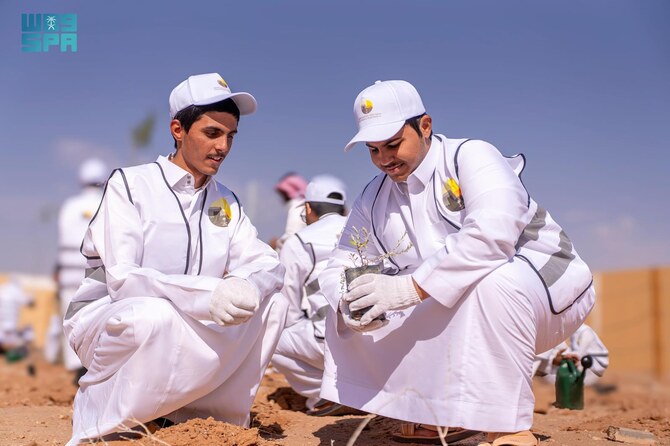
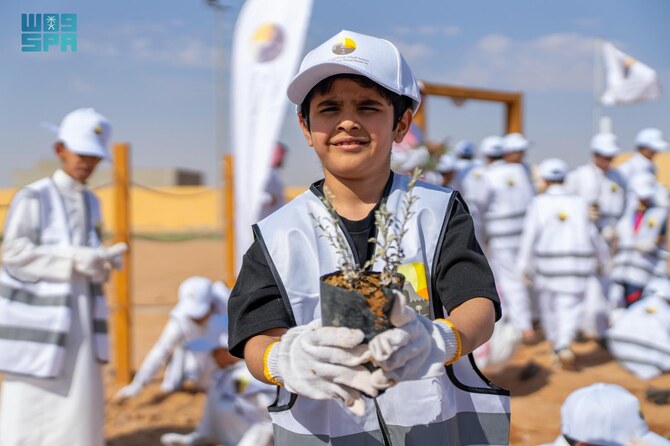
RIYADH: The King Abdulaziz Royal Reserve Development Authority has completed the second phase of a school-based initiative aimed at raising environmental awareness and encouraging community involvement, the Saudi Press Agency reported on Wednesday.

In the second phase of the initiative, it expanded its reach to 1,300 students across all grades — up from the 500 students involved in the first phase — and included five school complexes where students planted 1,600 native trees and seedlings.

The initiative aligns with the authority’s broader goals of increasing vegetation cover, educating young people, and promoting sustainable practices, in line with the 2030 strategic targets for royal reserves and the Saudi Green Initiative.

It includes interactive projects and volunteer opportunities for students and is designed to inspire young people to become environmental stewards. 

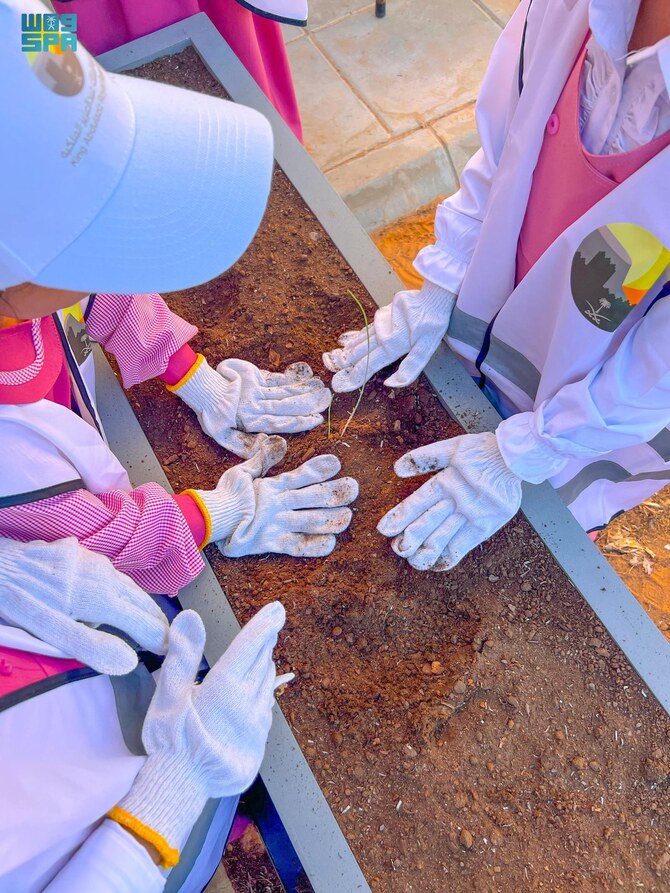
The participants’ volunteer hours are recorded on the National Volunteer Portal affiliated with the Ministry of Human Resources and Social Development.

By caring for these plants, students will develop a deeper connection with their environment, the SPA reported.


Automatic defense systems ‘hugely important’ in dealing with threats

Updated 9 sec ago
Follow

Automatic defense systems ‘hugely important’ in dealing with threats

RIYADH: Automatic defensive systems that respond to threats in real time without human intervention are “hugely important” in modern air defense, a senior executive at Lockheed Martin told Arab News at the World Defense Show in Riyadh on Thursday.

Joseph Rank, chief executive and vice president at Lockheed Martin Saudi Arabia and Africa, said the ability to connect detection systems directly to interceptors without delay is critical when responding to fast-moving threats such as missiles and drones.

“Integration is hugely important today. There’s so many threats, and the way you deal with threats in a real-time basis is by having everything integrated,” Rank said.

He described systems in which sensors identify incoming projectiles and automatically communicate with defensive assets.

“Your sensors or your radars have to see the incoming missiles or drones, but you don’t want to wait and have a human in loop … The sensors communicate automatically to the missiles that are going to knock those out of the air,” he said.

Rank said latency must be minimal to ensure an effective response.

“The latency has to be almost like nothing there, like a nanosecond, so that immediately, when you pick up that incoming missile or drone, it’s automatically communicated, no human in the loop that’s there,” he said.

He spoke about how the company uses a system called Command IQ to support this interconnectivity, linking sensors and interceptors in real time and incorporating artificial intelligence to assess response options.

The system works by “connecting everything together, sensors to shooters in real time, and it also integrates artificial intelligence. So, it gives you the best options.

“You might have three or four options to shoot or eliminate that drone. It gives you what’s the most cost-effective, what has the most probability of kill. And so, it helps you protect your citizens here, the citizens of the Kingdom.”

Beyond system integration, Rank also addressed the company’s operations in Saudi Arabia, describing a shift from supplying equipment to carrying out manufacturing and maintenance activities locally.

“We used to sell things to the Kingdom. Now we actually make things here in the Kingdom,” he said.

The company is meeting or exceeding the country’s 60 percent localization requirement and is investing in workforce development, he added.

Rank said that the company, which has operated in Saudi Arabia for 60 years, intends to continue expanding its role, including through future co-development of systems in Saudi Arabia.

“We’re going to build new things here in the Kingdom that will be for the Kingdom’s use, and we will export abroad.”

The company also announced in a statement on Thursday that it signed a memorandum of understanding with the Arabian International Co. for Steel Structures to expand localized production of components for the advanced Terminal High Altitude Area Defense weapon system.