
RIYADH: Saudi Arabia’s sovereign wealth fund is spearheading the growth of the e-mobility sector in the Kingdom with a planned $39 billion investment, according to an expert.
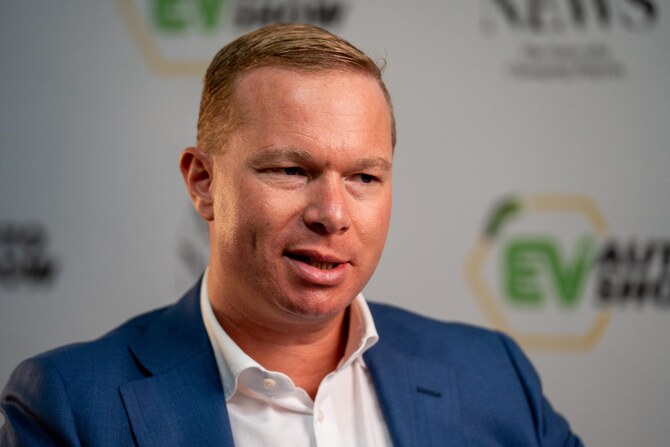
Speaking to Arab News on the sidelines of the EV Auto Show in Riyadh on Sept. 17, Heiko Seitz, partner and global e-mobility leader at PwC, said the Public Investment Fund is significantly facilitating finance streams to create a healthy eclectic vehicle value chain.
“Between now and 2030, the PIF ecosystem will invest a total of approximately $39 billion in the creation of an entire new industry. We will see half of that capital going to the creation of (an) EV manufacturing ecosystem, one quarter going into battery manufacturing and supply chain, and another quarter into parts and chips etc,” said Seitz.
He added: “We see that there is a national effort to build an industry from scratch. It is quite spectacular and fascinating to see how a country is able, in such a short time, to partner up with leading companies globally, and bring the best of the world to the Kingdom, and therefore starting their own success journey from scratch.”
During the talk, Seitz also highlighted some of the main challenges Saudi Arabia is facing in the e-mobility sector, which include the availability of new vehicles and the lack of charging infrastructure.
“Approximately 30 percent of all the cars being offered for sale currently in Europe are battery electric. Here in the Middle East, it’s only approximately 7 percent, so there are lots of vehicle models that could be sold here, but they’re not yet. And that obviously limits the choice for the customer,” said Seitz.
The PwC official added that the issues surrounding charging infrastructure will be resolved soon, as companies including Electric Vehicle Infrastructure Co., also known as EVIQ, are ramping up charging stations in the Kingdom.
In May, EV maker Lucid, backed by the PIF, signed a memorandum of understanding with EVIQ to facilitate the activation of high-speed public charging infrastructure in Saudi Arabia.
“We see that there are lots of announcements of big companies like EVIQ starting to build the ecosystem, and I’m quite optimistic that we’re going to have a very bright future for electric mobility in the region,” added Seitz.
The PwC official further highlighted that the costs of electric vehicles are coming down globally, and it is slowly becoming as affordable as an internal combustion engine vehicle.
“In Saudi Arabia, we see that it is almost actually equally affordable to drive an EV as a commercial fleet operator than it is to drive the equivalent combustion engine vehicle. For the end customer, it is still a little bit more expensive because fleet customers always get better discounts,” he said.
He added that the prices of EVs in Saudi Arabia will come down further, with the entry of new car brands into the Kingdom.
“What we see now is that with more vehicle brands coming to the Kingdom to compete, there is going to be a price war, just like we have seen this price war unfold in Europe,” said Seitz.
He added: “I’m very confident that over the next years, possibly, already over the next months, prices will come down significantly, just like we’ve seen in Europe, where it’s already 15 percent cheaper without subsidies to drive a battery electric vehicle compared to the combustion engine car.”
Citing a recent survey conducted by PwC, Seitz said that 40 percent of the Saudi population is interested in buying an electric vehicle in the next three to four years.
“With more models coming to the market and with Lucid and Seer, (and) other local Saudi brands bringing the east to the market, I don’t see anything that should stop the customer from going all-electric,” he said.
The PwC official also lauded Saudi Arabia’s efforts in promoting green techniques in mobility, despite being an oil-rich nation.
He said: “Twenty-four percent of global carbon dioxide emissions come from the transport sector. So if we’re serious about making our future greener and cleaner, we have to decarbonize mobility now.”
Seitz praised Saudi Arabia for its “fabulous, green electricity agenda,” adding: “We expect that by 2035, the entire mobility transport, the entire mobility energy demand and much more will be fully fueled by green energy based on solar power. So, here the Kingdom actually shows that you don’t only electrify, you can also decarbonize mobility in an oil-rich country.”