Hundreds of Hezbollah members wounded in Lebanon when pagers explode, security source says

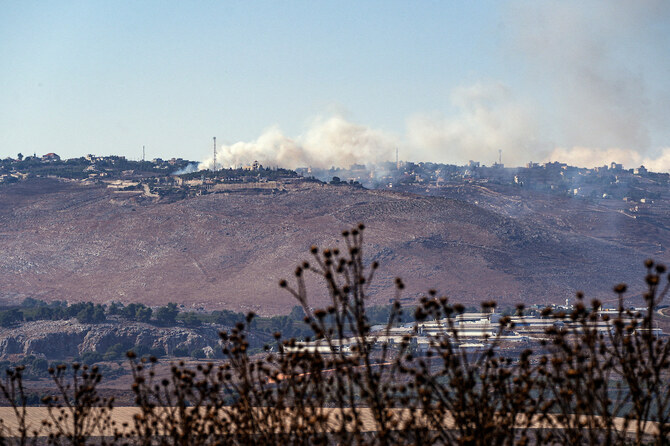
Smoke rises above Lebanon following an Israeli strike, amid the ongoing cross-border hostilities between Hezbollah and Israeli forces, as seen from Israel's border with Lebanon in northern Israel, September 8, 2024. (Reuters)
Short Url
Updated 17 September 2024
Follow

Hundreds of Hezbollah members wounded in Lebanon when pagers explode, security source says

BEIRUT: Hundreds of members of the Lebanese armed group Hezbollah, including fighters and medics, were seriously wounded on Tuesday when the pagers they use to communicate exploded, a security source told Reuters.
A Hezbollah official, speaking on condition of anonymity, said the detonation of the pagers was the “biggest security breach” the group had been subjected to in nearly a year of war with Israel.
The explosions took place amid heightened violence between Israel and Hezbollah, who have been engaged in cross-border warfare since the Gaza war erupted last October in the worst such escalation in years.
There was no immediate comment from the Israeli military to Reuters enquiries about the detonations.
A Reuters journalist saw ambulances rushing through the southern suburbs of the capital Beirut amid widespread panic. Residents said explosions were taking place even 30 minutes after the initial blasts. The security source added that devices were also exploding in the south of Lebanon.
Groups of people huddled at the entrance of buildings to check on people they knew who may have been wounded, the Reuters journalist said.
Regional broadcasters carrying CCTV footage which showed what appeared to be a small handheld device placed next to a grocery store cashier where an individual was paying spontaneously exploding. In other footage, an explosion appeared to knock out someone standing at a fruit stand at a market area.
Lebanon’s crisis operations center, which is run by the health ministry, asked all medical workers to head to their respective hospitals to help cope with the massive numbers of wounded coming into for urgent care. It said health care workers should not use pagers.
Hezbollah fired missiles at Israel immediately after the Oct. 7 attacks by Hamas gunmen on Israel. Hezbollah and Israel have been exchanging fire constantly ever since, while avoiding a major escalation as war rages in Gaza to the south.
Tens of thousands of people have been displaced from towns and villages on both sides of the border by the hostilties.


In Lahore’s historic Walled City, Ramadan fills the rows at Mughal-era Sunehri Mosque

Updated 46 sec ago
Follow

In Lahore’s historic Walled City, Ramadan fills the rows at Mughal-era Sunehri Mosque

  • Experts call for restoration of the 18th-century mosque amid encroachments and structural strain
  • Generations of traders shift their work schedules in Ramadan to gather for iftar and nightly prayers

LAHORE, Pakistan: In Old Lahore’s Kashmiri Bazaar, Ramadan changes the rhythm of trade.

By late afternoon, shop shutters begin to drop halfway and traders step away from their counters. Within minutes, the courtyard of Sunehri Mosque begins to fill.

On most days, the 18th-century mosque holds just a few rows of worshippers. In Ramadan, that number more than doubles.

“It has been 27 years since I have been leading the prayers here,” Qari Mohammed Hanif, the 47-year-old imam at the mosque, told Arab News. “On normal days, there are four to five rows. But in Ramadan, the mosque fills completely. People stand till the lower end.”

The congregation is largely drawn from the surrounding market — shopkeepers, traders and workers who close their businesses and walk directly into prayer.

The congregation at Sunehri Masjid is largely drawn from shopkeepers, traders and workers who close their businesses and walk directly into prayer. (Supplied)

For many, the mosque is inseparable from livelihood.

“I have a shop at Sunehri Masjid,” said Nasir Mehmood, 46, who runs a yarn business steps away. “This is our third generation running the shop. First it was my grandfather, then my father and now us. The shop is 50 years old.”

He said that at the beginning of Ramadan, he breaks his fast at home with his family. As the month progresses, the routine shifts.

“We start breaking our fast here at the shop, together with our friends and fellow shopkeepers. We also offer Taraweeh prayers here,” he continued, referring to the special Ramadan prayer performed after the obligatory Isha prayer at night.

Working hours extend as well.

“For the first three to four fasts, we come at 12 p.m. and leave after Asar prayers,” said Sheikh Mohammed Saleem, 50, who runs a clothing shop nearby. “After that, our routine changes. We open at 11 a.m. and stay until 12 a.m. at night, continuing this schedule until the last fast of Ramadan.

“Some food is brought from home, and some we buy from the market,” he added. “All of us gather together to break our fast.”

For many, the mosque is inseparable from livelihood. (Supplied)

Others return year after year for spiritual reasons.

“I have been coming here for 11 years,” said Mohammed Rafique, 45. “Whenever I am in this area, I always come to this mosque. I find peace here, peace in my heart. There is something from Allah. I cannot explain it. Whenever I come here, I try to break my fast here.”

Even younger traders feel a strong attachment to the space. Abdullah, 25, who gave only one name, said the mosque has become part of his working life.

“I have a shop in Lahore’s Rang Mehal, in Kasera Bazaar, under Sunehri Masjid,” he said. “I have been here for three years. The environment here is very good, the people are good.”

GILDED DOMES

The building that fills so quickly during Ramadan was constructed in 1753 during the later Mughal period by Nawab Bhikari Khan, a deputy governor of Lahore. Its three gilded domes gave it the name “Sunehri,” meaning golden.

Unlike imperial Mughal mosques built in expansive courtyards, Sunehri Mosque was embedded within a functioning marketplace. It rose not in isolation but among shops, a structure woven into commercial life rather than set apart from it.

“The Sunehri Mosque is small in scale because it was built during the decline of the Mughal Empire, a time when political power had weakened and resources were limited,” cultural heritage expert Saad Zahid told Arab News. “Its modest size and comparatively simple detailing reflect this period of reduced imperial strength.

Sunehri Mosque was embedded within a functioning marketplace. It rose not in isolation but among shops, a structure woven into commercial life rather than set apart from it. (Supplied)

“Unlike earlier Mughal monuments, it does not display the same richness or refinement, making it an important example of late Mughal architecture in Lahore,” he added.

Lahore, once a major administrative and cultural center of the Mughal Empire, saw numerous mosques constructed at the height of imperial power. Like most of them, Sunehri Mosque’s courtyard also featured a central pond, a hallmark of Mughal mosque design, though visitors usually find it dry these days.

Sunehri Masjid

While the mosque remains active and crowded during Ramadan, aspects of its physical condition raise concern.

The historic shops built beneath the mosque are now heavily encroached upon, obscuring parts of the mosque’s facade. Piles of wooden ladders and used boxes are stacked along sections of the structure. Tangled electricity wires hang across and above the building, cutting through the visual line of its domes. In some areas, residents hang washed clothes along its outer walls to dry.

B

angled electricity wires hang across and above the building, cutting through the visual line of its domes.  (Supplied)

Behind the mosque lies Baoli Bagh, once associated with an important Sikh-era gurdwara site, which Zahid said also deserves conservation.

He also argued that, like the Badshahi and Wazir Khan mosques, Sunehri Mosque should remain open to visitors beyond prayer times and be more actively promoted as part of Lahore’s historic landscape.

“The frescoes inside the mosque today appear overly bright and artificial. The original Mughal paintings were likely more subtle in tone, suggesting that later interventions have altered its authentic appearance,” he said, emphasizing the urgency of the building’s careful restoration to protect original design, materials and architectural identity rather than replace them with new construction.