

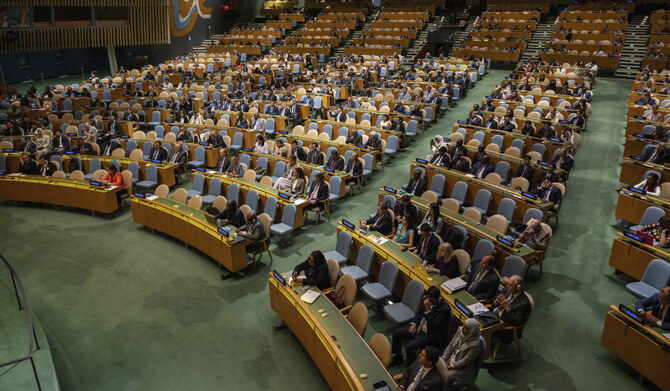

UNITED NATIONS, United States: UN member states debated Tuesday a push by the Palestinians to formally demand an end to the Israeli occupation of the Palestinian territories within 12 months.
The text, which has faced fierce criticism from Israel, is based around an advisory opinion from the International Court of Justice calling Israel’s occupation since 1967 “unlawful.”
“Israel is under an obligation to bring to an end its unlawful presence in the Occupied Palestinian Territory as rapidly as possible,” read the opinion, requested by the General Assembly.
In response, Arab countries called for a special session of the assembly just days before dozens of heads of state and government descend on the UN headquarters this month to address the kick off of this year’s General Assembly session.
“The idea is you want to use the pressure of the international community in the General Assembly and the pressure of the historic ruling by the ICJ to force Israel to change its behavior,” said Palestinian Ambassador to the UN Riyad Mansour Monday, acknowledging the draft resolution had “shocked many countries.”
The draft resolution, due for a vote Wednesday at 11:00 am (1500 GMT), “demands that Israel brings to an end without delay its unlawful presence in the Occupied Palestinian Territory,” and that this be done “no later than 12 months from the adoption.”
The first draft text gave only six months.
Israel firmly rejected the resolution on Tuesday.
“We gather here to watch the Palestinians’ UN circus — a circus where evil is righteous, war is peace, murder is justified,” said Israel’s ambassador to the UN Danny Danon.
“How dare you continue this tradition of passing one-sided resolutions against Israel.”
The draft resolution — which would be non-binding — “demands” the withdrawal of Israeli forces from the Palestinian territories, a halt to new settlements, the return of seized land and property, and the possibility of return for displaced Palestinians.
It also calls on states “to take steps toward ceasing” arms provisions to Israel when there are “reasonable grounds to suspect that they may be used in the Occupied Palestinian Territory.”
“The Palestinians want to live — not survive. They want to be safe in their homes,” said Mansour Tuesday, kicking off the debate on the first resolution ever introduced by the Palestinians.
“How many more Palestinians need to be killed before change finally takes place to stop this inhumanity?“
The ICJ opinion was “a historic opinion as this was the first time the court examined the Israeli occupation as a whole,” Mansour said.
US Ambassador Linda Thomas-Greenfield condemned the draft resolution as “inflammatory” and said it “is not going to advance the cause of peace.”
“It also fails to acknowledge, among other things, that Hamas, a terrorist organization, is currently exerting power, control and influence in Gaza,” Thomas-Greenfield added.
While the Security Council is largely paralyzed on the Gaza issue — with the United States repeatedly vetoing censures of its ally Israel — the General Assembly has adopted several texts in support of Palestinian civilians amid the current war.
In May the assembly overwhelmingly supported a largely symbolic resolution on full Palestinian membership of the UN, garnering 143 votes in favor, nine against with 25 abstentions.
The push had previously been vetoed by Washington at the Security Council.
The October 7 attack on southern Israel that sparked the current war resulted in the deaths of 1,205 people, mostly civilians, according to an AFP tally based on official Israeli figures.
Militants also seized 251 hostages, 97 of whom are still held in Gaza, including 33 the Israeli military says are dead.
Israel’s retaliatory military offensive has killed at least 41,252 people in Gaza, according to the Hamas-run territory’s health ministry, which does not provide a breakdown of civilian and militant deaths.
“We fight because we have no other choice yet, despite the cruelty we have faced, despite the unprecedented terror unleashed upon our people, this assembly remains silent,” Danon told the assembly meeting.


