

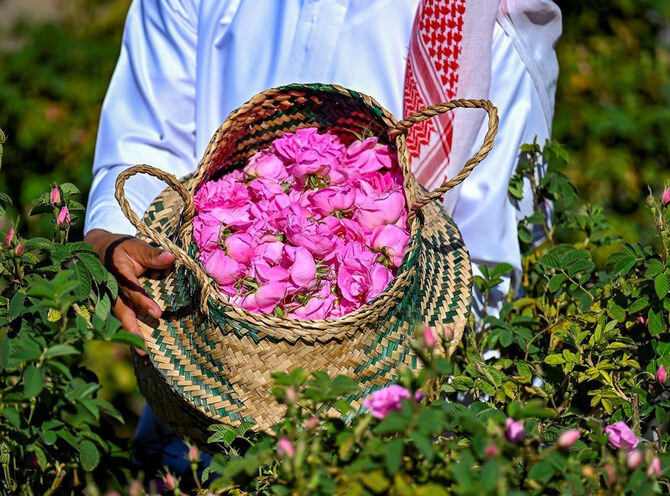
Saudi Arabia localizes rose cultivation to boost agriculture

1 / 2
Key incentives include the success of tissue culture rose cultivation, which lowers production costs while promoting growth. (SPA)
2 / 2
Key incentives include the success of tissue culture rose cultivation, which lowers production costs while promoting growth. (SPA)
Short Url
Updated 19 September 2024
Follow

Saudi Arabia localizes rose cultivation to boost agriculture

RIYADH: Saudi Arabia has announced the localization of rose cultivation to meet rising local demand, create jobs, and reduce reliance on costly, lower-quality imports.

The initiative also aims to boost exports to Gulf and Middle Eastern markets, supporting agricultural growth in line with Vision 2030, the Saudi Press Agency reported.

The Ministry of Environment, Water and Agriculture unveiled incentives to strengthen the sector, offering financial returns to enhance rose producers’ economic standing.

Key incentives include the success of tissue culture rose cultivation, which lowers production costs while promoting growth.

The ministry also offers affordable agricultural land, investment opportunities leveraging the comparative advantages of roses, and loans covering 70 percent of project costs from the Agricultural Development Fund.

Additionally, it provides technical support and streamlined licensing for rose cultivation projects.

The ministry emphasized using technologies such as hydroponics and smart systems to reduce costs and improve efficiency, as well as opportunities to produce rare and in-demand rose varieties for higher economic returns.


King Abdulaziz Foundation reveals rare images from king’s 1916 Basra visit

Updated 20 December 2025
Follow

King Abdulaziz Foundation reveals rare images from king’s 1916 Basra visit

  • Photographs form part of a wider collection documented by British photographer Gertrude Bell

RIYADH: The King Abdulaziz Foundation has revealed archival photographs documenting King Abdulaziz’s tour of the outskirts of Basra in 1916, a visit that came at an early stage of his efforts to build regional relationships.

One of the photographs, taken by British photographer Gertrude Bell, shows King Abdulaziz standing with his men in the Basra desert, the Saudi Press Agency reported. 

The image reflects his early political and diplomatic engagement in the region, as he sought to strengthen ties with neighboring areas and engage with the wider Arab and international community, SPA added.

The photograph forms part of a wider collection documented by Bell, which records key developments and transformations across the Arabian Peninsula during the early 20th century.

The Basra visit holds particular significance in King Abdulaziz’s journey as a unifying leader. 

Rather than crossing borders in pursuit of power, the visit reflected an approach focused on stability, cooperation and long-term regional harmony, laying the groundwork for a leadership style defined by pragmatism and openness, SPA said.