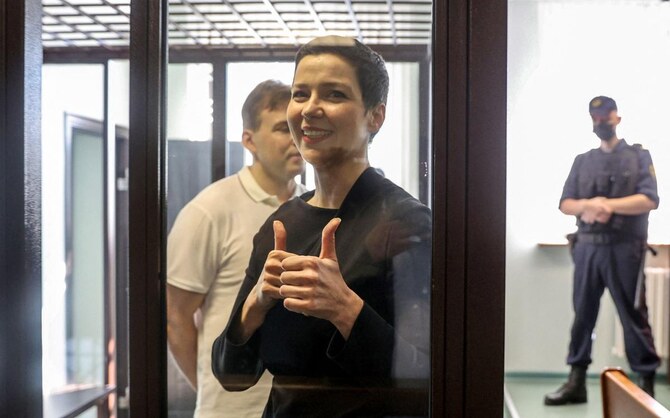
WARSAW: Nobody outside of Prison Colony Number Four in the Belarusian city of Gomel has seen or heard from Maria Kolesnikova, imprisoned for leading huge 2020 protests against President Alexander Lukashenko since February last year.
An orchestra flute player, Kolesnikova was the star of a street movement that shook the Minsk regime four years ago — she then famously ripped up her passport while the KGB tried to forcibly deport her.
The 42-year-old is now serving an 11-year sentence in Gomel, one of over 1,000 political prisoners in the country. She has been barred from contact with the outside world for 19 months.
Minsk announced a new wave of pardons on Monday, with 37 political prisoners freed, but it was not yet known if Kolesnikova was included.
Two ex-prisoners released from the same colony told AFP Kolesnikova spends months in the harshest “PKT” type of punishment cell, held in isolation from other inmates, who are banned from talking to her.
“I am worried for her life,” her sister Tatiana Khomich, who lives abroad, told AFP.
She has been told Kolesnikova’s weight has severely dropped.
Kolesnikova had lost weight after abdominal surgery in November 2022, but has now lost “even more,” unable to recover in harsh conditions and denied an appropriate diet, her sister said.
According to Khomich, she has a limited allowance of around 20 euros in the prison shop per month.
“She’s basically starving,” Khomich said.
The world last saw a glimpse of Kolesnikova after the surgery, when she was allowed to see her father, with authorities releasing a fuzzy picture.
Then, the letters stopped: the last one was dated February 15, 2023. Contact was also lost with other key imprisoned opposition figures.
Khomich knows that Kolesnikova spends most of her time in the PKT, which ex-convicts describe as a “prison inside a prison.” PKT is an acronym for “cell-type space.”
Darya Afanasyeva, a feminist activist who served a 2.5-year sentence in Gomel, said information on Kolesnikova trickled down to women in the prison if someone was sent to a punishment cell and heard her through a wall.
Released this spring and now living in Poland, she described the level to which Kolesnikova was kept out of sight.
When a medical van came into the prison, likely headed for Kolesnikova, Afanasyeva said authorities put the colony “on some kind of martial law.”
“Everyone was put in one room and you are not allowed to go to the windows,” the 29-year-old said.
“We saw it was headed to the PKT and we understood it was for Masha.”
Before Kolesnikova was sent to the PKT, Afanasyeva said she appeared “very thin.”
Afanasyeva said Kolesnikova’s isolation in the Gomel prison — which started filling up with political prisoners after the protests — started as soon as the protest leader arrived there in June 2022.
Women with political cases were singled out with a yellow triangle on their uniforms, ex-prisoners said.
Prison officials were quick to cut Kolesnikova off.
She was the only political prisoner placed in a “brigade” with no other women with political cases.
Afanasyeva described the level of surveillance around Kolesnikova when she was still working at the prison sewing factory.
“They put special cameras to watch her, she worked on a machine and these two cameras were right above her table,” the activist, who had a yellow triangle tattooed on her forearm, said.
“Everything to do with Masha was made into a secret,” said Kristina Cherenkova, another former political prisoner, arrested for social media posts against the war in Ukraine in her town near the Ukraine border.
“Practically the whole year and one month that I was in the Gomel prison, she was in the PKT,” Cherenkova, now also in Poland, said.
She relayed what women sent to solitary confinement had told her.
“At first, the girls said her voice was strong and that she sang in there,” Cherenkova said.
“But in the last months of me being there, they would say you could not hear her as much.”
When news broke of a major swap between Russia — on whom Belarus relies — and the West, Khomich had hoped her sister would be among prisoners released.
But while let down by an absence of Belarusian dissidents in the swap, it gave her a boost that “talks are possible, even in times of war.”
A fresh wave of pardons this summer has offered new hope to relatives of political prisoners.
Analyst Artyom Shraibman said Kolesnikova was getting “special treatment” in prison, with the regime driven by “revenge for the trauma of 2020.”
He struggled to imagine a free Kolesnikova, saying “Lukashenko mainly lets people go who would leave prison soon anyway.”
“Or who would die in prison soon,” he added.


![]()

‘Starving’ in isolation: fears for imprisoned Belarus protest leader
Short Url
https://arab.news/8sh4w
‘Starving’ in isolation: fears for imprisoned Belarus protest leader
- The 42-year-old is now serving an 11-year sentence in Gomel, one of over 1,000 political prisoners in the country
- Minsk announced a new wave of pardons on Monday, with 37 political prisoners freed, but it was not yet known if Kolesnikova was included


Latest updates







© 2026 SAUDI RESEARCH & PUBLISHING COMPANY, All Rights Reserved And subject to Terms of Use Agreement.