

Pakistan recorded 44% rise in workers remittances from July-August— state media

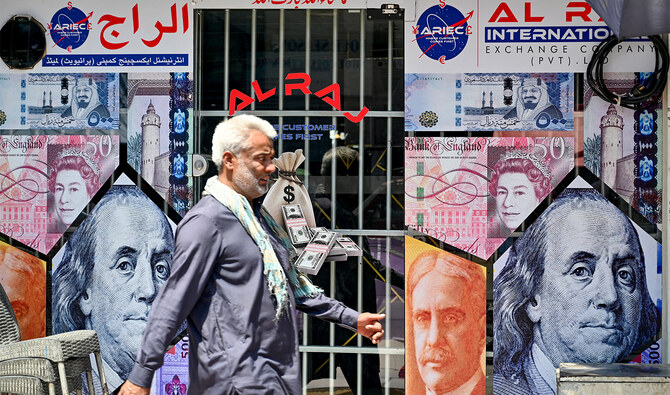
A man walks past a currency exchange shop in Rawalpindi on June 12, 2024. (AFP/File)
Short Url
Updated 16 September 2024
Follow

Pakistan recorded 44% rise in workers remittances from July-August— state media

  • Pakistan’s workers remittances have reached $5.94 billion dollars this fiscal year, says state media
  • Credits country’s investment-friendly policies, government crackdown against smuggling of dollars for surge

ISLAMABAD: Pakistan has seen a “significant increase” in workers remittances at the beginning of the current fiscal year from July-August, state-run media reported on Monday, crediting the surge to the Special Investment Facilitation Council’s (SIFC) policies and the government’s crackdown on the smuggling of foreign currency. 

Workers remittances form a cornerstone of Pakistan’s economy, significantly contributing to the country’s foreign exchange reserves and reducing the current account deficit. Remittances also play a major role in supporting Pakistan’s external account, especially at a time when the country is recording small gains after a prolonged economic crisis that diminished its foreign reserves and weakened its national currency. 

“There has been a significant increase of forty-four percent in remittances at the beginning of the current fiscal year due to the support of the SIFC,” state broadcaster Radio Pakistan reported. 

“According to the statistics released by the State Bank of Pakistan, remittances have reached 5.94 billion dollars with an increase of 1.81 billion dollars compared to 4.12 billion dollars in July-August last year.”

The SIFC was set up in July last year to serve as a “one window operation” to address any concerns of foreign investors, with a special focus on attracting funds from Gulf nations. The government has recently actively promoted the employment of Pakistanis abroad, especially in the Middle East, to ensure a steady increase in investments, crucial for the country’s economic growth.

The state broadcaster said that the government’s crackdown against illegal money transfer systems such as Hundi and the smuggling of dollars led to a stable exchange rate and increase in foreign reserves. 

Pakistan’s government last year launched a crackdown against currency smugglers and hoarders when the cost of the US dollar soared, as people preferred informal banking channels to remit money to relatives in Pakistan. 


Pakistan PM speaks to UAE president, calls for enhanced cooperation

Updated 13 February 2026
Follow

Pakistan PM speaks to UAE president, calls for enhanced cooperation

  • Shehbaz Sharif lauds UAE’s economic support in challenging times
  • Both leaders discuss a range of issues, agree to stay in close contact

ISLAMABAD: Prime Minister Shehbaz Sharif on Friday praised the United Arab Emirates for what he described as steadfast financial and political support during Islamabad’s recent economic crisis, as both sides signaled plans to deepen bilateral cooperation.

In a statement issued after Sharif spoke with UAE President Sheikh Mohamed bin Zayed Al Nahyan, the Prime Minister’s Office said the two leaders discussed matters of mutual interest and agreed to stay in close contact.

“The Prime Minister lauded the UAE’s consistent and unwavering support to Pakistan, that had helped the country navigate through difficult challenges,” the statement said, adding the two leaders “reaffirmed their shared desire to further enhance mutually beneficial cooperation between Pakistan and the UAE.”

The UAE, along with other friendly nations in the region, provided critical financial assistance to the South Asian country during a balance-of-payments crisis that strained Pakistan’s foreign exchange reserves and pressured its currency. Islamabad subsequently secured an International Monetary Fund program as part of broader stabilization efforts.

Sharif, in a post on X, described the exchange as positive.

“We fondly recalled our recent meetings and reaffirmed our shared resolve to further strengthen the historic, fraternal ties between Pakistan and the United Arab Emirates, and to expand mutually beneficial cooperation,” he wrote.

Millions of Pakistanis live and work in the UAE, forming one of the largest expatriate communities in the Gulf state.

Remittances from the UAE rank among Pakistan’s top sources of foreign currency inflows and play a significant role in supporting the country’s external accounts.

UAE-based companies are also investing in Pakistan, helping Islamabad develop its seaports to facilitate regional trade.