ISLAMABAD: The Pakistani government on Monday postponed the tabling in parliament of a history-making “constitutional amendment package” on judicial reforms as several members of the legal fraternity rejected the proposals and challenged them in the Supreme Court of Pakistan.
The government was expected to table the amendments in the National Assembly and Senate on Monday after it did not do so a day earlier. According to Law Minister Azam Nazir Tarar, the package includes 52 amendments to the constitution, mostly involving minor wording changes.
The proposed amendments are expected to establish a federal constitutional court, raise the retirement age of superior judges by three years, and modify the process for the appointment of chief justice of the Supreme Court of Pakistan.
The matter has raised widespread concerns among opposition parties and independent experts who say the moves are aimed at increasing the government’s power in making key judicial appointments and dealing with the defection of lawmakers during house votes.
The government was initially expected to table the amendments on Sunday, but Defense Minister Khawaja Asif, a senior member of the ruling Pakistan Muslim League-Nawaz (PML-N) party, later said they could not secure the required 224 votes, two-thirds majority, needed to pass the amendments.
“We want and desire complete consensus within the House, so this process will continue, and when all parties agree on this document, this draft will be presented in the House,” Asif said, while speaking in the National Assembly on Monday afternoon.
“We believe that no one will oppose the proposals as we are determined to shape the constitution in line with the agreement in the Charter of Democracy.”
The Charter of Democracy (CoD) was signed between the PML-N and the Pakistan Peoples Party (PPP), two major political parties in Pakistan, on May 14, 2006 in London. The document outlined steps to end the military rule established after the 1999 coup d’état led by late General Pervez Musharraf and to restore democracy in Pakistan.
Asif said the amendments aimed to address “constitutional imbalances” and public representatives would have the right to undo any “intrusions” into parliamentary powers and the constitution.
“A draft has been prepared to address constitutional imbalances, especially those related to parliament, and it is a draft to improve the 19th amendment [on procedure for judicial appointments], and the constitution allows us to do so,” the defense minister said, adding there was no political motivation behind it.
The Pakistan Tehreek-e-Insaf (PTI) opposition party of jailed former premier Imran Khan has criticized the moves and believes that the amendments are meant to grant an extension to incumbent Supreme Court Chief Justice Qazi Faez Isa, who is widely believed to be aligned with the ruling coalition led by PM Shehbaz Sharif and in opposition to its chief rival, the PTI. PTI founder Khan has threatened nationwide protests against the reforms.
Speaking in the National Assembly, a former speaker and Khan aide, Asad Qaiser, strongly condemned the government’s moves and described them as a “mockery” of parliament.
“If you want to bring amendments, definitely bring them but after a proper debate and discussion on it,” he said, adding the government tried to pass amendments in the “dark of the night” and without even briefing its own members on them.
“We will oppose this type of pressure and oppression in the parliament, in the courts, on the road and everywhere.”
Law Minister Tarar said the draft of amendments had not yet been presented before the cabinet, as required under the constitution, and asked opposition parties to come up with positive recommendations, instead of undue criticism.
“A special parliamentary committee has been made, which included members of all political parties, so all are invited to bring suggestions in this regard to the committee,” he said.
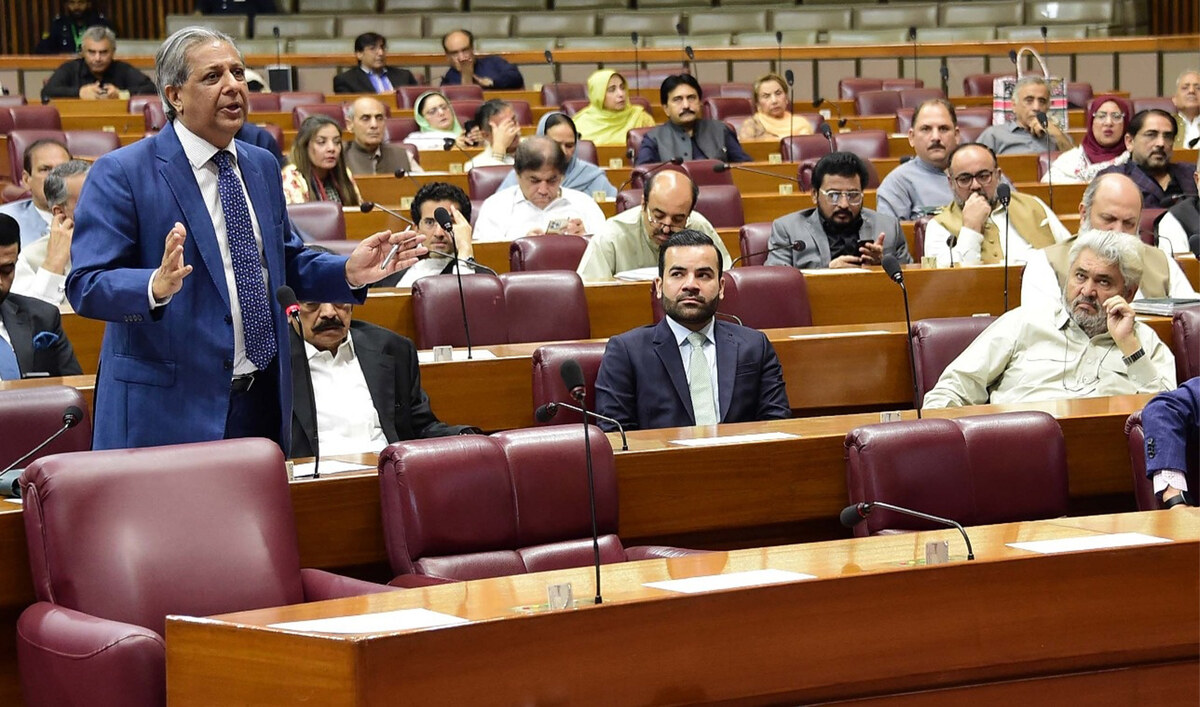
Pakistan's Azam Nazeer Tarar (left) is addressing a session of National Assembly in Islamabad, Pakistan on September 16, 2024. (@NAofPakistan/X)
‘SUBSERVIENT' JUDICIARY
Prominent lawyers, including Abid Zuberi, Shafqat Mehmood Chauhan, Shahab Sarki, Ishtiaq Ahmed Khan and Munir Kakar, filed a petition in the Supreme Court on Monday, challenging the proposed amendments to the constitution.
“Through the instant petition the petitioners seek to challenge the vires of the proposed constitutional package,” they stated in the petition. “The proposed bill puts forth proposed amendments to the constitution that would transfer the vested powers of the Supreme Court of Pakistan and the high courts of Pakistan as granted by the constitution to the executive and entirely annihilate the principles of independence of judiciary and suppression of power.”
Munir A Malik, a senior lawyer, said the proposed amendments would abolish the trichotomy of power — executive, legislature and judiciary — under the constitution.
“We will have a judiciary subservient to the executive and this is a frontal assault on the judicial system and the independence of the judiciary,” he told Arab News. “I think every lawyer who believes in the rule of law will stand up against any such step which undermines the independence of judiciary.”
Shaiq Usmani, former chief justice of the Sindh High Court, agreed that there had been a need for a constitutional court, but the proposed amendments were “most ill-timed.
“There is certainly a need for a constitutional court, yes, in a sense because the politicians here are constantly at war with each other and they always run to the Supreme Court to get their disputes resolved. As a result of that, the courts then have to give up commercial and other disputes of ordinary people, while they decide political cases,” he said.
“But this timing was wrong. At this time, when there is complete polarization in the political field, Pakistan is facing tremendous economic problems and so many other issues, so, this was certainly not the time for this sort of a thing. It was most ill-timed and fortunately, because of the fact that they [government] have not been able to get the required majority, it hasn’t been pushed through.”
Sabahat Rizvi, secretary of the Lahore High Court Bar Association, said the government “planned to disturb the unity of the judges” through this constitutional amendment package.
“They want to bring people of their choice, but we have already caused a lot of damage to our country and people through such constitutional amendments,” she told Arab News.
Rizvi said lawyers must unite against any such “attempt to undermine the independence of the judiciary,” irrespective of their political affiliations.
“Although lawyers have been divided due to their political affiliations, I would say that on this issue of national importance, they all should unite and come forward,” she said, promising to support any protest movement for this cause.
Arab News tried reaching the government’s spokesperson on legal affairs, Aqeel Malik, for a comment on the developments, but he did not answer the calls and messages.
AMENDMENTS
The coalition government is proposing that the retirement age of Supreme Court and high court judges be increased by three years from the existing 65 and 62 years, respectively. The current chief justice retires on Oct. 25.
The government is also mulling revising the seniority principle in the appointment of the top judge, the coalition government’s spokesperson on legal affairs Aqeel Malik told media last week. At present, according to Article 175A of the Constitution, the senior most judge of the Supreme Court is appointed as the chief justice on the basis of the principle of seniority, but there are widespread reports that the constitutional amendment envisions a five-member panel comprising top court judges as responsible for appointing the chief justice.
The reform package also includes a proposal to allow the transfers of judges from one high court to another and changes to Article 63-A of the Constitution, which relates to the disqualification of legislators who cross party lines in voting for a constitutional amendment.
The amendments have been proposed after a string of Supreme Court judgments that have ostensibly challenged Sharif’s coalition government, mostly notably a July 12 verdict by a 13-member bench of the Supreme Court that declared the PTI eligible for reserved parliamentary seats.
The verdict dealt a major blow to Sharif’s weak ruling coalition, which may lose its two-thirds majority in Pakistan’s parliament if the verdict is implemented. Sharif’s PML-N party has filed a review petition in the Supreme Court against the verdict.