China is raising its retirement age, now among the youngest in the world’s major economies

1 / 2
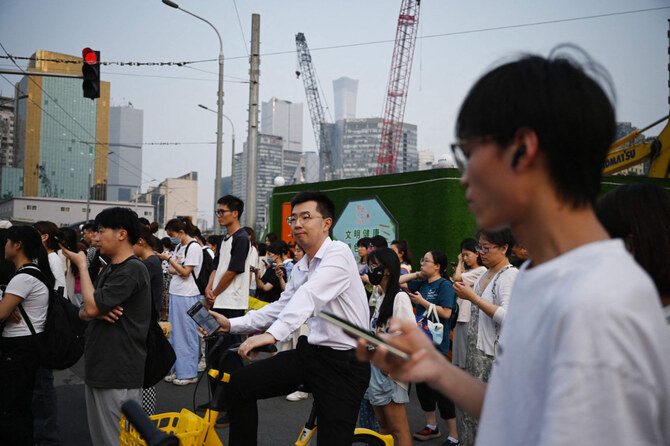
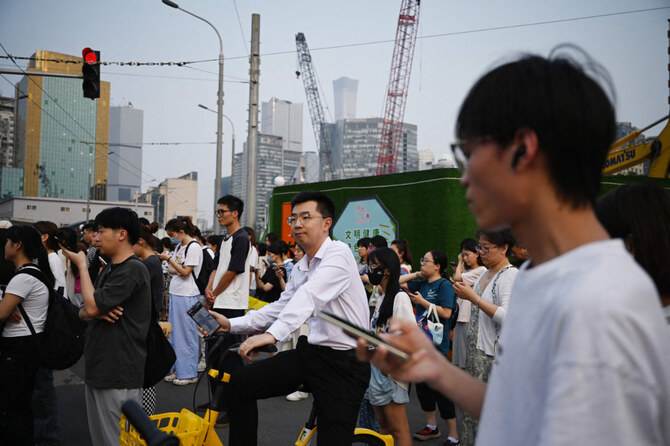
People wait to cross a road near a construction site in Beijing on July 9, 2024. As it grapples with a looming demographic crisis and an older population, China said it would gradually raise its statutory retirement age. (AFP)
2 / 2
People commute on a train in Shanghai, China, on September 20, 2022. China is grappling with a looming demographic crisis and an older population. (AFP)
Short Url
Updated 15 September 2024
Follow

China is raising its retirement age, now among the youngest in the world’s major economies

  • The policy change will be carried out over 15 years, with the retirement age for men raised to 63 years, and for women to 55 or 58 years depending on their jobs
  • The current retirement age is 60 for men and 50 for women in blue-collar jobs and 55 for women doing white-collar work

BEIJING: Starting next year, China will raise its retirement age for workers, which is now among the youngest in the world’s major economies, in an effort to address its shrinking population and aging work force.
The Standing Committee of the National People’s Congress, the country’s legislature, passed the new policy Friday after a sudden announcement earlier in the week that it was reviewing the measure, state broadcaster CCTV announced.
The policy change will be carried out over 15 years, with the retirement age for men raised to 63 years, and for women to 55 or 58 years depending on their jobs. The current retirement age is 60 for men and 50 for women in blue-collar jobs and 55 for women doing white-collar work.
“We have more people coming into the retirement age, and so the pension fund is (facing) high pressure. That’s why I think it’s now time to act seriously,” said Xiujian Peng, a senior research fellow at Victoria University in Australia who studies China’s population and its ties to the economy.
The previous retirement ages were set in the 1950’s, when life expectancy was only around 40 years, Peng said.


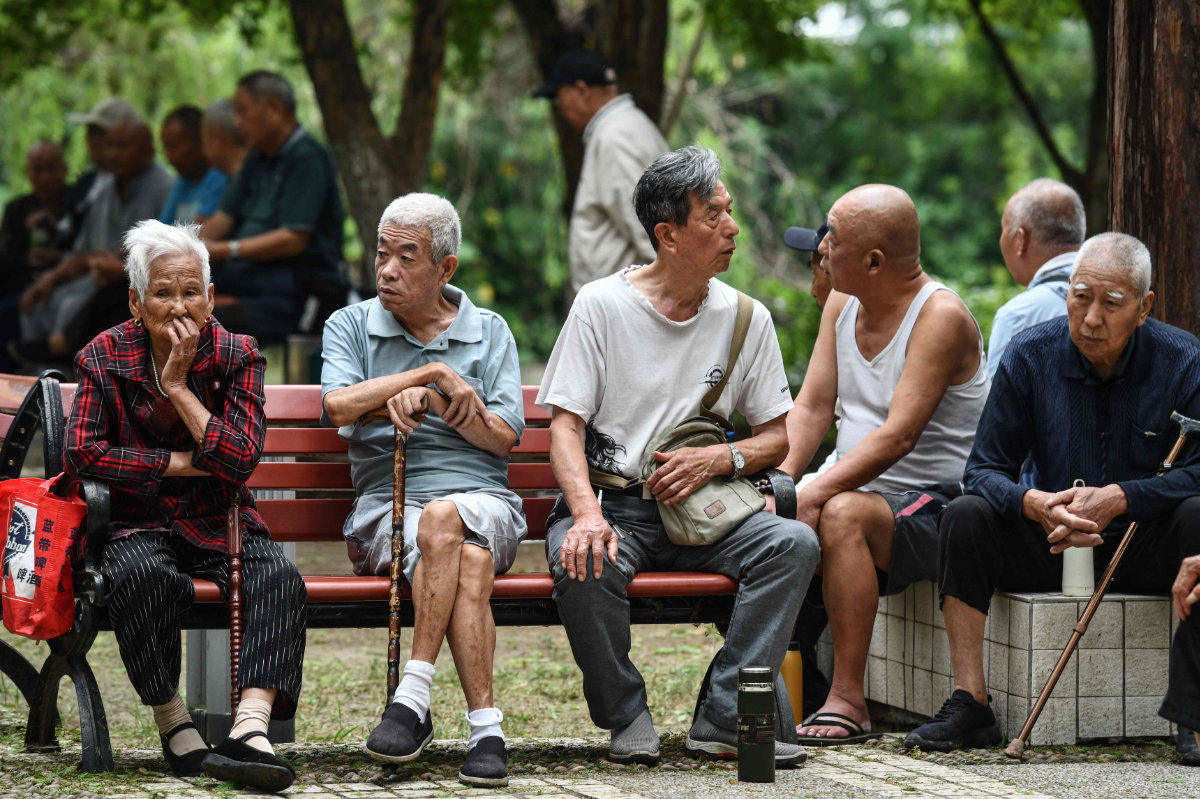
Elderly people rest at a park in Fuyang in eastern China's Anhui province on September 13, 2024. (AFP)

The policy will be implemented starting in January, according to the announcement from China’s legislature. The change will take effect progressively based on people’s birthdates.
For example, a man born in January 1971 could retire at the age of 61 years and 7 months in August 2032, according to a chart released along with the policy. A man born in May 1971 could retire at the age of 61 years and 8 months in January 2033.
Demographic pressures made the move long overdue, experts say. By the end of 2023, China counted nearly 300 million people over the age of 60. By 2035, that figure is projected to be 400 million, larger than the population of the US The Chinese Academy of Social Sciences had previously projected that the public pension fund will run out of money by that year.
Pressure on social benefits such as pensions and social security is hardly a China-specific problem. The US also faces the issue as analysis shows that currently, the Social Security fund won’t be able to pay out full benefits to people by 2033.
“This is happening everywhere,” said Yanzhong Huang, senior fellow for global health at the Council on Foreign Relations. “But in China with its large elderly population, the challenge is much larger.”
That is on top of fewer births, as younger people opt out of having children, citing high costs. In 2022, China’s National Bureau of Statistics reported that for the first time the country had 850,000 fewer people at the end of the year than the previous year , a turning point from population growth to decline. In 2023, the population shrank further, by 2 million people.


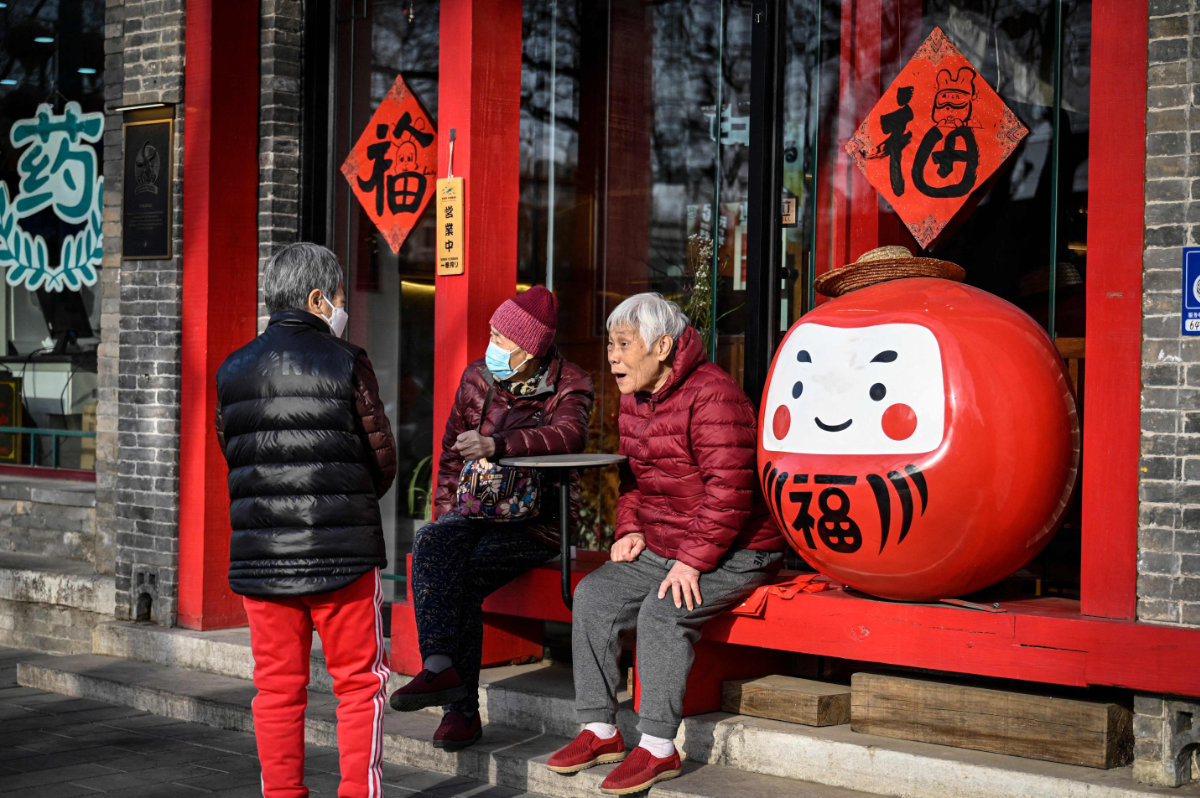
Elderly people chat outside a restaurant along a street in Beijing on March 16, 2023. (AFP)

What that means is that the burden of funding elderly people’s pensions will be divided among a smaller group of younger workers, as pension payments are largely funded by deductions from people who are currently working.
Researchers measure that pressure by looking at a number called the dependency ratio, which counts the number of people over the age of 65 compared to the number of workers under 65. That number was 21.8 percent in 2022, according to government statistics, meaning that roughly five workers would support one retiree. The percentage is expected to rise, meaning fewer workers will be shouldering the burden of one retiree.
The necessary course correction will cause short-term pain, experts say, coming at a time of already high youth unemployment and a soft economy.
A 52-year-old Beijing resident, who gave his family name as Lu and will now retire at age 61 instead of 60, was positive about the change. “I view this as a good thing, because our society’s getting older, and in developed countries, the retirement age is higher,” he said.
Li Bin, 35, who works in the event planning industry, said she was a bit sad.
“It’s three years less of play time. I had originally planned to travel around after retirement,” she said. But she said it was better than expected because the retirement age was only raised three years for women in white-collar jobs.
Some of the comments on social media when the policy review was announced earlier in the week reflected anxiety.
But of the 13,000 comments on the Xinhua news post announcing the news, only a few dozen were visible, suggesting that many others had been censored.


Rubio defends US ouster of Venezuela’s Maduro to Caribbean leaders unsettled by Trump policies

Updated 7 min ago
Follow

Rubio defends US ouster of Venezuela’s Maduro to Caribbean leaders unsettled by Trump policies

BASSETERRE, St. Kitts and Nevis: US Secretary of State Marco Rubio on Wednesday defended the Trump administration’s military operation to capture Venezuela’s Nicolás Maduro, telling Caribbean leaders, many of whom objected to that move, that the country and the region were better off as a result.
Speaking to leaders from the 15-member Caribbean Community bloc at a summit in the country of St. Kitts and Nevis, Rubio brushed aside concerns about the legality of Maduro’s capture last month that have been raised among Venezuela’s island-state neighbors and others.
“Irrespective of how some of you may have individually felt about our operations and our policy toward Venezuela, I will tell you this, and I will tell you this without any apology or without any apprehension: Venezuela is better off today than it was eight weeks ago,” Rubio told the leaders in a closed-door meeting, according to a transcript of his remarks later distributed by the US State Department.
Rubio said that since Maduro’s ouster and the effective takeover of Venezuela’s oil sector by the United States, the interim authorities in the South American country have made “substantial” progress in improving conditions by doing “things that eight or nine weeks ago would have been unimaginable.”
The Caribbean leaders have gathered to debate pressing issues in a region that President Donald Trump has targeted for a 21st-century incarnation of the Monroe Doctrine meant to ensure Washington’s dominance in the Western Hemisphere. The Republican administration has declared a focus closer to home even as Washington increasingly has been preoccupied by the possibility of a US military attack on Iran.
Rubio downplays antagonism in US regional push
In his remarks to the group, America’s top diplomat tried to play down any antagonistic intent in what Trump has referred to as the “Donroe Doctrine.” Rubio said the administration wants to strengthen ties with the region in the wake of the Venezuela operation and ensure that issues such as crime and economic opportunities are jointly addressed.
“I am very happy to be in an administration that’s giving priority to the Western Hemisphere after largely being ignored for a very long time,” Rubio said. “We share common opportunities, and we share some common challenges. And that’s what we hope to confront.”
He said transnational criminal organizations pose the biggest threat to the Caribbean while recognizing that many are buying weapons from the United States, a problem he said authorities are tackling.
Rubio also said the US and the Caribbean can work together on economic advancement and energy issues, especially because many leaders at the four-day summit have energy resources they seek to explore. “We want to be your partner in that regard,” he said.
Rubio said the US recognizes the need for fair, democratic elections in Venezuela, which lies just miles away from Trinidad and Tobago at the closest point.
“We do believe that a prosperous, free Venezuela who’s governed by a legitimate government who has the interests of their people in mind could also be an extraordinary partner and asset to many of the countries represented here today in terms of energy needs and the like, and also one less source of instability in the region,” he said.
Rubio added: “We view our security, our prosperity, our stability to be intricately tied to yours.”
Trump plays up Maduro’s ouster
Trump, in his State of the Union address Tuesday night, called the operation that spirited Maduro out of Venezuela to face drug trafficking charges in New York “an absolutely colossal victory for the security of the United States.”
The US had built up the largest military presence in the Caribbean Sea in generations before the Jan. 3 raid. That has now been exceeded by the surge of American warships and aircraft to the Middle East as the administration pressures Iran to make a deal over its nuclear program.
In the Caribbean, Trump has stepped up aggressive tactics to combat alleged drug smuggling with a series of strikes on boats that have killed over 150 people and he has tightened pressure on Cuba. Regional leaders have complained about administration demands for nations to accept third-country deportees from the US and to chill relations with China.
One regional leader who has backed the US escalation is Trinidad and Tobago Prime Min­is­ter Kam­la Persad-Bisses­sar, whom Rubio thanked for her “public support for US military operations in the South Caribbean Sea,” the State Department said.
Persad-Bissessar told reporters that her conversation with Rubio focused on “Haiti; we talked about Cuba of course; we talked about engagements with Venezuela and the way forward.”
She was asked if she considered the latest US military strikes in Caribbean waters as extrajudicial killings: “I don’t think they are, and if they are, we will find out, but our legal advice is they are not.”
Rubio had other one-on-one meetings with heads of government, including from St. Kitts and Nevis, Haiti, Jamaica and Guyana.
Caribbean leaders point to shifting global order
Trump said during the State of the Union that his administration is “restoring American security and dominance in the Western Hemisphere, acting to secure our national interests and defend our country from violence, drugs, terrorism and foreign interference.”
Terrance Drew, prime minister of St. Kitts and Nevis and chair of the Caribbean Community bloc, said the region “stands at a decisive hour” and that “the global order is shifting.”
Drew and other leaders said Cuba’s humanitarian situation must be addressed.
“It must be clear that a prolonged crisis in Cuba will not remain confined to Cuba,” Jamaican Prime Minister Andrew Holness warned. “It will affect migration, security and economic stability across the Caribbean basin.”
The US Treasury Department on Wednesday slightly eased restrictions on the sale of Venezuelan oil to Cuba, which instituted austere fuel-saving measures in the weeks after the US raid in Venezuela.
That move came hours before Cuba’s government announced that its soldiers killed four people aboard a speedboat registered in Florida that had opened fire on officers in Cuban waters.