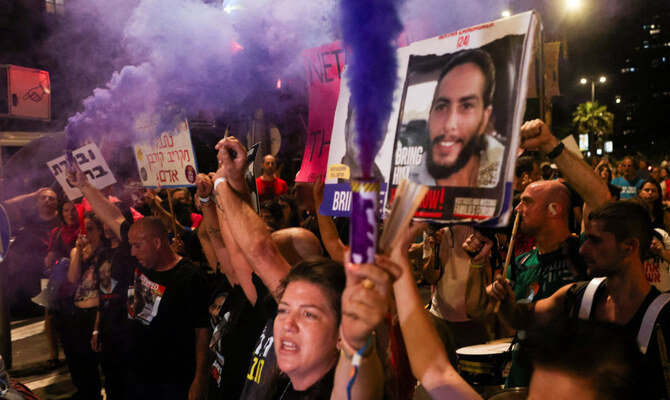
TEL AVIV: Thousands of people again took to the streets of Israel’s main cities on Saturday in a bid to increase pressure on the government to secure the release of hostages in Gaza.
Of 251 captives seized during Hamas’s October 7 attack on southern Israel that triggered the ongoing war, 97 are still held in the Gaza Strip including 33 the Israeli military says are dead.
Weekly rallies have sought to keep up pressure on the Israeli government, accused by critics of stalling on a deal to free the remaining hostages.
Protest organizers say crowd sizes have swelled this month after an announcement by Israeli authorities that six hostages whose bodies were recovered by troops had been shot dead by militants in a southern Gaza tunnel.
One of the six was Alexander Lobanov, whose wife Michal on Saturday addressed the crowd in Israel’s commercial hub of Tel Aviv, asking why the government did not “do everything” to bring him back alive.
“It was possible to save them, to rescue them through a deal,” she said, according to excerpts of her remarks provided by the Hostages and Missing Families Forum campaign group.
“True, it’s not as heroic as a military rescue, but it’s a different kind of bravery.”
Thousands of people joined the rally in Tel Aviv and another in Jerusalem, seat of the Israeli parliament, AFP correspondents said.
Prime Minister Benjamin Netanyahu’s government is facing rising anger from critics who accuse him of not doing enough to secure a truce deal that would see hostages exchanged for Palestinian prisoners held in Israeli jails.
The vast majority of the hostages freed so far were released during a one-week truce in November. Israeli forces have rescued alive just eight.
The October 7 attack resulted in the deaths of 1,205 people, mostly civilians, according to an AFP tally based on Israeli official figures.
Israel’s retaliatory military campaign to destroy Hamas has killed at least 41,182 people in Gaza, according to the Hamas-run territory’s health ministry.
Talks mediated by the United States, Egypt and Qatar to reach a deal between Israel and Hamas have stalled for months.
Demonstration organizer Noa Ben Baruch, 48, told AFP in Tel Aviv that “the urgency is unparallelled. It’s not only the hostages, it’s everything.”
As the war rages on for more than 11 months with no end in sight, “there is no point to it anymore,” she said.
“This war has to end yesterday. It’s futile.”
Around her members of the crowd waved Israeli flags and signs that read “Bring them home,” “Seal the deal,” “End the bloodshed” and “They trust us to get them out of hell.”
A group of women wore black t-shirts and jeans stained with fake blood, recreating a widely circulated picture of soldier Naama Levy taken when she was abducted on October 7.
In both Tel Aviv and Jerusalem, the names of hostages were read out on loudspeakers.
Tel Aviv resident Ran Eisenberg, 77, said rescuing them should be the government’s top priority.
“The fact that it doesn’t happen really makes me very frustrated,” he said.


![]()

Israeli protesters keep up pressure for Gaza hostage deal
Short Url
https://arab.news/zqxst
Israeli protesters keep up pressure for Gaza hostage deal
- Weekly rallies have sought to keep up pressure on the Israeli government, accused by critics of stalling on a deal to free the remaining hostages


Latest updates




© 2026 SAUDI RESEARCH & PUBLISHING COMPANY, All Rights Reserved And subject to Terms of Use Agreement.