LONDON: The UK government this week announced an overhaul in non-visa entry requirements for visitors from next year.
The Electronic Travel Authorization (ETA) scheme is similar to the ESTA system in the United States.
The interior ministry announced that all visitors who do not require a visa to travel to Britain will need an ETA from April 2, 2025.
“Everyone wishing to travel to the UK — except British and Irish citizens — will need permission to travel in advance of coming here.
“This can be either through an ETA or an eVisa,” the Home Office said in a statement.
It is a travel permit digitally linked to the traveler’s passport and is for people entering or transiting the UK without a visa or legal residence rights.
It costs £10 (12 euros, 13 dollars) and permits multiple journeys to the UK for stays of up to six months at a time over two years or until the holder’s passport expires — whichever is sooner.
Eligibility is based on nationality and suitable travelers can apply using the UK ETA app.
Previously, most visitors could arrive at a British airport with their passport and enter the country without a visa.
But that began to change in November last year when the then Conservative government introduced the ETA, starting with Qatari nationals.
The scheme was extended earlier this year and currently includes citizens of Bahrain, Kuwait, Oman, Saudi Arabia and the UAE. Children and babies from these countries need an ETA too.
Interior minister Yvette Cooper announced on Tuesday that all nationalities except Europeans can apply for an ETA from November 27. They will need one travel to Britain from January 8 next year.
The scheme will then extend to eligible Europeans, who will require an ETA from April 2, 2025. They will be able to apply from March 5.
Eligible travelers will need one even if they are just using the UK to connect to an onward flight abroad.
British and Irish passport holders and those with passports for a British overseas territory do not need an ETA.
Travelers with a visa also do not require one, nor do people with permission to live, work or study in the UK, including people settled under the EU Settlement Scheme agreed as part of Britain’s exit from the European Union in January 2020.
Travelers can get an ETA if they are coming to the UK for up to six months for tourism, visiting family and friends, business or short-term study.
They cannot get married, claim benefits, live in the country through frequent visits, or take up work as a self-employed person.
The Home Office says ETAs are “in line with the approach many other countries have taken to border security, including the US and Australia.”
It also mirrors the ETIAS scheme for visa-exempt nationals traveling to 30 European countries, including France and Germany, that the European Commission expects to be operational early next year.
It is part of the government’s drive to digitise its border and immigration system.
The Home Office says it will ensure “more robust security checks are carried out before people begin their journey to the UK,” which helps prevent “abuse of our immigration system.”
It is partly a consequence of Brexit, which ended freedom of movement to Britain for European nationals.
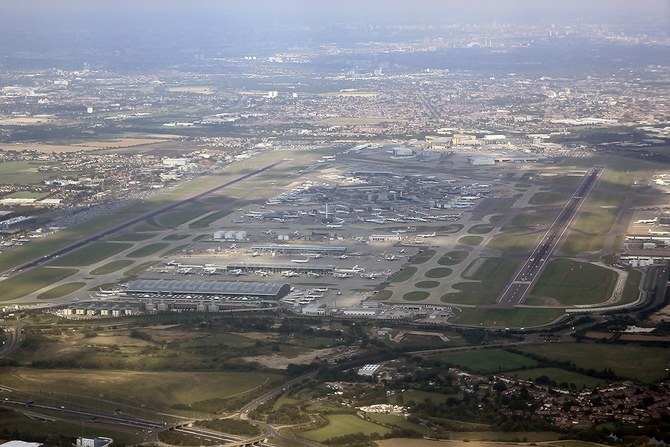
Heathrow Airport has blamed the ETA scheme for a 90,000 drop in transfer passenger numbers on routes included in the program since it was launched.
It has described the system as “devastating for our hub competitiveness” and wants the government to “review” the inclusion of air transit passengers.

UK to change travel entry requirements
Short Url
https://arab.news/bt5xr
UK to change travel entry requirements
- The interior ministry announced that all visitors who do not require a visa to travel to Britain will need an ETA from April 2, 2025
- “This can be either through an ETA or an eVisa,” the Home Office said
Thai villagers stay behind to guard empty homes as border clashes force mass evacuations
SURIN: Fighting that has flared along the Thai-Cambodian border has sent hundreds of thousands of Thai villagers fleeing from their homes close to the frontier since Monday. Their once-bustling communities have fallen largely silent except for the distant rumble of firing across the fields.
Yet in several of these villages, where normally a few hundred people live, a few dozen residents have chosen to stay behind despite the constant sounds of danger.
In a village in Buriram province, about 6 miles (10 kilometers) from the border, Somjai Kraiprakon and roughly 20 of her neighbors gathered around a roadside house, keeping watch over nearby homes. Appointed by the local administration as Village Security Volunteers, they guarded the empty homes after many residents were forced to flee and with fewer security officials stationed nearby than usual.
The latest large-scale fighting derailed a ceasefire pushed by US President Donald Trump, which halted five days of clashes in July triggered by longstanding territorial disputes. As of Saturday, around two dozen people had been reported killed in the renewed violence.
At a house on the village’s main intersection, now a meeting point, kitchen and sleeping area, explosions were a regular backdrop, with the constant risk of stray ammunition landing nearby. Somjai rarely flinched, but when the blasts came too close, she would sprint to a makeshift bunker beside the house, built on an empty plot from large precast concrete drainage pipes reinforced with dirt, sandbags and car tires.
She volunteered shortly after the July fighting. The 52-year-old completed a three-day training course with the district administration that included gun training and patrol techniques before she was appointed in November. The volunteer village guards are permitted to carry firearms provided by relevant authorities.
The army has emphasized the importance of volunteers like Somjai in this new phase of fighting, saying they help “provide the highest possible confidence and safety for the public.”
According to the army, volunteers “conduct patrols, establish checkpoints, stand guard inside villages, protect the property of local people, and monitor suspicious individuals who may attempt to infiltrate the area to gather intelligence.”
Somjai said the volunteer team performs all these duties, keeping close watch on strangers and patrolling at night to discourage thieves from entering abandoned homes. Her main responsibility, however, is not monitoring threats but caring for about 70 dogs left behind in the community.
“This is my priority. The other things I let the men take care of them. I’m not good at going out patrolling at night. Fortunately I’m good with dogs,” she said, adding that she first fed a few using her own money, but as donations began coming in, she was able to expand her feeding efforts.
In a nearby village, chief Praden Prajuabsook sat with about a dozen members of his village security team along a roadside in front of a local school. Around there, most shops were already closed and few cars could be seen passing once in a while.
Wearing navy blue uniforms and striped purple and blue scarves, the men and women chatted casually while keeping shotguns close and watching strangers carefully. Praden said the team stationed at different spots during the day, then started patrolling when night fell.
He noted that their guard duty is around the clock, and it comes with no compensation and relies entirely on volunteers. “We do it with our own will, for the brothers and sisters in our village,” he said.
Beyond guarding empty homes, Praden’s team, like Somjai, also ensures pets, cattle and other animals are fed. During the day, some members ride motorbikes from house to house to feed pigs, chickens and dogs left behind by their owners.
Although his village is close to the battlegrounds, Praden said he is not afraid of the sounds of fighting.
“We want our people to be safe… we are willing to safeguard the village for the people who have evacuated,” he said.
Yet in several of these villages, where normally a few hundred people live, a few dozen residents have chosen to stay behind despite the constant sounds of danger.
In a village in Buriram province, about 6 miles (10 kilometers) from the border, Somjai Kraiprakon and roughly 20 of her neighbors gathered around a roadside house, keeping watch over nearby homes. Appointed by the local administration as Village Security Volunteers, they guarded the empty homes after many residents were forced to flee and with fewer security officials stationed nearby than usual.
The latest large-scale fighting derailed a ceasefire pushed by US President Donald Trump, which halted five days of clashes in July triggered by longstanding territorial disputes. As of Saturday, around two dozen people had been reported killed in the renewed violence.
At a house on the village’s main intersection, now a meeting point, kitchen and sleeping area, explosions were a regular backdrop, with the constant risk of stray ammunition landing nearby. Somjai rarely flinched, but when the blasts came too close, she would sprint to a makeshift bunker beside the house, built on an empty plot from large precast concrete drainage pipes reinforced with dirt, sandbags and car tires.
She volunteered shortly after the July fighting. The 52-year-old completed a three-day training course with the district administration that included gun training and patrol techniques before she was appointed in November. The volunteer village guards are permitted to carry firearms provided by relevant authorities.
The army has emphasized the importance of volunteers like Somjai in this new phase of fighting, saying they help “provide the highest possible confidence and safety for the public.”
According to the army, volunteers “conduct patrols, establish checkpoints, stand guard inside villages, protect the property of local people, and monitor suspicious individuals who may attempt to infiltrate the area to gather intelligence.”
Somjai said the volunteer team performs all these duties, keeping close watch on strangers and patrolling at night to discourage thieves from entering abandoned homes. Her main responsibility, however, is not monitoring threats but caring for about 70 dogs left behind in the community.
“This is my priority. The other things I let the men take care of them. I’m not good at going out patrolling at night. Fortunately I’m good with dogs,” she said, adding that she first fed a few using her own money, but as donations began coming in, she was able to expand her feeding efforts.
In a nearby village, chief Praden Prajuabsook sat with about a dozen members of his village security team along a roadside in front of a local school. Around there, most shops were already closed and few cars could be seen passing once in a while.
Wearing navy blue uniforms and striped purple and blue scarves, the men and women chatted casually while keeping shotguns close and watching strangers carefully. Praden said the team stationed at different spots during the day, then started patrolling when night fell.
He noted that their guard duty is around the clock, and it comes with no compensation and relies entirely on volunteers. “We do it with our own will, for the brothers and sisters in our village,” he said.
Beyond guarding empty homes, Praden’s team, like Somjai, also ensures pets, cattle and other animals are fed. During the day, some members ride motorbikes from house to house to feed pigs, chickens and dogs left behind by their owners.
Although his village is close to the battlegrounds, Praden said he is not afraid of the sounds of fighting.
“We want our people to be safe… we are willing to safeguard the village for the people who have evacuated,” he said.
© 2025 SAUDI RESEARCH & PUBLISHING COMPANY, All Rights Reserved And subject to Terms of Use Agreement.


