Body of activist shot in West Bank arrives in Turkiye

1 / 2
Above, honor guards and mourners watch over the coffin of Turkish-American Aysenur Ezgi Eygi during her funeral procession at Istanbul airport. (Demiroren News Agency/AFP)
2 / 2
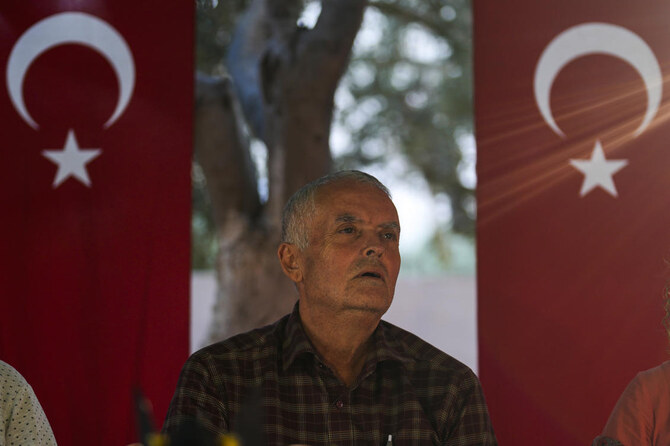
Mehmet, the father of Turkish-American human rights activist Aysenur Ezgi Eygi, speaks to the media outside the family home in Didim, Turkiye on Sept. 12, 2024. (AP)
Short Url
Updated 13 September 2024
Follow

Body of activist shot in West Bank arrives in Turkiye

  • The UN rights office has accused Israeli forces of shooting Aysenur Ezgi Eygi in the head
  • Her family said she was ‘shot in the head and killed by a bullet from an Israeli soldier’

ISTANBUL: The body of a US-Turkish activist, shot dead by Israeli forces while protesting against illegal Israeli settlements in the occupied West Bank, arrived in Turkiye on Friday.
The killing last week of Aysenur Ezgi Eygi, 26, has sparked international condemnation.
The United Nations rights office has accused Israeli forces of shooting Eygi in the head.
The Israeli army has acknowledged opening fire in the area and has said it is looking into the case.
Turkish officials, including Istanbul governor Davut, Gul attended the ceremony at Istanbul’s airport, where they prayed before the coffin wrapped in the Turkish flag.
Ankara has launched an investigation into Eygi’s death during a protest in the occupied West Bank town of Beita.
It has also petitioned the UN to launch an independent inquiry into the killing.
Turkish President Recep Tayyip Erdogan, a vocal opponent of Israel’s war in Gaza, has vowed to ensure “that Aysenur Ezgi’s death does not go unpunished.”
Her family said she was “shot in the head and killed by a bullet from an Israeli soldier” during a weekly demonstration against Israeli settlements, which are illegal under international law.
US President Joe Biden called on Wednesday for Israel to provide “full accountability” and demanded it “do more” to avoid such killings.
The European Union’s top diplomat, Josep Borrell, said on Tuesday that increased violence in the occupied West Bank meant it risked becoming “a new Gaza.”
Eygi’s family is hoping to hold her funeral on Saturday in the western coastal town of Didim.
“It’s sad but it’s also a source of pride for Didim,” Eygi’s uncle Ali Tikkim, 67, who lives in the town, said on Wednesday.


Abbas reiterates opposition to displacement of Palestinians

Russian President Vladimir Putin with Palestinian President Mahmoud Abbas at the Senate Palace of the Kremlin in Moscow. (AP)
Updated 23 January 2026
Follow

Abbas reiterates opposition to displacement of Palestinians

  • During Moscow talks, president calls for immediate halt to Israeli acts of terror
  • Historically, Russia has supported and stood by the Palestinian people at political and diplomatic levels

MOSCOW: The Palestinian National Authority’s President Mahmoud Abbas has reiterated his opposition to all attempts to displace Palestinian people from their land.

Speaking with Russian President Vladimir Putin at the presidential palace in Moscow, Abbas was reported by the Kremlin’s official website as saying that “the Palestinian people are holding on to their land, and we categorically oppose attempts by the Americans and Israelis to expatriate Palestinians beyond Palestinian territory.” 
He said the Palestinian people “will not abandon their land, whatever the cost.” Abbas stressed the need to fully implement US President Donald Trump’s peace plan, leading to the withdrawal of occupation forces and the launch of the reconstruction process.
He emphasized that the Palestinian Authority would assume a central role in administering the Gaza Strip, and that the enclave and the West Bank constituted two parts of a single territorial unit, with a unified and undifferentiated system of civilian institutions.
He stressed the need for an immediate halt to “Israeli settler colonialism and Israeli acts of terror in the West Bank, including Jerusalem, along with the release of withheld Palestinian funds and the cessation of all measures that undermined the Palestinian Authority and the two-state solution.”
He reaffirmed his commitment to continue the struggle for the realization of the Palestinian people’s right to self-determination and of their right to a fully sovereign, independent state based on the borders of June 4, 1967, with East Jerusalem as its capital, while living in security and peace with neighbors.
He told Putin: “What we need is peace, and we hope that with your help and support, we can achieve it — a peace built on the basis of international legal resolutions, decisions of the United Nations, and the principles established following the wars of 1967 and 1973.
“East Jerusalem remains the capital of Palestine, and we know that Russia has always supported — indeed, was the first to support — Palestine, maintaining a firm stance in support of our people.”
Abbas thanked his Russian counterpart for Moscow’s support and commended the bilateral “bonds of friendship” between both countries. He added: “We are friends of Russia and the Russian people. For over 50 years our nations have been bound by a strong friendship that has developed over the decades and continues on the correct path. Russia is a great friend and a nation upon which we rely in many spheres.
“Historically, Russia has supported and stood by the Palestinian people at political and diplomatic levels. Your economic and financial support is both significant in scale and crucial in importance.”
Abbas emphasized moving forward with the implementation of a comprehensive national reform program aimed at consolidating the rule of law, strengthening the principles of good governance, transparency, and accountability, and ensuring the separation of powers.
Putin affirmed Moscow’s “principled and consistent approach” to the Palestinian question.
He said: “We believe that only the establishment and full functioning of the Palestinian state can lead to a lasting settlement of the Middle East conflict.”