BARCELONA: Unauthorized migration to European Union countries dropped significantly overall in the first eight months of this year, even as political rhetoric and violence against migrants increased and far-right parties espousing anti-immigration policies made gains at the polls.
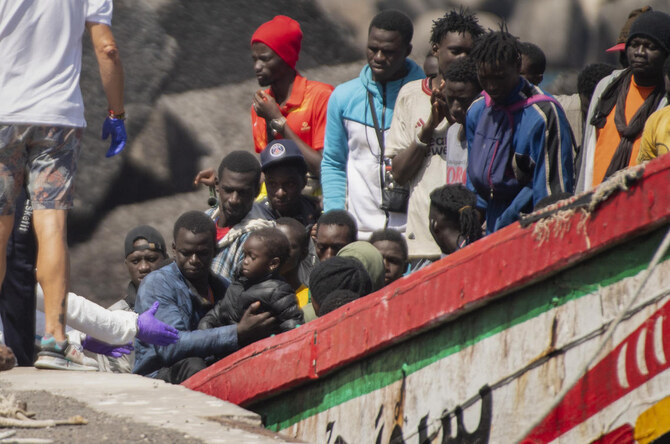
There was, however, a spike in migrant arrivals to the Canary Islands, a Spanish archipelago close to the African coast that is increasingly used as an alternate stepping stone to continental Europe.
Irregular migration dominated the European parliamentary elections in June and influenced recent state elections in eastern Germany, where a far-right party won for the first time since World War II. The German government this week announced it was expanding border controls around its territory following recent extremist attacks.
What do the numbers show?
Despite the heated debates, irregular crossings over the southern borders of the EU — the region that sees the most unauthorized migration — were down by 35 percent from January to August, according to the latest preliminary figures compiled by the United Nation’s International Organization for Migration.
Nearly 115,000 migrants — less than 0.03 percent of the EU’s population — have arrived without permission into the EU via Mediterranean and Atlantic routes so far this year, compared to 176,252 during the same period last year, the UN says. In contrast, more than a million people, most of them fleeing conflict in Syria, entered the EU in 2015.
Data shared by the EU’s border and coast guard agency Frontex shows a similar trend: Unauthorized crossings over the region’s southern borders fell 39 percent overall this year compared to last year.
“The emergency is not numerical this year, nor was it last year,” Flavio di Giacomo, a spokesperson with the IOM office for the Mediterranean, told The Associated Press.
Camille Le Coz, an associate director of the nonprofit Migration Policy Institute in Europe, said irregular migration is “getting way too much attention compared to the scope of the issue and compared to other issues Europe should be tackling, such as climate change.”
The most commonly used route for migrants is from North Africa, across the dangerous Central Mediterranean to Italy. Yet roughly 64 percent fewer migrants disembarked in Italy this year than during the same period in 2023, according to IOM and Frontex numbers.
Experts say that’s a result of the EU-supported crackdown in Tunisia and Libya, which comes at a price for migrants, many of whom are systematically rounded up and dumped in the desert.
How long the downward trend will hold remains to be seen, however. Smugglers are always quick to adapt and find new routes around border controls. In the Eastern Mediterranean, the second-most-used route, smuggling networks are now using speedboats in increasingly aggressive ways to avoid controls and targeting islands farther away from the Turkish coast in the central Aegean, according to Greek authorities.
The number of migrants arriving in Greece by sea and overland during the first eight months of the year rose by 57 percent, UN data shows.
An alarming spike in the Atlantic
Meanwhile, irregular migration from West Africa to the Canary Islands via the Atlantic, the third-most-used route, has more than doubled: More than 25,500 migrants — mostly from Mali, Senegal and other West African countries — had arrived in the islands as of Aug. 31, the UN says.
Countless other migrants have gone missing along the route, where rough winds and strong Atlantic currents work against them. Several migrant boats, carrying only the remains of Malian, Mauritanian and Senegalese citizens, have been found this year drifting as far away as the Caribbean and off Brazil. Precize numbers are hard to verify, but the Spanish migrant rights group Walking Borders has reported more than 4,000 dead or missing.
The trend has Spanish authorities on alert for the fall, when conditions in the Atlantic are most favorable for the journey. The treacherousness of the route seems to have done little to dissuade would-be migrants, whose ranks have swelled to include people from Syria and Pakistan, according to rescuers.
“There are situations that need to be addressed, like the situation in the Canary Islands,” Le Coz acknowledged.
A HUMANITARIAN CRISIS
The adult migrants who successfully make it to the Canaries usually keep moving, headed for the promise of jobs and safety in mainland Spain or other European countries farther north. But that is not the case for thousands of unaccompanied minors. Under Spanish law, these young migrants must be taken under the wing of the local government, leading to overcrowded shelters and a political crisis. Earlier this year, island leaders fought unsuccessfully to have other regions of Spain share the responsibility.
Spanish Prime Minister Pedro Sánchez recently traveled to three West African countries in an attempt to curb migration. In Senegal, he and President Bassirou Diomaye Faye signed agreements to promote temporary work opportunities in Spain for Senegalese nationals and vocational training in Senegal. They also agreed to step up police cooperation.
No magic solutions
Current anti-immigrant sentiments notwithstanding, Europe’s aging population, declining birth rates and labor shortages have only increased the need for immigrant workers to sustain pensions and boost economic growth.
And as long as migrants lack opportunities in their own countries, their exodus will continue. Add to this the growing instability and conflict in parts of Africa, the Middle East and Asia that have displaced millions.
“There is no magic deterrence,” Le Coz said. “Migrants end up taking the toll of all of this: They are risking their lives, doing jobs in Europe where they face uncertain legal status for years and are vulnerable to all sorts of exploitation.”
While long-term solutions to tackle unauthorized migration are being implemented, such as temporary work programs for migrants, they are still falling short.
“That’s one step in the right direction, but this needs to happen at a much larger scale, and they need the private sector to be more involved,” Le Coz added.


![]()

Unauthorized migration into the EU declined despite heated politics
Short Url
https://arab.news/c75e2
Unauthorized migration into the EU declined despite heated politics
- There was, however, a spike in migrant arrivals to the Canary Islands
- But Spanish archipelago is increasingly used as stepping stone to continental Europe


Latest updates


© 2026 SAUDI RESEARCH & PUBLISHING COMPANY, All Rights Reserved And subject to Terms of Use Agreement.