SEOUL: North Korea offered a rare glimpse into a secretive facility to produce weapons-grade uranium as state media reported Friday that leader Kim Jong Un visited the area and called for stronger efforts to “exponentially” increase the number of his nuclear weapons.
It’s unclear if the site is at the North’s main Yongbyon nuclear complex, but it’s the North’s first disclosure of a uranium-enrichment facility since it showed one at Yongbyon to visiting American scholars in 2010. While the latest unveiling is likely an attempt to apply more pressure on the US and its allies, the images North Korea’s media released of the area could provide outsiders with a valuable source of information for estimating the amount of nuclear ingredients that North Korea has produced.
During a visit to the Nuclear Weapons Institute and the production base of weapon-grade nuclear materials, Kim expressed “great satisfaction repeatedly over the wonderful technical force of the nuclear power field” held by North Korea, the official Korean Central News Agency reported.
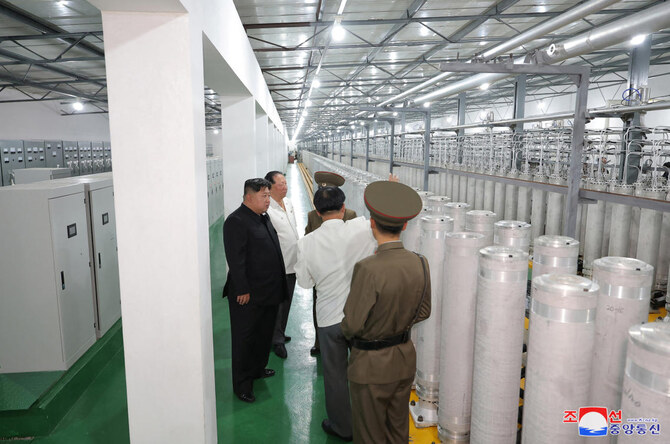
KCNA said that Kim went around the control room of the uranium enrichment base and a construction site that would expand its capacity for producing nuclear weapons. North Korean state media photos showed Kim being briefed by scientists while walking along long lines of tall gray tubes, but KCNA didn’t say when Kim visited the facilities and where they are located.
KCNA said Kim stressed the need to further augment the number of centrifuges to “exponentially increase the nuclear weapons for self-defense,” a goal he has repeatedly stated in recent years. It said Kim ordered officials to push forward the introduction of a new-type centrifuge, which has reached its completion stage.
Kim said North Korea needs greater defense and preemptive attack capabilities because “anti-(North Korea) nuclear threats perpetrated by the US imperialists-led vassal forces have become more undisguised and crossed the red-line,” KCNA said.
South Korea’s Unification Ministry said it strongly condemned North Korea’s unveiling of a uranium-enrichment facility and Kim’s vows to boost his country’s nuclear capability. A ministry statement said North Korea’s “illegal” pursuit of nuclear weapons in defiance of UN bans is a serious threat to international peace. It said North Korea must realize it cannot win anything with its nuclear program.
North Korea first showed a uranium enrichment site in Yongbyon to the outside world in November 2010, when it allowed a visiting delegation of Stanford University scholars led by nuclear physicist, Siegfried Hecker, to tour its centrifuges. North Korean officials then reportedly told Hecker that 2,000 centrifuges were already installed and running at Yongbyon.
Satellite images in recent years have indicated North Korea was expanding a uranium enrichment plant at its Yongbyon nuclear complex. Nuclear weapons can be built using either highly enriched uranium or plutonium, and North Korea has facilities to produce both at Yongbyon. It’s not clear exactly how much weapons-grade plutonium or highly enriched uranium has been produced at Yongbyon and where North Korea stores it.
“For analysts outside the country, the released images will provide a valuable source of information for rectifying our assumptions about how much material North Korea may have amassed to date,” said Ankit Panda, an expert with the Carnegie Endowment for International Peace.
“Overall, we should not assume that North Korea will be as constrained as it once was by fissile material limitations. This is especially true for highly enriched uranium, where North Korea is significantly less constrained in its ability to scale up than it is with plutonium,” Panda said.
In 2018, Hecker and Stanford University scholars estimated North Korea’s highly enriched uranium inventory was 250 to 500 kilograms (550 to 1,100 pounds), sufficient for 25 to 30 nuclear devices.
The North Korean photos released Friday showed about 1,000 centrifuges. When operated year-round, they would be able to produce around 20 to 25 kilograms (44 to 55 pounds) of highly enriched uranium, which would be enough to create a single bomb, according to Yang Uk, a security expert at Seoul’s Asan Institute for Policy Studies.
The new-type centrifuge Kim wants to introduce is likely an advanced carbon fiber-based one that could allow North Korea to produce five to 10 times more highly enriched uranium than its existing ones, said Lee Choon Geun, an honorary research fellow at South Korea’s Science and Technology Policy Institute.
Some US and South Korean experts speculate North Korea is covertly running at least one other uranium-enrichment plant. In 2018, a top South Korean official told parliament that North Korea was estimated to have already manufactured up to 60 nuclear weapons. Estimates on how many nuclear bombs North Korea can add every year vary, ranging from six to as much as 18.
Since 2022, North Korea has sharply ramped up weapons testing activities to expand and modernize its arsenal of nuclear missiles targeting the US and South Korea. Analysts say North Korea could perform nuclear test explosions or long-range missile tests ahead of the US presidential election in November with the intent to influence the outcome and increase its leverage in future dealings with the Americans.
“Overall, the message they are trying to send is that their nuclear capability is not just an empty threat, but that they are continuing to produce (bomb fuel),” Yang said. “And who are they speaking to? It could obviously be South Korea but also certainly the United States.”
North Korea had conducted test-launches of multiple short-range ballistic missiles on Thursday. In an apparent reference to those launches, KCNA said Kim had supervised test-firing of nuclear-capable 600mm multiple rockets to examine the performance of their new launch vehicles.

North Korea discloses a uranium enrichment facility as Kim calls for more nuclear weapons
https://arab.news/5p3wf
North Korea discloses a uranium enrichment facility as Kim calls for more nuclear weapons
- It’s unclear if the site is its previously known nuclear-enrichment site in Yongbyon, north of Pyongyang, or another that was undisclosed until now
‘I was motivated by solving problems the world didn’t care about,’ first Saudi Nobel laureate Omar M. Yaghi tells Arab News
- Yaghi became the first Saudi national to win a Nobel Prize, sharing the 2025 Chemistry award for work on metal-organic frameworks
- Prior to gaining US and Saudi citizenship, he grew up in a Palestinian refugee camp, where water scarcity and hardship shaped his early life
STOCKHOLM: Saudi-American scientist Omar M. Yaghi’s career has been shaped by a rare combination of intellectual audacity and personal history — a lifelong drive to push science beyond known limits, while never losing sight of its capacity to serve humanity.
In 2025, that journey culminated in global recognition when Yaghi became the first Saudi national to receive a Nobel Prize, and only the second Arab-born laureate to be awarded the chemistry prize, after the Egyptian-American scientist Ahmed Zewail in 1999.
Yaghi shared the Nobel Prize in Chemistry with British-Australian scientist Richard Robson and Japanese scientist Susumu Kitagawa.
Together, the three were recognized for more than half a century of contributions to the development of metal-organic frameworks, or MOFs — porous, sponge-like materials with vast internal spaces capable of storing carbon dioxide or harvesting water from the air.
They will also share the 11 million Swedish krona (about $1 million) prize.
Once a niche academic pursuit, MOF science is now studied in more than 100 countries and applied at industrial scale, with uses ranging from climate change mitigation to addressing water scarcity.
Yaghi’s rise to the pinnacle of global science began far from elite laboratories. He grew up in a Palestinian refugee family of 10 children, living on the outskirts of the Al-Wehdat refugee camp in the Jordanian capital, Amman.
The family’s single-room home had no electricity. Water arrived only once a week — sometimes once every two weeks — prompting residents to rush to fill every available bucket before the next long wait.
“It’s not the poetic idea that because I had hardship with water when I was a child that I was determined to solve the problem,” Yaghi told Arab News.
“I was much more motivated by solving problems that the world didn’t really care about. That’s basic science, which is about going to the frontiers of knowledge and being brave enough to solve problems.
“Once you make that great discovery, then it leads to much more benefit than you would have achieved had you done it by initially answering the problems of society,” he said.
His childhood revolved around three defining spaces: the family home near Al-Wehdat, where livestock were raised; the butcher shop his father, Mounes, ran on King Talal Street; and the private Bishop’s School in the historic Jabal Amman district.
The Yaghi family originally came from Al-Masmiyya, a Palestinian village between Jerusalem and Jaffa that was depopulated and destroyed after being occupied by the Zionist paramilitary group Haganah in 1948.
In 2018, Yaghi made a homage visit to Al-Masmiyya, searching for specific locations preserved in family stories of life before the Nakba.
After displacement, the family settled in Amman, where Omar was born in 1965 and where his father built a cattle and butchery business that left a lasting impression on his son.
“This shop figured prominently in my life. There, I learned the power of a work ethic. I learned that when you have a transaction with other people, you should be honest, the power of honesty and of hard work,” he said.
Yaghi watched his parents work relentlessly to support their children’s education. His father rose before dawn and worked until after sunset, while his mother baked fresh bread, prepared meals, cared for the household, and tended the cows.
“I was shy and quiet. And had done my homework separately from the other kids, and didn’t play the games that they were playing, and it seems like I spent most of my childhood sitting in a corner, reading or writing, and observing what was happening around me,” he said.
Although the family was registered as refugees with the UN Relief and Works Agency for Palestine Refugees in the Near East, his father opted against enrolling his children in UNRWA schools.
“We didn’t go to UNRWA schools because my father felt that he needed reporting on our performance in school on a regular basis,” Yaghi said. UNRWA provided reports only once a term — too infrequent for his father’s liking.
At Bishop’s School, Yaghi studied English and some French alongside mathematics and science, subjects the school emphasized strongly. “Math and science were topics that my father absolutely wanted to see us do very well at,” he said.
At the age of 10, a chance encounter with molecular drawings in the school library proved transformative. He was captivated by their beauty and mystery, later learning that these shapes formed the basic building blocks of all matter, living and non-living alike.
In 1980, aged just 15, Yaghi travelled alone to the US, enrolling at Hudson Valley Community College in Troy, New York, where he studied English, science, and mathematics.
The family’s savings — nearly $9,000 — sustained him for about two years. To survive, he worked odd jobs in supermarkets and tutored fellow students in math.
Although he could read and write English, he soon realized he was unprepared for the speed and idiom of American speech.
He immersed himself in the language, watching news broadcasts and soap operas, speaking with classmates, reading at least one full newspaper story every day, and consulting a dictionary he had brought from Amman.
“Most words that were in the newspaper were not in this dictionary, but I managed to get at least a few new words,” he said. Within three to six months, he had mastered American English.
In 1985, he earned a bachelor’s degree in chemistry from the State University of New York at Albany. Five years later, he completed his PhD at the University of Illinois Urbana-Champaign.
After academic appointments at Arizona State University, the University of Michigan, and UCLA, Yaghi joined UC Berkeley in 2012, where he holds the James and Neeltje Tretter Chair.
He is also the founding director of the Berkeley Global Science Institute and has taught students from 15 countries, including Saudi Arabia, the UAE, China, and the UK.
In 1995, Yaghi coined the term “metal-organic framework” to describe crystalline structures capable of hosting guest molecules within their internal cavities while withstanding temperatures exceeding 300 degrees centigrade.
Four years later, he introduced MOF-5, now considered a classic in the field for its extraordinary internal surface area. By 2003, he had demonstrated that MOFs could be rationally modified — a breakthrough that unlocked their practical versatility.
James Stephenson, CEO of Promethean Particles, said MOFs are prized for their ability to capture carbon dioxide and harvest water, and for the precision with which they can be engineered for specific gases.
A single gram of MOF has a surface area of about 8,000 square meters, measured using the Brunauer-Emmett-Teller method. Stephenson often likens their structure to cages.
“If you think about a cage structure, and at every corner, there is a metal ion, and then the pieces that connect those are linkers. You can have almost limitless combinations of metals and linkers, and by changing them, you can create these cages in different sizes,” he said.
Promethean Particles has led industrial-scale MOF production since 2012 and, in 2022, pioneered their use for carbon capture at Drax, the UK’s largest power plant in North Yorkshire.
“MOFs are known for all this complexity, but really, it’s about the space inside them,” Stephenson said. “It’s about the holes that make them so different. Our approach is to make MOFs at large volumes, as cost-effectively as possible, with safe, abundant raw materials.”
The company already supplies a UK customer operating a MOF-based water harvesting machine. Stephenson says MOFs offer advantages over desalination plants, which are energy-intensive, immobile, and ill-suited to remote areas.
“Dewpoint machines have limitations today with regard to the conditions in which they can extract water from the atmosphere. So the potential for MOFs as a water harvest will allow us to provide access to water to more people,” he added.
According to the World Health Organization, 2.1 billion people worldwide lack access to safely managed drinking water, including 106 million relying on untreated surface sources.
Since 2018, Yaghi has increasingly pursued entrepreneurial ventures, founding Atoco to work on water harvesting and CO2 capture, and co-founding H2MOF for hydrogen storage and WaHa Inc. for water harvesting projects in the Middle East.
He said current energy-efficient MOF prototypes can produce 100 liters of water per day, with the potential to reach 2,000 liters.
“I’m very hopeful that this becomes a major contributor to the supply of water, not just in the arid regions, but also in regions of the world where there may be a lot of water, but it’s not clean,” Yaghi said.
His achievements have brought international recognition. He received the King Faisal International Prize for Chemistry in 2015, and in 2021 King Salman granted him Saudi citizenship for his contributions to reticular chemistry and nanomaterials.
He is also co-director of the KACST-UC Berkeley Center of Excellence for Nanomaterials for Clean Energy Applications and advises the KACST president.
“The Saudis have treated me very well, and they were very kind to confer Saudi citizenship on me. I collaborate with them. As a scientist, my only concern is solving a problem that serves humanity,” he said.
“I am very proud of my Palestinian origin. I was born and raised in Jordan. I became an American citizen. Americans have treated me very well,” he added.
Yaghi has donated a model of MOF-5 to the Nobel Prize Museum, where it will be displayed alongside Zewail’s “femtochemistry apparatus.”
That instrument illustrates Zewail’s technique of capturing chemical reactions within a femtosecond — a span to a second what a second is to 32 million years.
The donation puts Yaghi among hundreds of laureates who have contributed artifacts since the museum’s founding in 2001, marking the centenary of the Nobel Prize, established in 1901.
“I think first and foremost, a scientist is about answering questions that advance the state of knowledge,” Yaghi said.
“I like basic research very much because it allows you to be free in pursuing an intellectual challenge. When you solve an intellectual challenge, you end up providing a base for many benefits to society.”


