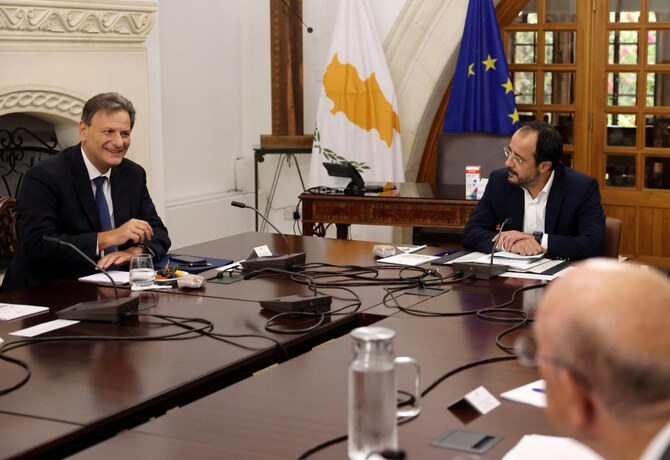
Turkiye condemns Cyprus-US defense co-operation roadmap

The US steps, including last June’s announcement of the launch of a strategic dialogue with Cyprus, are detrimental to the security of the Turkish Cypriot side of the island. (REUTERS)
Short Url
Updated 12 September 2024
Follow

Turkiye condemns Cyprus-US defense co-operation roadmap

  • The US steps, including last June’s announcement of the launch of a strategic dialogue with Cyprus, are detrimental to the security of the Turkish Cypriot side of the island

ISTANBUL: Turkiye said it condemned this week’s signing of a roadmap to boost two-way defense co-operation between the United States and the Republic of Cyprus.
The move came amid United Nations efforts to find common ground for the resumption of long-stalled negotiations between the rival Greek and Turkish Cypriot communities on the Mediterranean island, which has been divided for decades.
The US steps, including last June’s announcement of the launch of a strategic dialogue with Cyprus, are detrimental to the security of the Turkish Cypriot side of the island, the Turkish foreign ministry said.
“These steps ... undermine the neutral USA position toward the island of Cyprus and make it more difficult to reach a just, lasting and sustainable settlement of the Cyprus issue,” it said in a statement on Wednesday.
On Monday, the United States and the internationally recognized Republic of Cyprus signed the co-operation roadmap in Nicosia.
In a joint statement, their defense ministries reaffirmed their commitment to collaborate to tackle international security concerns via the roadmap.
Cyprus was partitioned in a Turkish invasion in 1974 after a brief Greek-inspired coup. Peace talks have been on hold since 2017.
The Turkish Cypriot side administers a breakaway state in the north of Cyprus recognized only by Ankara. It says a resumption of talks hinges on acceptance of its equal sovereignty with the Greek Cypriot government.


Venezuela aims to boost oil output but sanctions stand in the way, VP says

Updated 58 min 21 sec ago
Follow

Venezuela aims to boost oil output but sanctions stand in the way, VP says

  • Sanchez called the recent capture of Nicolas Maduro a “dark day” for the country

DUBAI: Venezuela’s Vice President for Economy Calixto Ortega Sanchez said on Wednesday that his country needed vast foreign investment and sanctions relief to tap its huge oil reserves and restart its ailing economy.

“We know that the reference for Venezuela is that (it is) the country with the biggest oil reserves, and we want to stop being known for this, and we want to be known as one of the countries with the highest production levels,” Sanchez said.

Responding to questions by American journalist Tucker Carlson, Sanchez called the recent capture of Nicolas Maduro a “dark day” for the country but said Venezuela was working to reestablish a relationship with the US, which he described as a “natural partner” for the country.

“The Venezuelan people and authorities have shown that they are ready to peacefully move forward and to build opportunities,” he said during a session at the World Government Summit.

Sanchez, who headed Venezuela’s central bank, said the most pertinent issue facing his country is continued US sanctions.

Despite failing to result in regime change, the sanctions had effectively stifled the economy from growing, he added.

He said the Venezuelan government was now working to reform its laws to allow foreign investment and hoped the US would ease sanctions to aid their work.

“The first decisions that interim President Rodriguez took was to go to the National Assembly and ask for reform to the hydrocarbon law … this law will allow international investors to go to Venezuela with favorable conditions, with legal assurance of their investments,” he added.

“The economy is ready for investment. The economy is ready for the private sector; it is ready to build up a better future for the Venezuelan people.”

Sanchez played down inferences by Carlson that his government had been taken over, insisting that the regime still held authority in the country. He said the country had set up two funds to receive money from oil production that would fund better welfare and social conditions for Venezuelans.

“Allow us to have access to our own assets … we don’t have access to our own money,” he added.

“If you allow us to function like a regular country, Venezuela will show extraordinary improvement and growth.”