

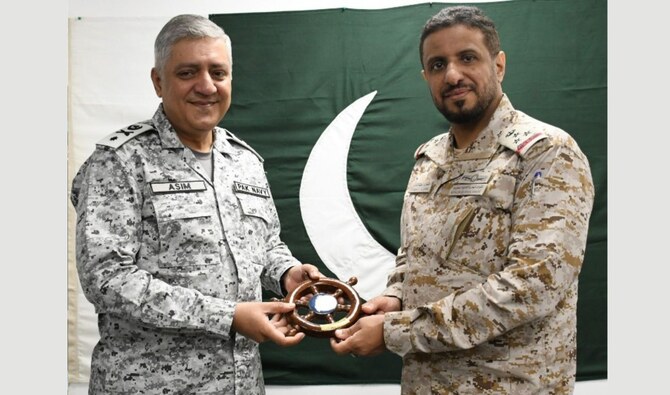
Saudi naval delegation discusses maritime security with Pakistani task force commander in Bahrain

Royal Saudi Naval Forces Maritime Component Commander, Cdre Othman Oqab Al Zahrani (R) meets with Pakistan’s Commodore Asim Sohail Malik, who is currently commanding the Combined Task Force 150 (CTF 150) in Bahrain, on September 11, 2024. (Photo courtesy: Pakistan Navy)
Short Url
Updated 11 September 2024
Follow

Saudi naval delegation discusses maritime security with Pakistani task force commander in Bahrain

  • Pakistan assumed command of the multinational Combined Task Force 150 earlier this year in July
  • The task force is to counter smuggling, narcotics trafficking and ensure the region’s maritime security

KARACHI: A delegation of the Royal Saudi Naval Forces (RSNF) on Wednesday met with Pakistan’s Commodore Asim Sohail Malik, who is currently commanding the Combined Task Force 150 (CTF 150) in Bahrain, to explore potential avenues for collaboration and discuss the region’s maritime security.

CTF 150 is part of the Combined Maritime Forces (CMF), a multinational naval partnership aimed at ensuring the security in critical regions like the Indian Ocean, Arabian Sea and the Gulf of Oman.

CTF 150’s mission is to counter illicit activities at sea, including smuggling, trafficking of narcotics and other non-state actor threats, to promote stability and security in these vital international waters.

Pakistan assumed command of this task in July for the 13th time, with the country’s naval officials pointing out its frequent leadership of CTF 150 highlighted the trust placed in it by other coalition partners.

“During the meeting, both [sides] shared their perspectives on regional maritime security challenges and explored potential avenues for collaboration between CTF 150 and the upcoming RSNF Maritime Component Command to maintain security and stability in the region,” an official statement circulated by the naval headquarters in Islamabad said.

“Discussions focused on CTF 150’s ongoing operations aimed at disrupting illicit activities in the Arabian Sea and ensuring maritime security in the region,” it added.

The statement said Pakistani official and Saudi Arabia’s Commodore Othman Oqab Al Zahrani also reaffirmed the excellent relationship between the naval forces of their countries, emphasizing the necessity of working together to ensure greater maritime security.

The RSNF delegation also engaged with the entire Pakistan Navy team currently leading CTF 150 and exchanged views on viable options to counter contemporary maritime security challenges.

Commodore Malik assured the Saudi delegation that his team would continue to strengthen the efforts of the multinational task force to ensure robust security in the maritime domain of its responsibility. He also assured the visiting delegation Pakistan Navy’s commitment to working with other coalition navies.


Pakistan says Qatar to elevate economic partnership to ‘higher strategic level’

Updated 5 sec ago
Follow

Pakistan says Qatar to elevate economic partnership to ‘higher strategic level’

  • Qatari emir accepts invitation to visit Pakistan later this year, Sharif’s office says
  • Doha talks also addressed rising tensions between Pakistan and Afghanistan

ISLAMABAD: Pakistan said on Tuesday Qatar had agreed to elevate bilateral economic cooperation to a “higher strategic level” during talks between Prime Minister Shehbaz Sharif and Qatari Emir Sheikh Tamim bin Hamad Al Thani in Doha, according to a statement from the Prime Minister’s Office.

The meeting with Qatar’s head of state marked the highest-level engagement of Sharif’s visit and comes as Islamabad seeks to attract Gulf investment to support economic stabilization under a $7 billion International Monetary Fund (IMF) program while coordinating with regional partners on rising security tensions.

Qatar is a key economic partner for Pakistan, hosting nearly 300,000 Pakistani workers and previously announcing plans to invest $3 billion in sectors including transport, aviation, energy, health, media and technology. The two countries also maintain defense cooperation and structured political and business dialogues.

“His Highness Sheikh Tamim bin Hamad Al Thani reiterated Qatar’s commitment to a deepening economic partnership to a higher strategic level,” Sharif’s office said in the statement.

According to the statement, the two leaders reviewed the entire spectrum of bilateral relations and reaffirmed their commitment to strengthening longstanding ties.

The Qatari emir also accepted Sharif’s invitation to visit Pakistan later this year, the Prime Minister’s Office said.

Earlier during the visit, Sharif held talks with Qatar’s Prime Minister Sheikh Mohammed bin Abdulrahman bin Jassim Al Thani, where discussions focused on expanding cooperation in trade and investment, energy, defense, manpower and labor, and culture.

“They reaffirmed the strong brotherly relations between Pakistan and Qatar and expressed satisfaction at the growing momentum in political, economic and institutional ties,” Sharif’s office said.

“Discussions focused on enhancing cooperation in the fields of trade and investment, energy, defense, manpower and labor and culture, with both sides stressing the importance of their task force to accelerate cooperation in all these areas.”

Sharif also met Qatar’s State Minister for Trade Dr. Ahmed bin Mohammed Al-Sayed and a delegation of the Qatar Businessmen Association (QBA), where he highlighted Pakistan’s investment-friendly reforms and invited Qatari investors to explore opportunities in infrastructure, logistics, energy, agriculture, technology and export-oriented manufacturing, according to the prime minister’s office.

The business outreach reflects Islamabad’s broader push to convert political goodwill with Gulf partners into tangible investment inflows as it works to sustain macroeconomic stability and growth.

TENSIONS WITH AFGHANISTAN 

The Doha talks also addressed rising tensions between Pakistan and Afghanistan following cross-border military exchanges in recent days.

Pakistan last week carried out airstrikes inside Afghanistan against what it described as Tehreek-e-Taliban Pakistan (TTP) targets, after blaming recent militant attacks in Islamabad, Bajaur and Bannu on fighters operating from Afghan territory, which Kabul denies. Afghan Taliban authorities said the strikes killed civilians and described them as a violation of Afghanistan’s sovereignty.

The issue also came up during a separate meeting between Sharif and Qatar’s Deputy Prime Minister Sheikh Saoud Al-Thani.

“Regional developments were also discussed, in particular the situation in Iran and Afghanistan,” Sharif’s office said in a statement. “Both sides emphasized the importance of dialogue, de-escalation and collective efforts to promote peace and stability in the region.”

Similar cross-border strikes last year triggered weeklong clashes before Qatar and Turkiye helped mediate a tenuous ceasefire between Islamabad and Kabul.
