

Police protests continue in Lakki Marwat as Bajaur cops boycott polio duty over militant attacks

Protestors block road in Pakistan's Lakki Marwat district on September 11, 2024. (Lakki Marwat Police)
Short Url
Updated 11 September 2024
Follow

Police protests continue in Lakki Marwat as Bajaur cops boycott polio duty over militant attacks

  • Lakki Marwat police demand ‘army should withdraw from district and police should be given back their full powers’
  • Policemen in Bajaur also refuse polio duty after losing a colleague who was protecting a vaccination team in the area

DERA ISMAIL KHAN: A sit-in by police in the northwestern Pakistani district of Lakki Marwat entered its third day on Wednesday, with protesters demanding the military’s withdrawal and the transfer of power to civilian law enforcers, as Bajaur cops announced a boycott of polio duty after their colleague was killed earlier today.

The Pakistan army has a heavy presence in the Khyber Pakhtunkhwa (KP) province bordering Afghanistan, where it has been battling militants from Al-Qaeda, Pakistani Taliban and other groups for nearly two decades.

There have been protests in several districts of KP since July, when Pakistan’s cabinet announced that a new military operation would be launched amid a surge in terror attacks across the country. People in the northwestern region have rejected plans for an armed operation and demand that civilian agencies like the provincial police and the counter-terrorism department be better equipped.

“Lakki Marwat police sit-in protest against Pakistani army continues for the third day in intense heat at Taja Chowk,” district police said in a statement to media, saying the Peshawar-Karachi Indus Highway had been completely closed for all types of vehicular traffic for 72 hours.

“Police only have one demand and a one point agenda that the army should withdraw from the district and police should be given back their full powers.”

The sit-in by policemen, who have been joined by representatives of civil society and political parties as well as tribal elders and members of the public, comes days after unidentified gunmen attacked a police van in Lakki Marwat, killing an officer. Two brothers of a serving policeman in in the area were also gunned down last week.

Police in KP’s Bajaur tribal district also decided to protest after losing a colleague who was gunned down in a suspected militant attack targeting a polio vaccination team. The unknown assailants also fatally shot a polio worker while going door to door to administer vaccine to children.
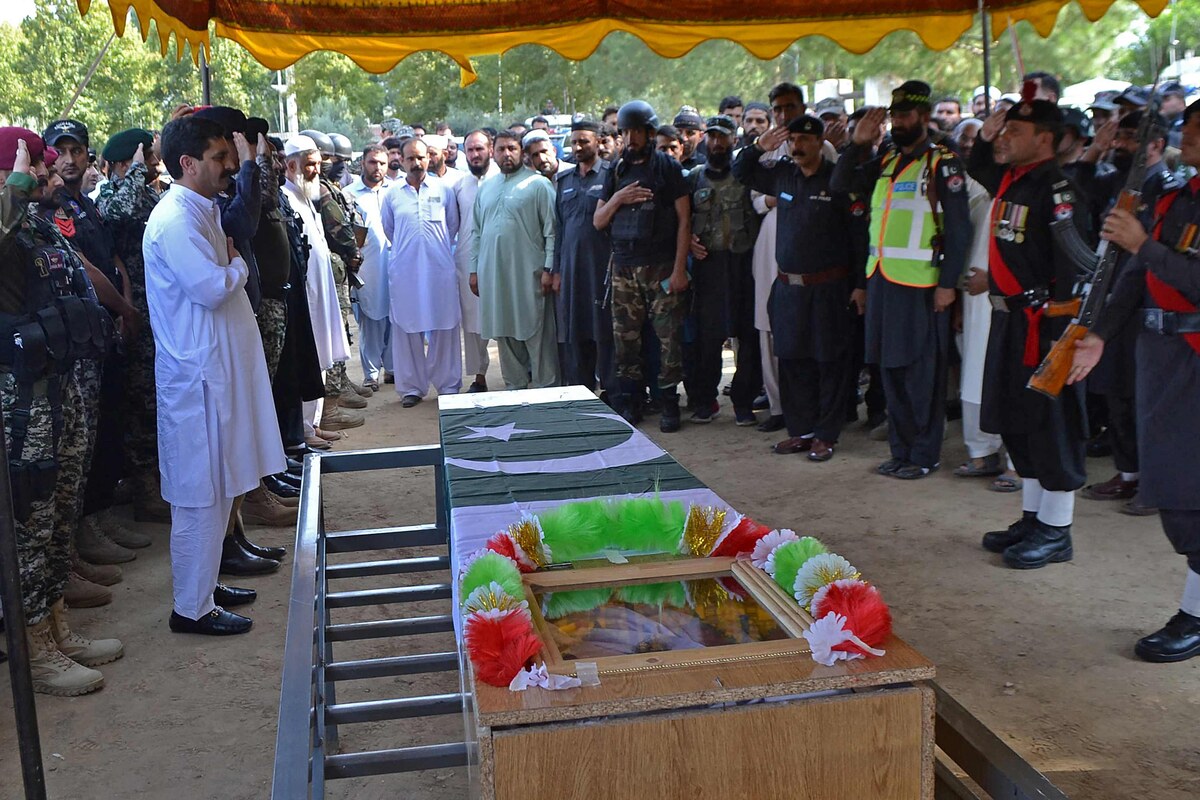


Security officials attend the funeral prayers for a policeman who was killed along with a polio worker in an attack by gunmen in Bajaur district, Khyber Pakhtunkhwa province on September 11, 2024. (AFP)

“There will be complete boycott of polio duty,” a video circulating on social media showed a man standing among a group of uniformed personnel as saying. “They [the government and security officials] will give us the killers of Luqman [the police constable killed in the latest attack while performing polio duty].”

“We will question who killed our colleague in broad daylight,” he added.

Pakistan has seen a rise in militant attacks in recent weeks, with many of them taking place in Khyber Pakhtunkhwa where groups like the outlawed Pakistani Taliban, or TTP, have stepped up attacks, daily targeting security forces convoys and check posts, and carrying out targeted killings and kidnappings of law enforcers and government officials.

At least 75 policemen have been killed in ambushes and target killings in Khyber Pakhtunkhwa in 2024, according to police data.

The volatile Lakki Marwat district is located on the edge of Pakistan’s restive tribal regions that border Afghanistan, from where Islamabad says militants mainly associated with the banned Tehreek-e-Taliban Pakistan frequently launch attacks, targeting police and other security forces. Islamabad has even blamed Kabul’s Afghan Taliban rulers of facilitating anti-Pakistan militants. Kabul denies the charges.



Pakistan army chief assumes role as first Chief of Defense Forces, signaling unified command

Updated 5 sec ago
Follow

Pakistan army chief assumes role as first Chief of Defense Forces, signaling unified command

  • New role is held simultaneously with Gen Asim Munir’s existing position as Chief of Army Staff
  • It is designed to centralize operational planning, war-fighting doctrine, modernization across services

ISLAMABAD: Pakistan’s most senior military officer, Field Marshal Syed Asim Munir, formally took charge as the country’s first Chief of Defense Forces (CDF) on Monday, marking a structural change in Pakistan’s defense command and placing the army, navy and air force under a single integrated leadership for the first time.

The new role, held simultaneously with Munir’s existing position as Chief of Army Staff, is designed to centralize operational planning, war-fighting doctrine and modernization across the services. It reflects a trend seen in several advanced militaries where a unified command oversees land, air, maritime, cyber and space domains, rather than service-level silos.

Pakistan has also established a Chief of Defense Forces Headquarters, which Munir described as a “historic” step toward joint command integration.

In remarks to officers from all three forces after receiving a tri-services Guard of Honor at the General Headquarters (GHQ) in Rawalpindi, Munir said the military must adapt to new theaters of conflict that extend far beyond traditional ground warfare.

He stressed the need for “a formalized arrangement for tri-services integration and synergy,” adding that future war will involve emerging technologies including cyber operations, the electromagnetic spectrum, outer-space platforms, information warfare, artificial intelligence and quantum computing.

“He termed the newly instituted CDF Headquarters as historic, which will afford requisite integration, coherence and coordination to meet the dynamics of future threat spectrum under a tri-services umbrella,” the military quoted Munir as saying in a statement. 

The ceremony also included gallantry awards for Pakistan Navy and Air Force personnel who fought in Marka-e-Haq, the brief May 2025 conflict between Pakistan and India, which Pakistan’s military calls a model for integrated land, air, maritime, cyber and electronic combat. During his speech, Munir paid tribute to the personnel who served in the conflict, calling their sacrifice central to Pakistan’s defense narrative.

The restructuring places Pakistan closer to command models used by the United States, United Kingdom and other nuclear-armed states where a unified chief directs inter-service readiness and long-range war planning. It also comes at a time when militaries worldwide are re-engineering doctrine to counter threats spanning satellites, data networks, information space and unmanned strike capabilities.