

High-level Chinese business delegation in Islamabad amid Pakistan push for investments

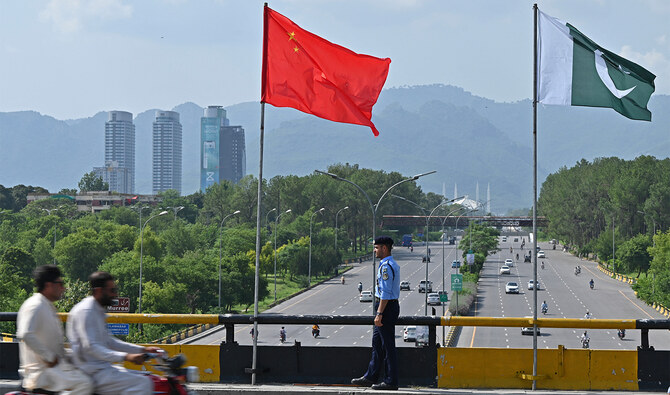
A policeman stands guard under the national flags of China and Pakistan along a road ahead of the visit of Chinese Vice Premier He Lifeng, in Islamabad on July 30, 2023. (AFP/File)
Short Url
Updated 11 September 2024
Follow

High-level Chinese business delegation in Islamabad amid Pakistan push for investments

  • Pakistan apprises Chinese companies of investment opportunities in agriculture, IT, energy, minerals, tourism sectors
  • Pakistan and China signed 32 memorandums of understanding to promote trade and investment in June this year

ISLAMABAD: A high-level delegation of Chinese companies is in Islamabad this week, state-run Radio Pakistan reported on Wednesday, as Pakistan pushes for foreign investment in a bid to shore up its $350 billion economy as it navigates a tough reforms agenda mandated by the International Monetary Fund (IMF).

Islamabad and Beijing signed 32 memorandums of understanding (MoUs) to promote trade and investment in June during Prime Minister Shehbaz Sharif’s visit to China with a team of 100 businessmen. The agreements covered fields like IT, textiles, leather and footwear, minerals, pharmaceuticals and agriculture and food processing. 

Chinese investment and financial support for Pakistan since 2013 have been a boon for the South Asian nation’s struggling economy, including the rolling over of loans so that Islamabad is able to meet external financing needs at a time foreign reserves are critically low. Beijing has over $65 billion in investments in road, infrastructure and development projects under the China-Pakistan Economic Corridor, which is a part of the Belt and Road scheme.

The Chinese delegation currently in Islamabad includes four main business groups, Radio Pakistan reported, who on Tuesday visited the Special Investment Facilitation Council (SIFC) set up by Pakistan in July last year to serve as a “one window operation” to attract foreign investments. 

“Chinese business delegation has evinced keen interest for investment in major sectors of Pakistan’s economy and relocating Chinese industries here,” Radio Pakistan said. 

“The delegation was apprised of potential investment opportunities in priority sectors including agriculture, livestock, Information Technology, energy, minerals, tourism and industry.”

The Chinese companies were also briefed about policy-level measures undertaken by the SIFC to improve the country’s overall business environment as well as on “salient features of industrial development in Pakistan.”

There was no comment from the Chinese side about the meetings in Islamabad. 

The CPEC framework is central to Beijing’s initiative to rebuild a new “Silk Road” through land routes and sea lanes to connect with markets in the Middle East, Africa and Europe. But the undertaking has been hit by Pakistan struggling to keep up its financial obligations as well as militant attacks on Chinese nationals in Pakistan.

In recent months, China has publicly raised with Pakistan the issue of the security of its workers and interests, especially since a March suicide attack in which five Chinese workers and their local driver were killed in Pakistan’s northwest.

Pakistan has also initiated difficult talks on reprofiling power sector debt owed to China as well as negotiations on structural reforms, but progress has been slow.


Pakistani, Bangladeshi officials discuss trade, investment and aviation as ties thaw

Updated 53 min 45 sec ago
Follow

Pakistani, Bangladeshi officials discuss trade, investment and aviation as ties thaw

  • Pakistan and Bangladesh were once one nation, but they split in 1971 as a result of a bloody civil war
  • Ties between Pakistan, Bangladesh have warmed up since last year and both nations have resumed sea trade

ISLAMABAD: Pakistan's High Commissioner to Bangladesh Imran Haider on Sunday met Chief Adviser Muhammad Yunus in Dhaka, the latter's office said on, with the two figures discussing trade, investment and aviation.

Pakistan and Bangladesh were once one nation, but they split in 1971 as a result of a bloody civil war, which saw the part previously referred to as East Pakistan seceding to form the independent nation of Bangladesh.

Ties between Pakistan and Bangladesh have warmed up since former prime minister Sheikh Hasina’s ouster as a result of a student-led uprising in August 2024. Relations remain frosty between Dhaka and New Delhi over India’s decision to grant asylum to Hasina.

Pakistan has attempted to forge closer ties with Bangladesh in recent months and both South Asian nations last year began sea trade, followed by efforts to expand government-to-government commerce.

"During the meeting, both sides discussed ways to expand cooperation in trade, investment, and aviation as well as scaling up cultural, educational and medical exchanges to further strengthen bilateral relations between the two South Asian nations," Yunus's office said in a statement on X.

In 2023-24 Pakistan exported goods worth $661 million to Bangladesh, while its imports were only $57 million, according to the Trade Development Authority of Pakistan. In Aug. this year, the Pakistani and Bangladeshi commerce ministries signed a memorandum of understanding to establish a Joint Working Group on Trade, aiming to raise their bilateral trade volume to $1 billion in the financial year that began in July.

The Pakistani high commissioner noted that bilateral trade has recorded a 20 percent growth compared to last year, with business communities from both countries actively exploring new investment opportunities, according to the statement.

He highlighted a significant increase in cultural exchanges, adding that Bangladeshi students have shown strong interest in higher education opportunities in Pakistan, particularly in medical sciences, nanotechnology, and artificial intelligence. Haider also said that Dhaka-Karachi direct flights are expected to start in January.

"Chief Adviser Professor Muhammad Yunus welcomed the growing interactions between the two countries and emphasized the importance of increased visits as well as cultural, educational and people-to-people exchanges among SAARC (South Asian Association for Regional Cooperation) member states," the statement read.

"Professor Yunus also underscored the need to further boost Bangladesh–Pakistan trade and expressed hope that during Mr. Haider’s tenure, both countries would explore new avenues for investment and joint venture businesses."