KYIV, Ukraine: Ukraine’s prime minister warned Tuesday that the country could be facing its toughest winter since the full-scale Russian invasion began, as airstrikes against the country’s beleaguered energy infrastructure intensify.
Russian attacks continue to hammer Ukraine’s energy generation capacity, leaving the country heavily reliant on its three functioning nuclear power stations and electricity imports from European Union countries.
“Energy resilience is one of our greatest challenges this year,” Prime Minister Denys Shmyhal told a news conference in Kyiv.
“We successfully got through what was essentially two and a half winters. We will get through three, with this upcoming heating season likely being just as difficult, if not the hardest,” he said.
Shmyhal said Ukraine’s government, helped by European countries, was urgently developing initiatives to decentralize its power generation, to make it less vulnerable to attacks. That includes expanding renewable power capacity — a development applauded by environmental groups.
Greenpeace has argued that a decentralized solar power network — which would be harder to damage with Russian missile and drone strikes — could rapidly help repair domestic capacity, and is urging the government to make a bolder expansion into green energy.
The group is calling for internationally backed investments worth nearly 4.5 billion euros ($4.9 billion) through 2030, focusing on renewable projects dominated by the solar photovoltaic sector.
“(Our) research says that the current targets, which the Ukrainian government set for reaching solar energy by 2027, could be increased at least fivefold. This is a very conservative evaluation,” Natalia Gozak, head of Greenpeace in Ukraine, told The Associated Press after the group opened an office in Kyiv on Tuesday.
According to the United Nations and the World Bank, Ukraine lost more than half of its power-generating capacity in the first 14 months of the war, with the situation continuing to deteriorate. Much of the country’s solar power generation was also lost because areas in the south of the country with more abundant sunlight came under Russian occupation.
The pre-war power mix in Ukraine was heavily dominated by traditional sources of energy, with coal, oil, natural gas and nuclear making up nearly 95 percent of the total, according to the two bodies.
Alexander Egit, an executive director at Greenpeace for Central and Eastern Europe, urged Western donor nations to back projects focused on renewable energy during and after the war.
“We expect billions of euros to be invested in Ukraine’s reconstruction by the European Union and beyond,” he said. “Greenpeace’s role is to advocate for decentralized renewable energy to ensure Ukraine is rebuilt as a modern, green, and independent nation.”


![]()

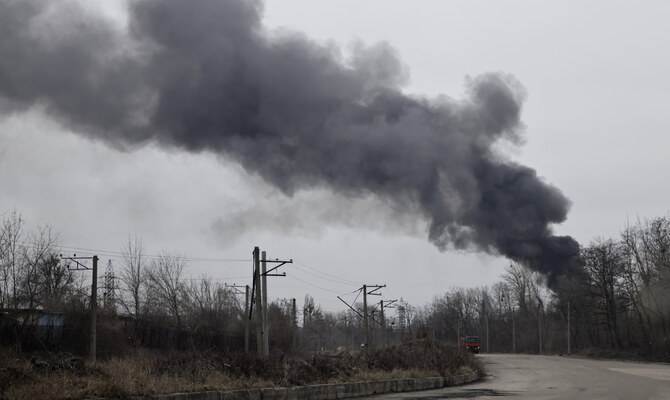
Ukraine braces for hardest winter due to intensified Russian attacks on energy infrastructure
Short Url
https://arab.news/m8jjx
Ukraine braces for hardest winter due to intensified Russian attacks on energy infrastructure
- “Energy resilience is one of our greatest challenges this year,” Prime Minister Denys Shmyhal told a news conference in Kyiv


Latest updates






© 2026 SAUDI RESEARCH & PUBLISHING COMPANY, All Rights Reserved And subject to Terms of Use Agreement.