

Saudi Cabinet reviews efforts by Muslim, Arab countries toward establishing Palestinian state

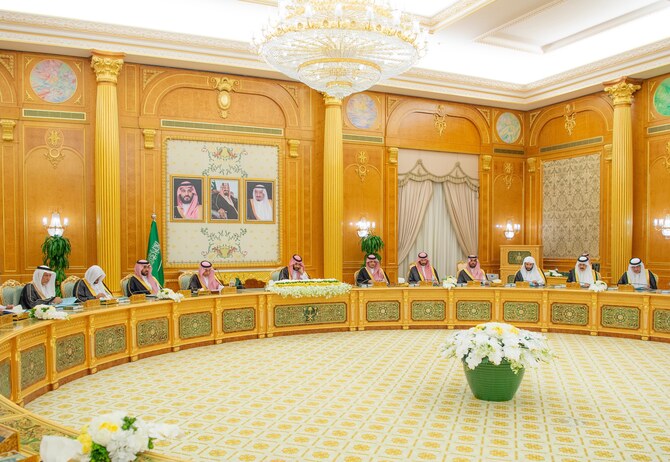
Saudi Crown Prince Mohammed bin Salman chairs the Cabinet meeting on Tuesday. (SPA)
Short Url
Updated 10 September 2024
Follow

Saudi Cabinet reviews efforts by Muslim, Arab countries toward establishing Palestinian state

RIYADH: The Saudi Cabinet reviewed efforts by Muslim and Arab countries to support the establishment of a Palestinian state, Saudi Press Agency reported on Tuesday.

It also reviewed efforts to restore the Palestinians’ legitimate rights and and halt Israeli violations of international and humanitarian laws.

The Cabinet also praised the efforts of the Aligned for Advancing Lifesaving and Peace in Sudan Group to alleviate the suffering of the Sudanese people, expand the delivery of humanitarian aid, and work toward a ceasefire agreement.

The group is made up of countries mediating between the warring parties in Sudan and include Saudi Arabia, Egypt, the UAE, and the US.

At talks held in August in Switzerland, ALPS said it had secured promises to let aid flow through the Adre border crossing from Chad into the Darfur region and along the Dabbah Road from Port Sudan on the Red Sea.

Between August 20 and 30, 59 aid trucks carrying medical, food, nutrition, emergency shelter and essential household items crossed from Chad to Darfur via the Adre border crossing point, the UN Office for the Coordination of Humanitarian Affairs has said.

The Cabinet also welcomed Saudi Arabia’s successful bid to host the UN World Data Forum 2026 in Riyadh, granted in recognition of the Kingdom’s achievements in the statistical sector and its track record in hosting successful international events.


Najran farmers find sugarcane cultivation viable, promising lucrative economic returns

Updated 07 December 2025
Follow

Najran farmers find sugarcane cultivation viable, promising lucrative economic returns

  • Najran's mountainous parts are blessed with temperate climate and abundant water resources, suitable for sugarcane production

NAJRAN: Farmers in Saudi Arabia's southwestern region of Najran have found that sugarcane production is a viable enterprise, the Saudi Press Agency (SPA) has reported.

One farmer, Ibrahim Shakwan, confirmed to SPA the success of his 7.3-hectare sugarcane farm and noted "growing regional interest due to its high productivity and lucrative economic returns."

Najran was chosen as a trial area for sugarcane production owing to the temperate climate, diverse soils, and abundant water resources in its mountainous parts. The experiment is in line with Saudi Vision 2030, which calls for enhancing food security and self-sufficiency.

Others regions in the Kingdom's southwest, such as Jazan, Asir and Baha, have similar features as Najran. 

Sugarcane is easily propagated via cuttings that yield a high number of plantable pieces. (SPA)

Sugarcane is easily propagated via cuttings that yield a high number of plantable pieces. Planting occurs primarily in the summer, although seedlings can be planted year-round. 

Effective cultivation methods include selecting disease-resistant varieties, proper soil preparation, and balanced irrigation and fertilization, according to the report.

The crop is harvested approximately eight months after planting, with fertilization ending three months before and irrigation ceasing 20 days prior to harvest to boost sugar concentration and improve juice quality, which is rich in natural sugars, vitamins, and minerals.

Several countries in the Middle East have long been growing sugarcane, with Egypt and Iran as key producers. 

Botanists believe sugarcane was first cultivated 10,000 years ago in what is now New Guinea in the southwest Pacific Ocean, where the environment is humid, according to an article titled Sugar Please, published in the Aramcoworld magazine in 2012.