

Israeli strike kills Hezbollah commander in Lebanon

1 / 2
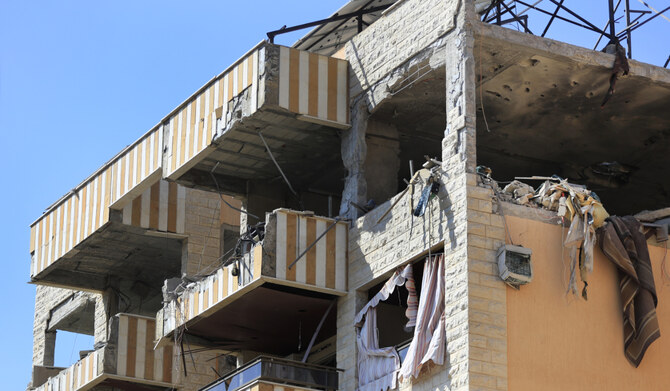
Damage to an apartment building that was destroyed by Israeli airstrikes is shown in Nabatiyeh town, south Lebanon, Tuesday, Sept. 10, 2024. (AP)
2 / 2
Mohammed Raad, the head of Hezbollah’s parliamentary bloc, speaks during a commemoration on the 40-day anniversary of Hezbollah top commander Fouad Shukur, who was killed by an Israeli airstrike in a southern suburb of Beirut, on Sept. 7, 2024. (AP)
Short Url
Updated 10 September 2024
Follow

Israeli strike kills Hezbollah commander in Lebanon

  • Mohammad Qassem Al-Shaer, “a field commander” in the group’s elite Radwan Force, “was targeted in an Israeli strike on a motorcycle in the Bekaa” Valley
  • 10 civilians wounded in Israeli raids across south Lebanon, Western Bekaa

BEIRUT: An Israeli strike on Tuesday in eastern Lebanon killed a Hezbollah commander, with the group retaliating by firing rockets at Israeli army targets.

Mohammed Qassem Al-Shaer, 47, was targeted as he rode a motorcycle on the Saghbine road in Western Bekaa.

A civilian car passed at the time of the drone strike, leading to one death and two injuries from the attack, according to the Ministry of Health.

Al-Chaer, aged 47, was from Sohmor, Western Bekaa.

Israeli raids also targeted cities and villages that until now had fallen outside the conflict zone, with southern Lebanon facing intense attacks since the morning.

A military drone targeted one of five floors of a building in Nabatieh with more than four missiles, injuring eight civilians, according to the Lebanese Ministry of Health.

The identity of the injured and those targeted is still unknown.

An Israeli military drone later raided an area between Jouaiyya, Wadi Jilou and Mahrouna, targeting it with three missiles and igniting a massive fire.

A drone also targeted the center of Houla’s square.

An Israeli missile struck Khiam in the morning — but failed to detonate — following an Israeli raid at midnight on Monday.

The Israeli army is targeting border villages daily, usually at night, destroying roads and empty residential neighborhoods.

A security source told Arab News that Israel “seeks to form a fire belt in the border region to slow down Hezbollah’s combat movement.”

The source added: “Israel’s hostilities reached 15 km deep into Lebanese territory, targeting villages like Srifa, Froun, Ghandouriyeh and Wadi Al-Houjeir, and focusing its attacks on forest areas and valleys.”

Israel also targeted Lebanese Civil Defense fire brigades, as well as fire services associated with Hezbollah and its ally, the Amal Movement.

The head of Hezbollah’s parliamentary bloc, MP Mohammed Raad, said that the party opened a support front in Lebanon “in solidarity with Gaza and its people as a preemptive measure to protect Lebanon from Israeli aggression on its land, its sovereignty and its people.”

He added: “The sacrifices and losses we have endured in this regard are far less than the costs we would have faced if the enemy had achieved its goals in Gaza.”

Raad said that Israel had “reached a point where it can penetrate Gaza and destroy it, but it cannot achieve its objectives, establish its presence, or set up the alternative situation it seeks.”

Israel is “aimlessly circling and deteriorating internally at the security, economic, financial and displacement levels,” Raad said.

He highlighted the “burden of exceptional expenses” on Israel’s economy and the “ugly image that has rendered it a pariah entity worldwide.”

Raad said that Israel was now “operating in lost time, perhaps extending to the US elections and their scheduled date.

“This is why we see it moving from northern Gaza to the south, then turning to the West Bank to ignite a fruitless battle, and then threatening to expand northward toward southern Lebanon,” he added.

“However, it cannot meet its commitment to returning all northern residents to their homes.”

At about 2 a.m., Israeli raids hit the town of Aita Al-Shaab in the central sector, causing material damage to property and infrastructure, particularly to electricity and water networks.

The Israeli army also launched flares at night over border villages adjacent to the Blue Line.

Reconnaissance and drone flights continued throughout the night until morning over the towns of Naqoura, Yarine, Jebbayn, Dhayra, Aita Al-Shaab, Beit Lif and Rmeish.

On Tuesday, Hezbollah’s military media also released a video showing footage of its fighters targeting settlements and army bases in northern Israel.


After wins abroad, Syria leader must gain trust at home

Updated 2 sec ago
Follow

After wins abroad, Syria leader must gain trust at home

BEIRUT: One year after ousting Bashar Assad, Ahmed Al-Sharaa has restored Syria’s international standing and won sanctions relief.
But analysts warn the former jihadist still needs to secure trust on the home front.
Sectarian bloodshed in the country’s Alawite and Druze minority heartlands — alongside ongoing Israeli military operations — have shaken Syria as President Sharaa tries to lead the country out of 14 years of war.
“Syria has opened a new chapter that many once thought impossible,” said Nanar Hawach, senior Syria analyst at the International Crisis Group, citing relaunched diplomatic ties and foreign investment.
But he added: “International rehabilitation means little if all Syrians don’t feel safe walking their own streets.”
US President Donald Trump has taken a particular shining to the 43-year-old, a surprise political victory for a former militant who once had a US bounty on his head due to his ties to Al-Qaeda.
Sharaa has toured capitals from the Gulf to Europe to Washington since his Islamist alliance toppled Assad on December 8 last year, ending more than half a century of the family’s iron-fisted rule.
Washington and the UN Security Council have removed him from their respective “terrorism” and sanctions lists, and a delegation from the world body visited Damascus for the first time this week.
The United States, the European Union and Britain have lifted major economic sanctions on Syria, and Damascus has announced investment deals for infrastructure, transport and energy.
Sharaa has even visited Russia, whose military pounded his forces during the war and which is now home to an exiled Assad.
“Sharaa won abroad, but the real verdict comes at home,” Hawach said.

- ‘Real accountability’ -

Critics say Syria’s temporary constitution fails to reflect the country’s ethnic and religious diversity and concentrates power in the hands of a president appointed for a five-year transition.
The new authorities have disbanded armed factions, including Islamist and militant fighters, but absorbed most into the new-look army and security forces, including some foreign fighters.
And some government forces or their allies have been implicated in outbreaks of sectarian violence.
The Alawite community massacres in March, killed more than 1,700 people, according to the Syrian Observatory for Human Rights.
And clashes in July in south Syria’s Druze-majority Sweida province left more than 2,000 dead, including hundreds of Druze civilians.
Authorities have announced investigations into the bloodshed and have arrested and put some suspects on trial.
Nicholas Heras, from the New Lines Institute, said Sharaa “has twice failed as a leader of national reconciliation” — during the violence against the Alawites and the Druze.
Heras told AFP questions remain over “the extent to which he personally wants to rein in the militant Islamist militias that played the strongest role in bringing him to power in Damascus.”
Sharaa’s position, he said, remains precarious “because he does not command a unified security apparatus that can enforce the rules made by his government.”

- ‘Terrifying’ -

Gamal Mansour, a researcher at the University of Toronto, said “factional leaders who are essentially warlords” have taken up official roles, contributing to a “crisis of trust” among minorities.
However, “most Syrians believe Sharaa is the only option that provides guarantees,” he said, calling the prospect of a power vacuum “terrifying.”
Just keeping the country together is a major task, with some on the coast and in Sweida urging succession and the Kurds seeking decentralization, which Damascus has rejected.
A Kurdish administration in the northeast has agreed to integrate its institutions into the central government by year-end but progress has stalled.
Adding to pressures is neighboring Israel, which has repeatedly bombed Syria and wants to impose a demilitarised zone in the south.
Israel’s forces remain in a UN-patrolled buffer zone on the occupied Golan Heights and conduct regular incursions deeper into Syria despite the two sides holding direct talks.
On Monday, Trump told Israel to avoid destabilising Syria and its new leadership.
In October, committees selected new members of parliament, but the process excluded areas outside government control and Sharaa is still to appoint 70 of the 210 representatives.
lar/lg/dc