

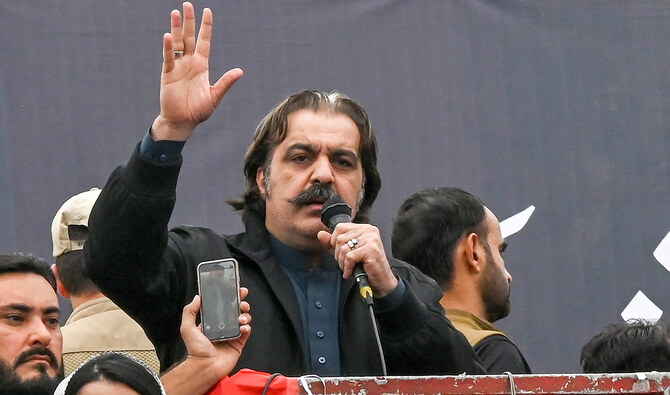

ISLAMABAD: The brother of Ali Amin Gandapur, a senior leader of the Pakistan Tehreek-e-Insaf (PTI) party who is the chief minister of the northwestern Khyber Pakhtunkhwa province, said on Tuesday he had established contact with the leader who had been “missing” since Monday evening when he was invited to the capital for an official meeting.
Reports of Gandapur’s ‘disappearance’ emerged as PTI Chairman Gohar Khan and other members of the party were detained in late night arrests in Islamabad over charges of violating a new law to regulate public gatherings in the Pakistani capital.
“Established contact with brother who after a hectic prolonged meeting on law and order [in Islamabad] has now entered his own province [Khyber Pakhtunkhwa],” PTA MNA Faisal Amin Khan, Gandapur’s brother, said on X.
Zarwali Khan, Gandapur’s secretary, also told Arab News the CM was in Peshawar, the provincial capital.
Earlier, PTI Spokesman Zulfi Bukhari had said Gandapur has been “missing” since 7pm on Monday evening.
“It has now been confirmed that he has been abducted/arrested,” Bukhari wrote on X. “There is no element of a democracy left after this recent crackdown tonight.”
PTI’s Omar Ayub Khan, who is the leader of the opposition in the National Assembly, has posted that Gandapur was “being held incommunicado by the Federal Government/ Establishment after being invited for a cup of tea.”
“His security staff is not traceable, and their phones are powered off,” he said. “All this is being done because PTI and our Allies held a peaceful protest in Islamabad on 8th September.”
PTI held a major political gathering on the outskirts of the city demanding the release from prison of its founder, former Prime Minister Imran Khan, on Sunday. The gathering was largely peaceful but some supporters clashed with police en route to the gathering, in which a senior police official was injured, police said.
The government last week passed the Peaceful Assembly and Public Order Act, 2024, to “regulate” holding public gatherings in Islamabad, including by specifying timings for rallies and designating specific areas. The law has set three-year jail terms for participants of ‘illegal’ assemblies, with ten-year imprisonment for repeat offenders.
The Islamabad administration had allowed the PTI to hold Sunday’s rally from 4pm till 7pm but the gathering went on until nearly 11pm.
“They were arrested due to violation of the new law, the Peaceful Assembly and Public Order Act, in PTI gathering on September 8,” Islamabad police spokesperson Taqi Jawad told Arab News, confirming the arrests of PTI leaders Gohar Khan, Shoaib Shaheen and Sher Afzal Marwat.

The screengrab taken from a video posted on PTI Gohar Khan's X shows Islamabad Police detaining Gohar Khan in Islamabad on September 10, 2024. (@BarristerGohar/X)
At Sunday’s rally, Gandapur had delivered a hard hitting speech directly taking on the all-powerful military and calling on it to put its house in order.
“Fix your institution, fix your generals, fix yourself,” Gandapur said in a direct reference to the army.
Khan, jailed since last August, was ousted from the PM’s office in 2022 in a parliamentary vote of no confidence after what is widely believed to be a falling out with Pakistan’s powerful military, which denies being involved in politics. Since his removal, Khan and his party have waged an unprecedented campaign of defiance against the military.
The ex-PM also faces a slew of legal charges and was convicted in four cases since he was first taken into custody, all of which have been either suspended or overturned by the courts. He remains in jail, however, on new charges brought by Pakistan’s national accountability watchdog regarding the illegal sale of gifts from a state repository while he was prime minister from 2018 till 2022.
The PTI says it has faced an over year-long crackdown since protesters allegedly linked to the party attacked and damaged government and military installations on May 9, 2023, after Khan’s brief arrest that day in a land graft case. Hundreds of PTI followers and leaders were arrested following the riots and many remain behind bars as they await trial. The military, which says Khan and his party were behind the attacks, has also initiated army court trials of at least 103 people accused of involvement in the violence.
The party says it was not allowed to campaign freely ahead of the Feb. 9 general election, a vote marred by a mobile Internet shutdown on election day and unusually delayed results, leading to accusations that it was rigged and drawing concern from rights groups and foreign governments.
The PTI says it won the most seats but its mandate was “stolen” by PM Shebaz Sharif’s coalition government which formed the government with the backing of the all-powerful military. Both deny the claim.


