13 injured as roadside bomb targets anti-polio team in northwest Pakistan

1 / 2
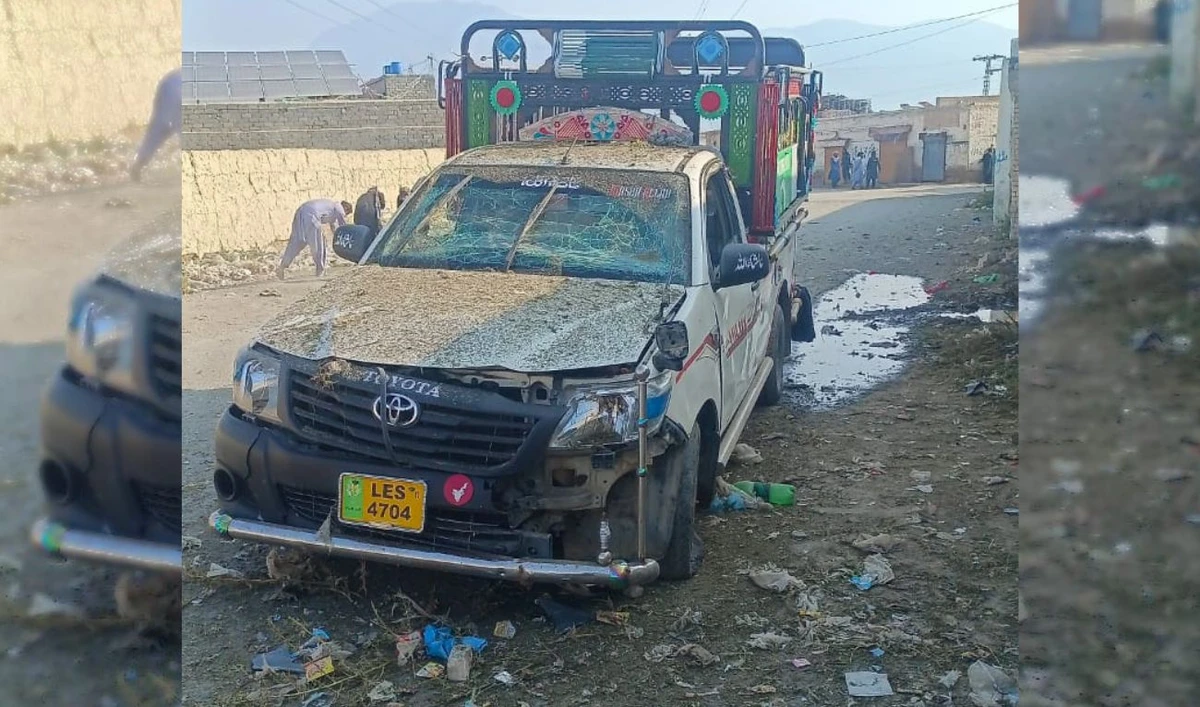
The photo shows a police vehicle targeted by a roadside bomb while escorting an anti-polio team in Pakistan’s northwestern Khyber Pakhtunkhwa province on September 9, 2024. (Photo courtesy: Police)
2 / 2
Policemen escort members of a polio vaccination team during a door-to-door vaccination campaign in Karachi on June 28, 2022. (AFP/File)
Short Url
Updated 09 September 2024
Follow

13 injured as roadside bomb targets anti-polio team in northwest Pakistan

  • The incident came as Pakistan launched an anti-polio vaccination drive in 115 districts across the South Asian country
  • No group claimed responsibility but Pakistani Taliban, other militants have previously targeted anti-polio teams in region

DERA ISMAIL KHAN: Thirteen people were wounded when a roadside bomb targeted a police vehicle escorting an anti-polio team in Pakistan’s northwestern Khyber Pakhtunkhwa (KP) province on Monday, officials said.
The northwestern Pakistani province, which borders Afghanistan, has been the scene of a number of attacks on police, security forces and anti-polio vaccination teams as well as kidnappings in recent months.
The blast, which took place in Wana town of KP’s South Waziristan tribal district, injured seven policemen and three anti-polio vaccinators among 13 people, according to Wana police spokesman Habib Islam.
“The police vehicle escorting polio team came under an improvised explosive device (IED) attack near Karikot, a rugged village on the outskirts of Wana,” Islam told Arab News, adding the injured persons were immediately shifted to the Wana District Headquarters Hospital.
No group immediately claimed responsibility for the attack.
Hammad Mehmood, medical superintendent at the hospital, told Arab News that a total of 13 wounded persons were brought to the facility and most of them had suffered minor injuries except for one.
“The critically wounded person was referred to Dera Ismail Khan for treatment,” he added.
The incident came as Pakistan launched an anti-polio vaccination drive in 115 districts across the South Asian country, which has witnessed a virus outbreak this year.
The administration in South Waziristan, which borders Afghanistan and was once a stronghold of the Pakistani Taliban, also kicked off door-to-door campaign to vaccinate more than 70,000 children against the crippling disease.
In the past, Pakistani Taliban and other militants have targeted scores of anti-polio vaccinators and their security escorts in the restive region.
In July, two cops on polio duty were injured in separate attacks in the Tank and Dera Ismail Khan districts of the province.
In January this year, five policemen were killed and 22 others were injured after a blast targeted a polio protection team in Mamund village of KP’s Bajaur district, according to police. The police contingent was heading out to far-flung areas in the province to protect polio volunteers when it was targeted by a bomb.
Opposition to inoculation grew in the region after the US Central Intelligence Agency organized a fake vaccination drive to help track down former Al-Qaeda leader Osama bin Laden in the Pakistani garrison town of Abbottabad in 2011.
Pakistan and Afghanistan are the only two countries in the world where polio remains an endemic.
Pakistan, global crypto exchange discuss modernizing digital payments, creating job prospects 

Updated 05 December 2025
Follow

Pakistan, global crypto exchange discuss modernizing digital payments, creating job prospects 

  • Pakistani officials, Binance team discuss coordination between Islamabad, local banks and global exchanges
  • Pakistan has attempted to tap into growing crypto market to curb illicit transactions, improve oversight

ISLAMABAD: Pakistan’s finance officials and the team of a global cryptocurrency exchange on Friday held discussions aimed at modernizing the country’s digital payments system and building local talent pipelines to meet rising demand for blockchain and Web3 skills, the finance ministry said.

The development took place during a high-level meeting between Finance Minister Muhammad Aurangzeb, Pakistan Virtual Assets Regulatory Authority (PVARA) Chairman Bilal bin Saqib, domestic bank presidents and a Binance team led by Global CEO Richard Teng. The meeting was held to advance work on Pakistan’s National Digital Asset Framework, a regulatory setup to govern Pakistan’s digital assets.

Pakistan has been moving to regulate its fast-growing crypto and digital assets market by bringing virtual asset service providers (VASPs) under a formal licensing regime. Officials say the push is aimed at curbing illicit transactions, improving oversight, and encouraging innovation in blockchain-based financial services.

“Participants reviewed opportunities to modernize Pakistan’s digital payments landscape, noting that blockchain-based systems could significantly reduce costs from the country’s $38 billion annual remittance flows,” the finance ministry said in a statement. 

“Discussions also emphasized building local talent pipelines to meet rising global demand for blockchain and Web3 skills, creating high-value employment prospects for Pakistani youth.”

Blockchain is a type of digital database that is shared, transparent and tamper-resistant. Instead of being stored on one computer, the data is kept on a distributed network of computers, making it very hard to alter or hack.

Web3 refers to the next generation of the Internet built using blockchain, focusing on giving users more control over their data, identity and digital assets rather than big tech companies controlling it.

Participants of the meeting also discussed sovereign debt tokenization, which is the process of converting a country’s debt such as government bonds, into digital tokens on a blockchain, the ministry said. 

Aurangzeb called for close coordination between the government, domestic banks and global exchanges to modernize Pakistan’s payment landscape.

Participants of the meeting also discussed considering a “time-bound amnesty” to encourage users to move assets onto regulated platforms, stressing the need for stronger verifications and a risk-mitigation system.

Pakistan has attempted in recent months to tap into the country’s growing crypto market, crack down on money laundering and terror financing, and promote responsible innovation — a move analysts say could bring an estimated $25 billion in virtual assets into the tax net.

In September, Islamabad invited international crypto exchanges and other VASPs to apply for licenses to operate in the country, a step aimed at formalizing and regulating its fast-growing digital market.