

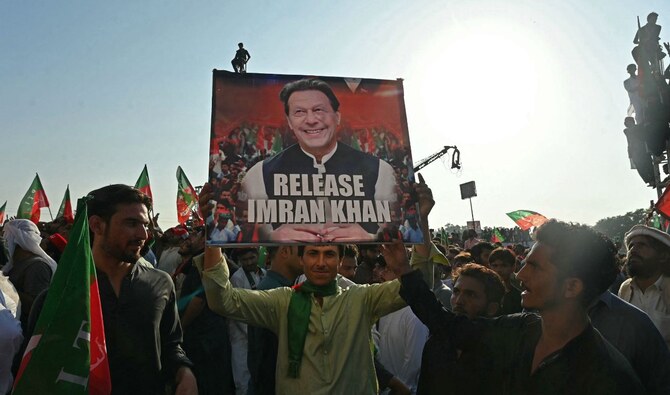

ISLAMABAD: Islamabad police and the federal ministry of interior said on Sunday evening “several” policemen had been injured as participants of a rally led by the party of jailed former Prime Minister Imran Khan pelted stones at officers “without provocation,” while the party alleged law enforcers were “shelling and attacking attendees for no reason.”
The Islamabad district administration had told rally-goers to disperse “immediately” or face “legal action” after the time allowed for the rally expired at 7pm. Soon after, local media widely showed footage of clashes between protesters and police, while Khan’s Pakistan Tehreek-e-Insaf (PTI) party leaders appealed to demonstrators to remain peaceful amid what they said was shelling by police.
“SSP Safe City and several policemen injured in stone pelting,” Islamabad Police said on X. “The protesters continue to throw stones at the police.”
The interior ministry sought a situation report from IG Police Islamabad and ordered “best treatment facilities” for the injured officers.
Local media widely reported soon after that the situation was under control at the rally venue, where the event continued despite the expiry of the deadline.
The PTI, on the other hand, alleged “brutal acts of violence against families and those attending the peaceful political event of the PTI in Islamabad.”
“Police have started shelling and attacking attendees for no reason whatsoever, cowardly and disgraceful by any standards,” PTI leader Zulfi Bukhari said on X.
Pakistan’s capital was tense throughout the day on Sunday, with heavy police deployment and many roads and “sensitive” areas of the city and entry and exit points sealed off with shipping containers ahead of the planned PTI to press for Khan’s release, who has been in jail for 13 months.
The district administration had allowed the PTI to hold the public gathering in the Sangjani locality on the outskirts of Islamabad between 4-7pm. The rally was previously planned for July and then August but was postponed both times after permission was revoked over what officials described as security threats and concerns about unrest.
At around 6pm on Sunday, the Islamabad administration said it had informed the rally’s organizers that the time limit for the gathering was approaching its end.
Because of the roadblocks, thousands of PTI supporters and leaders traveling to Islamabad complained they had been unable to reach on time.
“The developing situation at the site of Jalsa has given rise to a serious law and order situation,” the Islamabad district magistrate said in a notification to PTI Islamabad President Amir Masood Mughal.
“I hereby direct you and the management/administration of Jalsa at Sangjani, Islamabad to disperse immediately. The District Administration and ICT Police, Islamabad are hereby directed to proceed and take strict action against the violators and members of unlawful assembly in accordance with law.”
Tanzeela Jahan Khan, a PTI supporter who had arrived in Islamabad with a caravan from Gujranwala city on Sunday afternoon, said more people were trying to make their way to the capital but were facing difficulty due to read closures.
“More of our people are coming, they are on their way, all roads are blocked,” she told Arab News at the venue of the rally.
“They do not have any way to come, they are stuck for the last 4 hours. All roads are blocked.”
“RELEASE OF KHAN”
The main aim of the rally — the PTI’s first within Islamabad’s jurisdiction since the Feb. 8 general elections — is to mobilize supporters for the release of Khan, who has been in jail since August last year. He was convicted in four cases since he was first taken into custody, all of which have been either suspended or overturned by the courts. Khan remains in jail, however, on new charges brought by the national accountability watchdog regarding the illegal sale of gifts from a state repository while he was prime minister from 2018-22.
“The basic purpose of this rally is to secure the release of Imran Khan from jail, restore the rule of law and initiate a genuine democratic process in this country,” PTI leader Shoaib Shaheen told Arab News on Sunday morning.
“Islamabad’s district administration has closed all entry and exit routes to the federal capital to prevent our supporters from reaching the venue,” Shaheen said, adding that despite the hurdles, hundreds of PTI caravans were en route to the designated venue for the rally from across Pakistan.
All metro bus services were suspended for Sunday, while the Islamabad Expressway was closed at Khanna Bridge on both sides to Lehtrar Road, and only one lane was open at the key Faizabad Interchange. The Bharakahu entry and exits were closed at Satra Meel point, while GT Road was closed for traffic on both sides at Sangjani. Rawat T Cross was also closed, according to Islamabad traffic police.
Only Margalla Road could be used to access the Red Zone, which houses sensitive government and diplomatic buildings, while Srinagar Highway was open for traffic on both sides and could be used to reach the Islamabad airport and the Rawalpindi railway station as well as the M1 and M2 motorways.
The Islamabad police said the district administration had designated routes for the rally and prohibited travel to the venue through any other routes.
“Strict legal action will be taken over violation of the designated routes and the violators will be arrested immediately,” they said on X.
A police spokesman said on Sunday morning authorities had recovered a “suspicious bag” from near the rally venue in Sangjani containing hand grenades, detonators, electric wires and other explosive material. A bomb disposal squad had “neutralized” the materials and an investigation was underway.
“Further search operations are being conducted in view of the threat of terrorism at the gathering,” the police spokesman said. “Checking has been increased at the entrances and exits of the city. Citizens are requested to cooperate with the police during checking.”
To bolster security, a heavy contingent of law-enforcement personnel, including police, Rangers, and other paramilitary forces, were stationed at the rally venue and across the capital.
“They [PTI] are holding a rally for what, Imran Khan’s release?” ruling party minister Azma Bukhari told reporters in Lahore. “Have you ever seen them talk about the problems of the common person?”
She added that the government led by Prime Minister Shehbaz Sharif had “no objections” to PTI holding the rally.
“We are not afraid of political rallies,” Bukhari said. “We are only concerned about their actions and background. They have been planted to create chaos in Pakistan … We will not allow them to create instability. No mischief, chaos or disorder will be permitted.”
“GRAND POWER SHOW”
Videos shared by the PTI on social media showed party caravans moving toward the federal capital while some supporters also posted images of cargo containers that had been used to seal off the city.
The rally is being held days after a bill was passed by both houses of parliament to “regulate” public rallies in Islamabad, empowering the district magistrate to ban such gatherings if required.
But the PTI said it would hold a “grand power show” despite the hurdles.
“This jalsa [public gathering] marks the beginning of our wider and coordinated campaign against this incompetent government,” PTI’s Shaheen said in the morning.
“Our workers have begun reaching the venue, and we will hold the rally no matter what,” he added, warning authorities to avoid disrupting the “peaceful” gathering, which he described as the party’s democratic and constitutional right.
The PTI says it has faced a months-long crackdown since protesters linked to the party attacked and damaged government and military installations on May 9, 2023, after Khan’s brief arrest that day in a land graft case. Hundreds of PTI followers and leaders were arrested following the riots and many remain behind bars as they await trial. The military has also initiated army court trials of at least 103 people accused of involvement in the violence.
The party says it was not allowed to campaign freely ahead of the Feb. 9 general election, a vote marred by a mobile Internet shutdown on election day and unusually delayed results, leading to accusations that it was rigged and drawing concern from rights groups and foreign governments.
The PTI says it won the most seats but its mandate was “stolen” by PM Sharif’s coalition government which formed the government with the backing of the all-powerful military. Both deny the claim.


